DSP Seat Access for AI Inventory Buys
Advertisers need new DSP configurations to reach consumers in AI chatbots instead of web pages.

Conversational AI surfaces are a categorically different inventory class than open-web programmatic. The DSP seats, OpenRTB protocols, and private marketplaces built over the last two decades were designed around a specific set of signals: the page a user is sitting on, the keyword they typed, and a cookie-based profile assembled over time. When you have a conversation with a large language model, none of those three signals survive in their original form. There is no page to read, no keyword bid to evaluate, and no persistent cookie trail to pull a profile from. ChatGPT ads use contextual targeting instead: it works on conversation-level understanding, so it can match intent as that intent develops across a multi-turn dialogue, not against a static document.
This is not a distant or speculative shift. Global programmatic ad spend passed $200 billion in 2026, and the next meaningful increment of consumer attention is moving into LLM conversations, a surface the existing programmatic pipes were never built to serve. OpenAI held out against advertising for years before launching ads on February 9, 2026, a move that reflects what happens to the revenue math once a platform reaches billions of users: advertising becomes close to the only monetization path available at that scale. Microsoft's own move makes the shift concrete. Microsoft shut down its Invest DSP on February 28, 2026, and it said the move was a pivot toward conversational advertising built on its AI investments. It was a structural bet that the infrastructure advertisers will need next looks nothing like the platform being retired, not a platform retirement.
DSP seats in conversational AI
A DSP seat inside a conversational AI environment still runs on OpenRTB infrastructure, but the bid request arriving at that seat, and the signal the DSP acts on to price it, are structurally different from anything in the existing display or CTV stack. A DSP receives a bid request from an SSP or exchange, checks it against the buyer's targeting parameters, returns a bid, and the winning creative gets served, all within milliseconds, though the exact window depends on the exchange and the format.
Identity makes that process addressable in standard display or CTV: third-party cookies, UID2, household IDs, letting a DSP attach a bid request to something resembling a known person. None of that identity layer exists inside a conversational session. There is no persistent, user-level profile behind the bid request for a DSP to read. AI chatbot ad campaigns still run inside the OpenRTB protocol, but what drives the match is the live semantic content of the conversation itself, not a keyword string and not a stored profile.
The practical consequence is an auction that prices relevance differently than price alone. If bid price alone can no longer decide placement, a relevance-weighted auction lets a more contextually appropriate ad win over a higher dollar bid, so the basic logic a standard open-auction RTB buy runs on gets inverted. Supply access itself splits across distinct routes: through Criteo, the first adtech partner integrated into ChatGPT's Free and Go tiers in the U.S.; through Google's existing campaign infrastructure for AI Overviews and AI Mode; or through direct programmatic relationships with AI publishers, each carrying its own seat requirements and deal terms.
Seat structure and access terms across the three supply paths
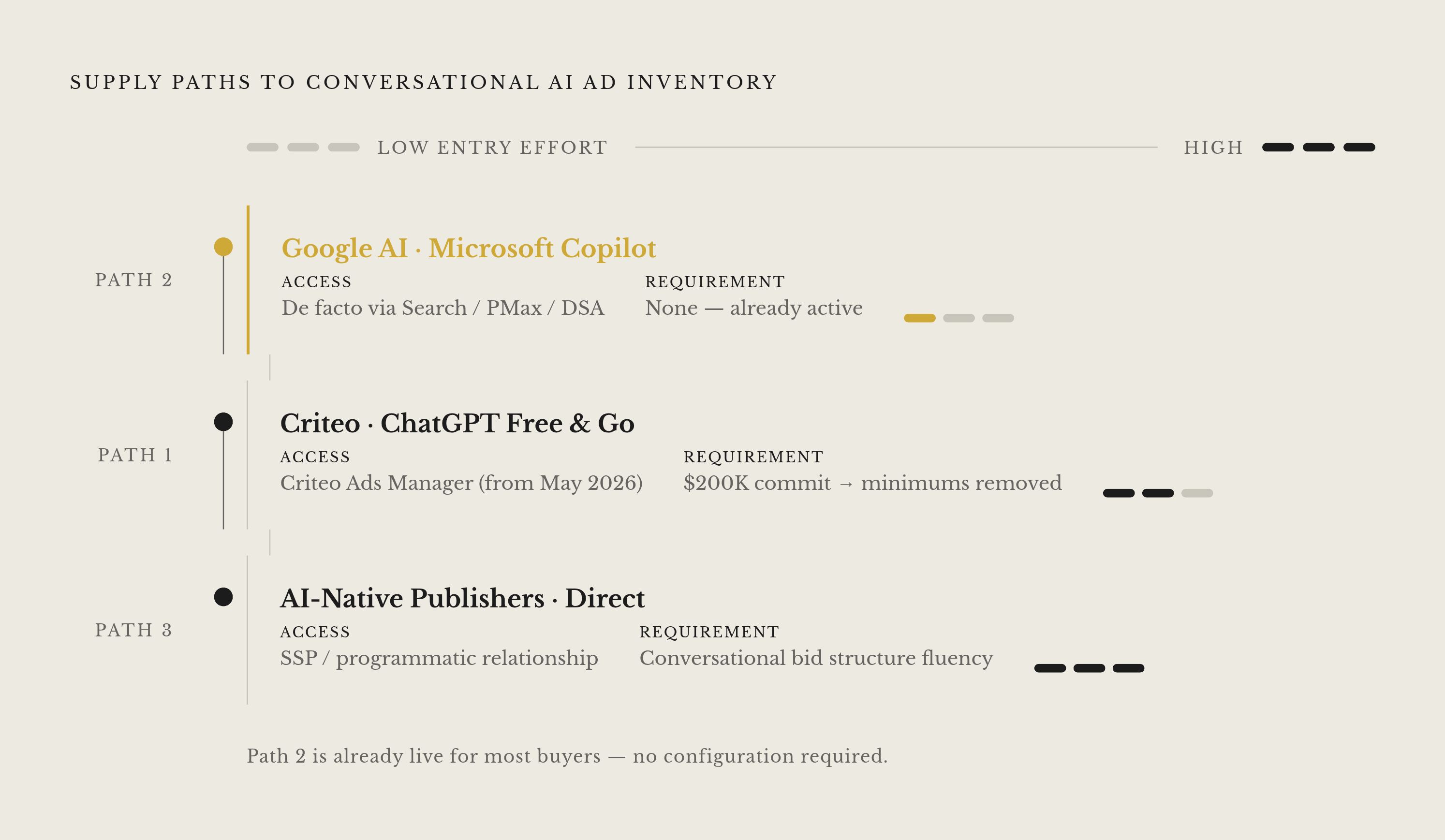
Three supply paths lead to AI inventory today: managed API access, retrofitted search infrastructure, and direct programmatic relationships. Each imposes a different seat structure, and treating the three as interchangeable is the most common configuration mistake buyers make.
The first path is managed, curated entry, the route into ChatGPT inventory through Criteo. The initial ChatGPT pilot asked for a $200,000 commitment at a steep CPM, with launch partners that included Target, Adobe, Williams-Sonoma, and Albertsons. That bar dropped fast. The self-serve Ads Manager opened on May 5, 2026, and spend minimums came off entirely, so access broadened within months of launch. If you already run campaigns through Criteo, you have a seat path sitting in front of you already. Buyers without that relationship have to decide whether onboarding Criteo as a standalone point solution makes sense now, or whether to wait for more SSPs and exchanges to enter.
The second path runs through infrastructure advertisers already operate: Google AI Mode and AI Overviews, and Microsoft Copilot. Google monetizes AI answers through the same machinery most advertisers are already using: Search campaigns on broad match or AI Max, Performance Max, Shopping campaigns, and Dynamic Search Ads are all eligible, with smart bidding required. There is no toggle to opt in or opt out. If a campaign qualifies under those eligibility rules, it already appears inside AI answers, whether the advertiser has configured for it or not. So a large share of buyers running Google campaigns today already hold de facto seat access to Google's AI surfaces, but they don't know it, and they haven't made the configuration choices that access demands. Microsoft Copilot works on a related but distinct model: it draws on the entire session's context rather than the most recent query alone, so it carries a longer signal window than a single search term, and bid logic needs to be calibrated for that. In both cases the seat is inherited rather than built, so the work for the buyer is auditing which campaigns now surface inside AI answers and whether the creative and targeting logic attached to them still make sense in that setting.
The third path is direct programmatic access through an AI-native exchange. Brands are beginning to bid for citation dominance inside AI-generated summaries and conversational interfaces, and this new inventory layer sits entirely outside the traditional display and video bidstream. If a DSP holds direct supply relationships with AI publishers, instead of routing through a general exchange, it can pass live conversational context straight into the bid request, so buyers get a signal built for matching on intent, not page category. This path asks the most of the buyer technically: understanding what a well-formed conversational bid request actually contains, which fields carry the context signal, how the relevance score gets calculated, and what the SSP on the publisher's side is exposing in the first place.
With ChatGPT's Sponsored Agents, users can chat directly with a brand-sponsored agent after clicking an ad, and the brand sets the knowledge base the agent relies on. It is not yet a standard seat structure in its own right, but it signals where the format is headed next.
Prompt-level signals versus keyword and cookie signals
If you want seat configuration right, you need to know what the prompt signal actually contains. A search query tells a brand what someone typed. A prompt tells a brand who they are and what constrains their decision. "I'm a freelancer in my first year, not yet VAT-registered" carries information a keyword never could: budget ceilings, timelines, prior experience, the alternatives already considered and ruled out before the question was even asked. A search marketer spent years assembling that same picture indirectly, stitching together multiple queries and retargeting cookies across sessions to approximate what a single prompt now states directly.
That density is visible in how far a conversation runs before it converts. Users typically go about six prompts deep before they move to the open internet to complete a purchase. Some categories move faster: flights and electronics convert quickly, while in sportswear a large share of prompts split between upper-funnel informational questions and transactional intent, and both ends of that split are legible directly from the prompt text itself. The honest objection to this signal is that it's rich but narrow: reach runs smaller than search or social, at least for now.
The market is already building toward a way to use that signal outside any one walled garden. Verve has positioned itself as the first ad tech platform to activate conversational intent signals for programmatic targeting, and by its own claim the first to do so from major LLM environments, which points to a market moving to make this signal accessible at scale rather than locked to a single surface. Adidas achieved a lift in branded search after appearing in LLM conversations, the first published case tying AI conversation presence to a measurable downstream channel effect. It is a recorded outcome that buyers configuring a seat today can point to, not a promise about what conversational intent might someday do.
Configuring a trading desk for an AI inventory seat
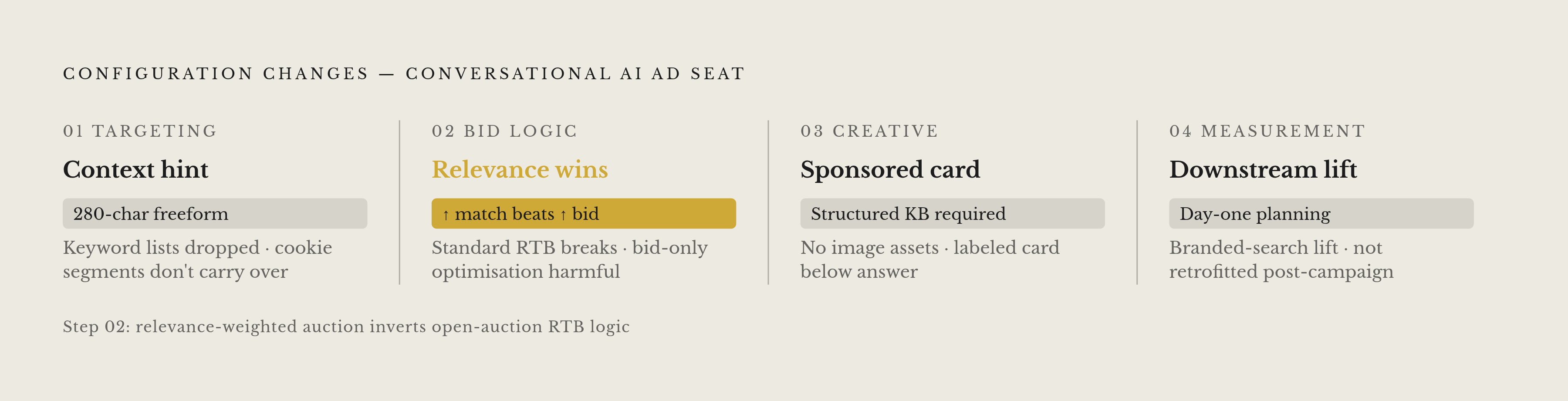
Everything above points to four concrete changes a trader has to make when activating an AI inventory seat: how targeting instructions get written, how bid logic gets calibrated, what creative and format specs apply, and how measurement gets framed.
Targeting starts with giving up the keyword list. The primary targeting control in this environment is a context hint, a freeform natural-language description of the conversations where the ad belongs, written at the ad group level and capped at 280 characters. Writing one well is a different skill than building a keyword list. It means describing a conversational situation in plain language and matching the register of the conversations a brand actually wants to appear inside, not guessing at search terms a user might type. Audience segments built from cookie-based profiles or third-party data do not carry over into this environment at all, because the match happens against live conversational context, not any stored attribute sitting in a data management platform.
Bid logic needs the same rethink. In a standard open-auction RTB buy, the highest bid wins. But a relevance-weighted second-price auction breaks that rule: a better-matched ad can beat a higher bid, so bid-only optimization leaves money on the table and hands placements to competitors with a stronger context match. Agentic AI systems go further still: they bid on individual events rather than audiences and price every impression in real time, making the shift from static CPM multipliers to dynamic, context-sensitive valuation structurally required. If traders keep flat CPMs or broad bid multipliers running in this environment, they will overpay consistently on low-intent moments and lose consistently on the high-intent ones, the exact opposite of what a richer signal is supposed to buy them.
Creative specs need their own rebuild. A ChatGPT ad renders as a labeled sponsored card, and it sits below the assistant's answer. It is not woven into the response text, not a pre-roll, and not a display banner. If you build assets for banner dimensions and conventional visual hierarchy, they don't translate into that placement. The Sponsored Agents format pushes the point further: once a user clicks through to chat directly with a brand-sponsored agent, the brand's job becomes setting the knowledge base that agent draws from, so the "creative" being configured is a structured data set rather than an image or a line of ad copy. So ad ops teams need to know which of these formats they're configuring before they spec a single asset, because a card, a session-inherited search placement, and a sponsored agent each need different inputs.
Measurement has to catch up to all of it. A seat that inherits access through Google's existing campaign infrastructure, a seat bought directly through Criteo, and a seat built on a direct relationship with an AI publisher each produce different signals about what worked and why. The Adidas branded-search lift shows that a downstream effect from AI conversation presence can be measured and attributed. Traders configuring a new seat need a measurement plan built for that downstream pattern from the first day of the campaign, not retrofitted once the first report comes due.
Sources
- Best Programmatic Advertising Platforms 2026: DSPs, AI ...
- How Agentic AI Is Replacing Manual Bidding in Programmatic DSPs
- Understanding Contextual Targeting in ChatGPT Ads: A 2026 Deep Dive
- LLM Ads Explained: How AI Advertising Works in 2026
- Large Language Model Advertising in 2026: Who’s Winning the AI Attention War?