Campaign Taxonomy for Conversational AI Placements
Search and social taxonomies collapse inside conversational AI.
Campaign taxonomy built for search and social cannot survive contact with a conversational AI interface, because the primitives those older channels run on, keywords, audiences, match types, were built to answer a different question about how people behave. So you get targeting that cannot be targeted, measurement that cannot measure, and optimization with nothing to optimize against.
Why Search and Social Campaign Structures Break Down Inside LLM Interfaces
Search campaign structure, keywords, match types, ad groups, audience layers, bid adjustments, exists to answer one question: given a single text string typed into a single results page at a single moment, what should show up next to it? Social campaign structure answers a related but different question: given what this person has done and who they resemble, what should appear in their feed? Both are static models: something is fixed, a query or a profile, and the system just matches against it.
Conversational AI breaks both assumptions at once. What a user sees comes out of back-and-forth dialogue, so what counts as relevant can shift with every message the person types. There's no results page that sits still long enough to bid on, no historical profile that does the work of prediction, and no keyword string you can attach a bid to. A keyword captures what someone typed into a box. A context hint has to capture what someone is trying to get done and whether an offer actually helps them do it right now, which is a different skill, not a new input field for an old one.
Signal quality is the upside in that shift. A search query is a fragment. A conversation is often a narrative: a person will lay out a budget, name a constraint, list the options already under consideration, and say outright what they ruled out and why. No keyword ever carried that information, because a keyword could only hint at intent through inference, but a conversation states it directly. The taxonomy built to exploit that signal has to be built from scratch, because nothing in a keyword-and-audience system was designed to read it.
How conversational AI ad serving works across surfaces
No single ad-serving model governs conversational AI, and the systems in use are not trending toward one shared standard. A taxonomy has to account for the fact that conversations pass through distinct phases, and each phase is a different advertising opportunity, with different creative and bidding requirements.
On ChatGPT, an ad is a labeled sponsored card placed below the assistant's answer, and you never see it folded into the answer text itself. That separation is a deliberate design choice: the model's output stays unsold, and the commercial unit sits next to it rather than inside it. Advertisers choose a Reach objective (CPM), a Clicks objective (CPC), or a Conversions objective (oCPC), through a self-serve Ads Manager that opened May 5, 2026, with spend minimums removed. The audience those ads can reach is limited by design: only logged-in adults on the Free and Go tiers see them, while Plus, Pro, Business, Enterprise, and Education subscribers see none.
Google monetizes its AI Overviews and AI Mode through existing campaign infrastructure: Search campaigns using broad match or AI Max, Performance Max, Shopping campaigns, and Dynamic Search Ads are all eligible. There's no opt-in or opt-out switch here. A qualifying campaign starts showing up inside AI answers automatically. Google is also testing a set of newer formats, Conversational Discovery ads, Highlighted Answers, Direct Offers, and checkout built directly into AI Mode, which launched with Etsy and Wayfair and is expected to add Shopify, Target, and Walmart. Reporting has not caught up to placement: Google Ads offers no way to see AI Overviews or AI Mode performance separately from the rest of an account, though Search Console added dedicated AI visibility reports in June 2026. Any taxonomy built for this surface has to plan around that blind spot rather than assume it will close.
Microsoft Copilot targets at the session level, reading the conversation's full arc rather than just what you typed most recently. Claude carries no advertising at all, with Anthropic's revenue running through enterprise contracts and paid subscriptions instead, and Perplexity shut its sponsored-answer program down in early 2026, a couple of years after launching it, citing concerns from leadership about user trust.
The three structural layers a conversational AI campaign taxonomy must be built around
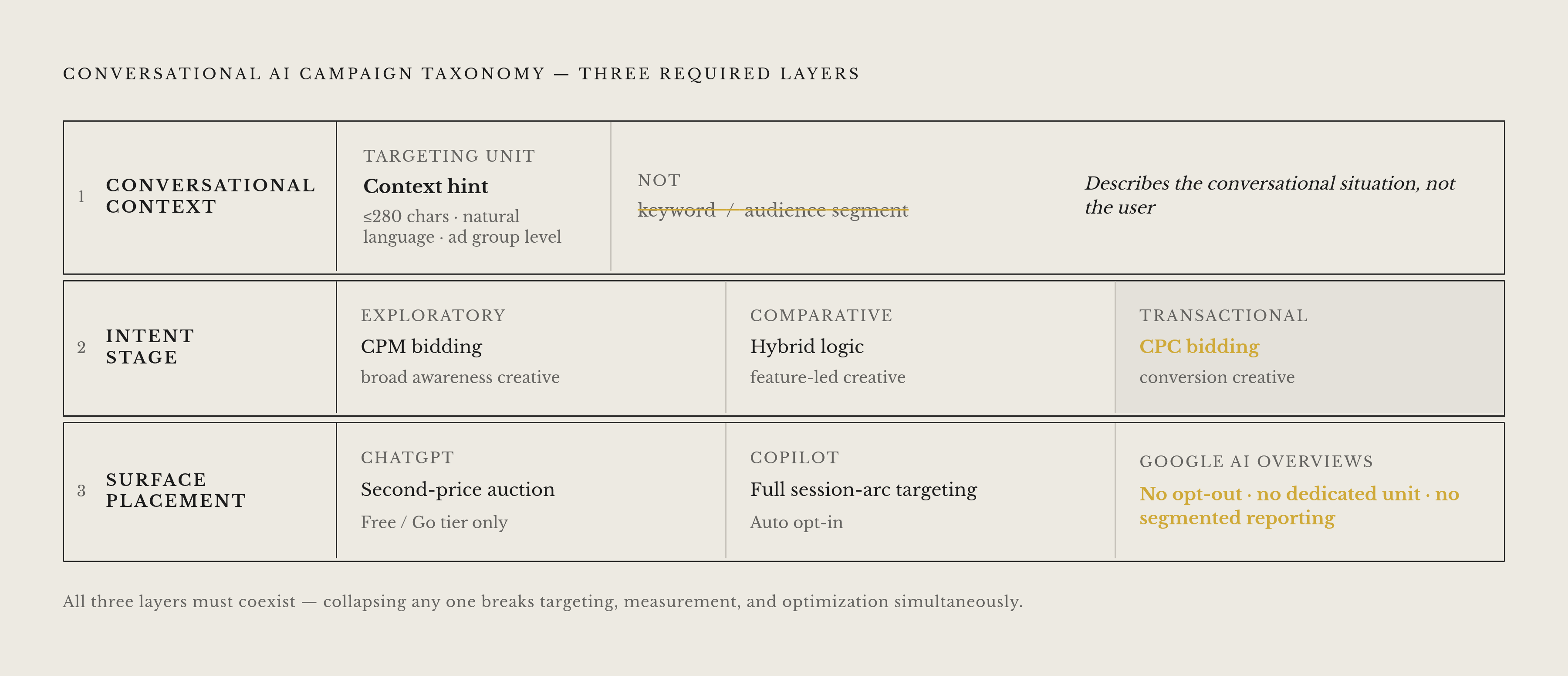
A taxonomy that can actually hold a conversational AI campaign together needs three layers that don't map onto anything in search or social: conversational context, intent stage, and surface-level placement mechanics, and a campaign has to be built around all three at once rather than picking one.
The first layer is conversational context. The unit being targeted is not a keyword and not an audience segment, but a written description of the situation a conversation needs to be in before an ad belongs there. On ChatGPT, that description is a context hint: a freeform block of natural language up to 280 characters, set at the ad group level, and the auction checks it against the live conversation. The matching system doesn't just look at the most recent message. It reads the trajectory of the whole exchange, what the user asked several turns back, how the assistant answered, what follow-up questions came up, and where the conversation seems to be headed. Copilot works on the same principle but reads the full session arc, while Google's AI surfaces infer context from the signals already present in an advertiser's existing campaigns. The mechanism differs by surface, but the underlying rule holds everywhere: the conversation itself is the targeting signal.
The second layer is intent stage. A conversation rarely stays in one place. It moves through phases, and each one is a different advertising opportunity, with its own creative needs and its own bidding logic. Bidding has to track that movement: a conversation still in an exploratory phase calls for an awareness-oriented CPM bid, while a conversation that has turned transactional calls for a performance-oriented CPC bid tied tightly to the specific decision the user is about to make.
The third layer is surface-level placement mechanics. Every surface has its own ad unit, its own auction logic, its own reporting access, and its own audience makeup, and a campaign structure has to build around those differences rather than smooth over them. ChatGPT offers a sponsored card below the answer, priced on CPM or CPC, targeted through context hints, reaching only Free and Go tier users, and allocated through a second-price auction. Google's AI surfaces offer no dedicated ad unit, no opt-out, and no segmented reporting, because presence there is decided by existing campaign eligibility, not by any conversational structure of its own. Copilot offers session-context targeting, and you get a full set of performance metrics, automatic opt-in for eligible campaigns, and an audience skewed toward business users through its Microsoft 365 integration. ChatGPT's Sponsored Agents add a fourth kind of unit entirely: a format where the user steps into a conversational environment the brand controls directly, which needs its own content approach and its own measurement setup separate from a sponsored card. If a campaign is built around one surface's mechanics, it won't carry over to another without rebuilding all three layers.
Intent stage as the basis for ad group structure and context hint design
Ad groups in a conversational AI campaign should be organized around intent stage within a given conversational context, not around product categories or audience segments, because the same product can matter in completely different conversational moments that each call for different creative and a different bid. In search, an ad group groups keywords that share a theme and points to one landing page, while in conversational AI the two things that define an ad group are the conversational situation and the stage of intent inside it, not the product being sold.
A travel brand makes the shift concrete. It doesn't run one ad group for "flights." It has separate ad groups for conversations at the exploratory stage, where someone says something like "I want to plan a family trip to Japan," the comparative stage, where the conversation has narrowed to "I'm deciding between flying into Tokyo versus Osaka," and the transactional stage, where the question becomes "What's the best time to book this flight," each with its own context hint, its own creative, and its own bid.
Keywords no longer work as a reliable stand-in for intent in this environment. A user planning software for a team might never type "project management software" into anything, but might spend several turns talking through team coordination problems, missed deadlines, and the friction of coordinating a remote team, and a context-matching system built to recognize that pattern can read it as high-intent even though no product name ever came up. Writing the context hint well is the highest-leverage task in this whole layer: a good hint describes a conversational situation, what the person is working toward, what's probably already been discussed, where the exchange seems to be going, in plain language, not as a keyword string or a topic label. Because the auction weighs relevance rather than just bid size, a tightly written hint attached to a modest budget can beat a vague hint attached to a much larger one, which is not how paid media usually works and rewards getting the taxonomy right over simply outspending a competitor.
B2B teams need to build one more constraint into this layer. On ChatGPT, the audience an ad can reach is, by the platform's own structure, limited to people who haven't paid for a subscription. Enterprise buyers whose employers cover their AI tooling costs are excluded from that audience by design. That's a fixed fact about the surface, not a targeting mistake to troubleshoot, and it belongs in the taxonomy itself, as a constraint on which intent stages are even worth pursuing on ChatGPT for a B2B product versus which belong on a surface like Copilot instead.
How the conversation gap forces attribution models to be rebuilt from the campaign level up
A user can run through several turns of a conversation across more than one session before ever converting, and last-click attribution has no way to credit any of that activity. It systematically undercounts conversational AI as a channel. A campaign taxonomy has to build a measurement strategy into its structure from the start rather than treat attribution as something to patch in after the campaign is already running.
Call this the conversation gap: someone asks a string of follow-up questions inside a chat, leaves, and converts somewhere else later, on another channel or through a direct visit, and a last-click model hands that conversion zero credit for the conversational touchpoint that may have done most of the persuading. Search and social don't have this problem in the same form, because both leave behind cookies, pixels, or logged interactions that attribution tools can trace back through a path. A private conversation inside an AI assistant leaves no cross-site trail at all, by design. OpenAI reports performance to advertisers only in aggregate and keeps the underlying conversations private, which makes the measurement gap here a deliberate platform commitment rather than a missing feature waiting on an engineering fix.
Three structural responses follow from that constraint. Creative needs to be tagged at the individual ad level, not just the campaign level, so a holdout test built around specific creative can isolate what conversational AI actually contributed. Every destination URL needs its own UTM parameters, cross-referenced against the clicks the platform itself reports, because the size of the gap between platform-reported clicks and attributed visits gives you a rough proxy for how large the conversation gap actually is. And incrementality testing needs to be built into the campaign from day one, with a holdout group that never sees the conversational AI placement at all, because that holdout is the only way to get a counterfactual that last-click attribution simply cannot produce. On Google's AI surfaces, there is no segmented reporting for AI Overviews and AI Mode, so you cannot isolate a campaign running there from the rest of an advertiser's Search and Performance Max activity unless you deliberately separate it at the campaign structure level first. Sponsored Agents add a second measurement problem on top of this one: once a user clicks into a brand-controlled agent conversation, that session generates its own set of interaction signals, structurally distinct from sponsored card metrics, and those signals need their own tracking design rather than being folded into the existing reporting setup.
How surface-level placement mechanics should determine campaign separation
A workable conversational AI campaign taxonomy requires three structural layers with no direct equivalent in search or social, conversational context, intent stages, and surface-level placement mechanics, organized around all three simultaneously rather than merged into a single cross-platform structure for convenience. A ChatGPT campaign is built around a context hint, a second-price auction, and an audience capped at Free and Go tier users. A Copilot campaign is built around session-level context, and it has automatic opt-in across eligible formats. A Google AI Overviews or AI Mode "campaign" isn't really a separate campaign at all; it's an extension of whatever Search, Shopping, Performance Max, or Dynamic Search Ads infrastructure already qualifies, running with no opt-out and no segmented reporting. Collapsing these into one taxonomy, on the assumption that an ad group is an ad group everywhere, breaks each of the three layers at once: the context hint written for ChatGPT means nothing to Copilot's session model, the bidding logic tuned to ChatGPT's second-price auction doesn't transfer to Google's existing campaign eligibility rules, and the measurement plan built around UTM tracking and holdout groups can't function on a Google surface that offers no way to separate its performance from the rest of the account in the first place.
Ignoring that separation produces reporting that cannot be trusted, because a blended view of ChatGPT, Copilot, and Google AI performance hides which surface is actually driving results, and it produces optimization that has nothing real to act on, because a bid or a creative change made at the blended level cannot be traced back to the mechanic that caused the shift. Getting the taxonomy right from the outset, three layers, kept distinct, deliberately not merged across surfaces, is what decides whether a conversational AI campaign can be targeted, measured, and improved at all, rather than run once and left to guess at its own results.