Supply Path Evaluation for AI Chat Inventory
Buyers need new rules to evaluate where ads appear inside AI conversations, not just next to them.

Supply path evaluation exists in programmatic because buyers needed a way to check who touches an impression before it reaches a user. AI chat inventory needs the same discipline, but the checklist has to change, because the thing being evaluated is now a participant in the conversation, not a slot next to content. It's a sentence generated inside content, in real time, shaped by the same model that wrote the paragraph around it.
The money moving into this channel is outrunning the tools built to check it. eMarketer projects US AI ad spending will hit $68.25 billion by 2030, and standalone chatbot ad spending is on track to reach $0.96 billion in 2026, over 1,600% growth year over year. Buyers running old SPO questionnaires against AI chat inventory are, in a lot of cases, asking the wrong questions entirely, and that's the plain problem this piece sets out to fix.
Two surfaces get lumped together that shouldn't be, and treating them the same is the first mistake worth naming. Ads next to AI-generated content, the Google AI Overviews and AI Mode model, behave structurally like search: the ad slot sits beside a summary, and buyers can reason about it with search-buying instincts. That category will account for more than 80% of AI ad spending in 2026. Ads inside a pure conversational response are a different animal entirely: the content and the ad come out of the same generative process, at the same time, and no existing framework was built to judge that. Buyers who evaluate both the same way are already behind.
What makes the auction mechanics inside a conversational LLM different from any auction a buyer has run before
In display and search, the auction decides who fills a slot. The slot itself, and the content around it, already exist before bidding starts. A publisher's page has already rendered; a search results page has already got its ten blue links laid out. The auction is a placement decision layered onto a fixed environment.
In a conversational chatbot, none of that is fixed yet. The auction has to decide whether an ad gets woven into a response the model hasn't written. The ad and the answer get produced together, in the same generative pass. That creates something with no real equivalent in older ad formats: call it a generative externality. Insert a sponsored product into a travel query and the whole answer can shift, longer, shorter, more specific, more hedged, depending on what the model decides to do with the ad it's been handed. Nothing like that happens when a banner loads next to an article.
Researchers have started to formalize how this should work. A framework out of Peking University and Alibaba Group, called LERA, breaks the process into two stages. First, embedding-based filtering trims a large pool of advertisers down to a shortlist, fast and cheap. Second, the LLM itself scores the shortlisted candidates for relevance, and those scores combine with bids to pick a winner. A critical-value payment rule sits underneath both stages, so pricing still respects incentive compatibility even though relevance is now judged by a language model instead of a keyword match. LERA's authors also extend the approach to multiple ad insertions across a longer dialogue, not just a single-turn placement.
Separate work by Hajiaghayi and colleagues looks at retrieval-augmented generation auctions, where what gets retrieved and how relevant it is become part of the payment math itself, not a side quality check bolted onto a bid. Relevance stops being a filter and becomes structurally load-bearing in the auction.
None of this is academic trivia for a buyer. If a path can't say whether the auction upstream actually read the conversation, or just matched a keyword to a topic label, there's no way to know whether spend is landing on intent or landing on a guess. And there's a real latency cost to doing this properly: running full LLM relevance scoring against every advertiser candidate is slow. LERA's two-stage design exists specifically to solve that throughput problem. Paths that skip the filtering step are either going to run slow, or they're going to quietly drop the contextual ranking and fall back to something cruder. Assume it's the second one until a vendor proves otherwise.
The three criteria that a supply path evaluation for AI chat inventory must answer
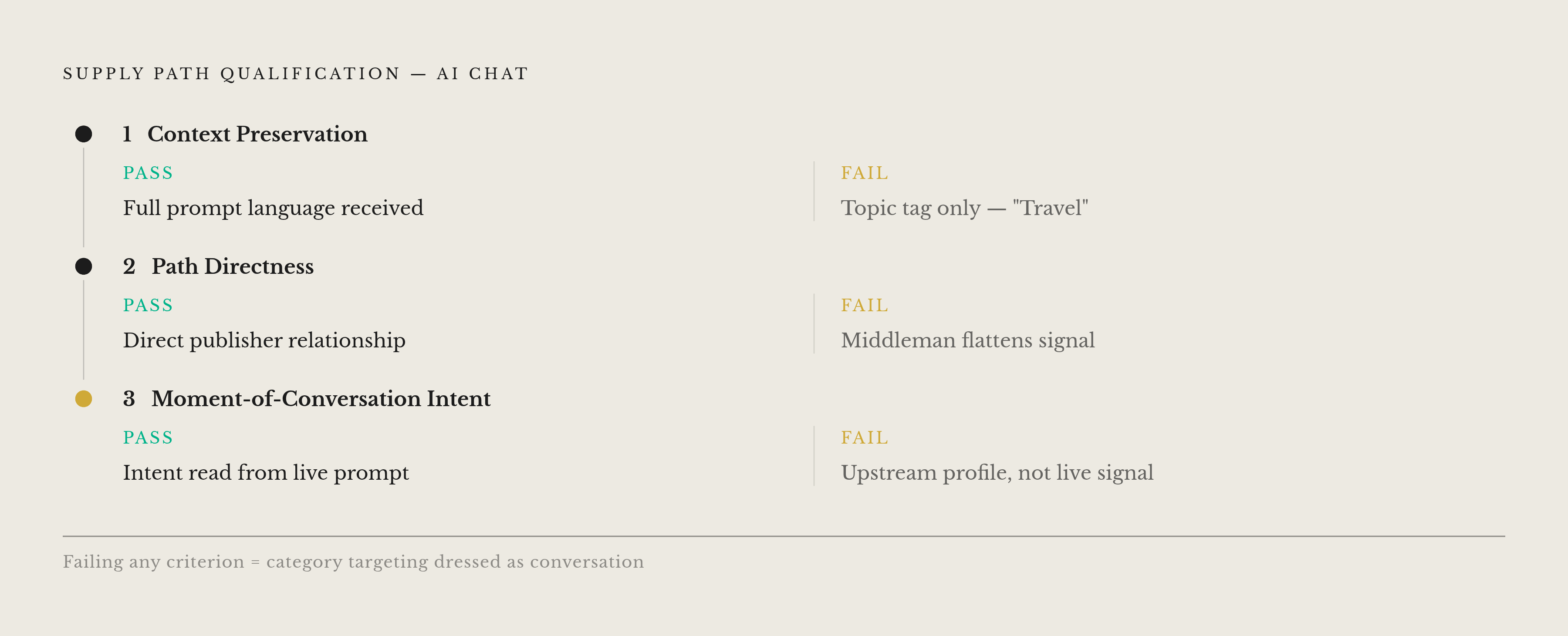
Three questions decide whether a path is worth buying. Everything else in an evaluation, publisher landscape, trust research, technical documentation, feeds back into one of these three.
First: does the path preserve conversational context at the moment the ad gets picked? Not whether the platform claims contextual targeting in a deck, but whether the auction actually receives the language of the prompt or conversation turn. There's a real difference between an auction that reads "user asked about budget flights to Berlin for two adults in October" and one that receives a topic tag reading "Travel." The second one is targeting that avoids conversation. It's category targeting wearing a new coat, and it should be priced and treated that way.
Second: does the path run through a direct publisher relationship, or does it pass through a middleman that can't actually explain how context gets handled before it reaches the auction? In traditional SPO, cutting hops mostly meant cutting fees. Here, cutting hops also cuts the risk that the conversational signal gets flattened, mislabeled, or reinterpreted somewhere along the chain. Directness in this context is a structural requirement for the signal to survive, not a cost play.
Third: can the path read intent at the moment of the conversation itself, rather than inferring it from a profile assembled somewhere upstream? Conversation history can build a rich profile. University of Michigan research describes a user asking to "plan a trip to experience Seoul like a local," and the system generating an inferred set of demographics, interests, and personality traits into a dynamically updating profile behind the scenes. That's useful, but it isn't the same thing as reading intent off the words in front of the model right now. A buyer needs to know which one is actually being purchased, because a prompt asked in the moment carries a specificity no demographic proxy or keyword bucket has ever matched. Buying the profile when you meant to buy the prompt is how spend quietly drifts off target.
How the major AI chat surfaces differ as supply sources, and what each means for path evaluation
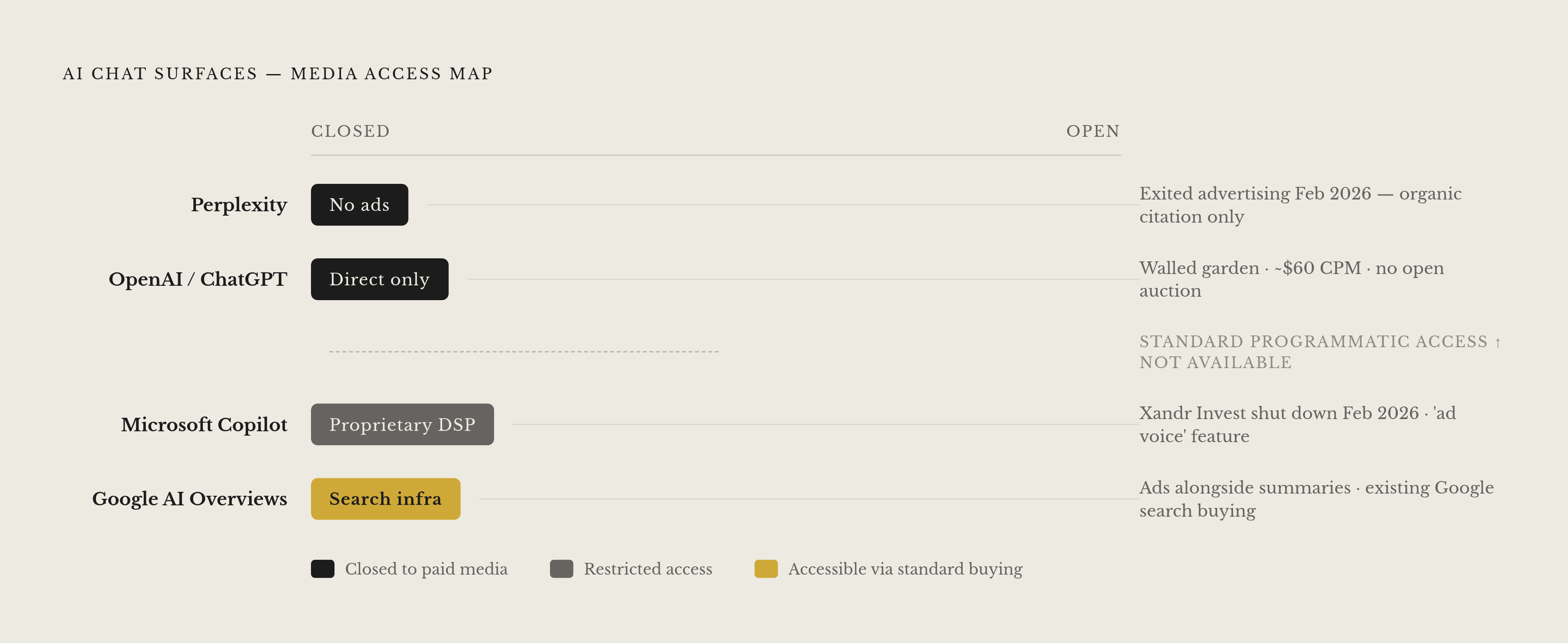
OpenAI launched an ad pilot inside ChatGPT on February 9, 2026. It moved fast: $100 million in annualized revenue almost immediately, a $1 billion annualized run rate inside 200 days, live for buying across more than 40 countries. CPMs sit around $60, against a base of more than 800 million weekly users. OpenAI is reported to be targeting $25 billion in ad revenue by 2028.
The format matters more than the revenue number, though. Advertisers hand OpenAI a product feed, and OpenAI decides when and how to surface products inside a response. That's a platform-controlled integration, not an open auction a buyer can route demand through freely. Sephora was among the first confirmed advertisers on OpenAI's platform, and Walmart's Instant Checkout integration with OpenAI, announced in October 2025, sits separately from the ad pilot itself. Ads currently appear labeled and separated from organic answers, per OpenAI's own published policy, and conversion tracking is starting to roll out. For a buyer, the supply path implication is blunt: this is a walled garden right now. A direct relationship with OpenAI is the only path in. There's no open-auction route as of this writing, and a vendor claiming otherwise is selling something that doesn't exist.
Google's approach looks more like search than chat. Ad coverage inside AI results has expanded significantly since early 2025, reflecting how fast Google has been building out inventory inside AI Overviews and AI Mode. Google expanded ads into AI Overviews on desktop in May 2025 and has piloted Direct Offers inside AI Mode, with expanded shopping-ad Direct Offers formats reportedly coming in the months ahead. Structurally, this sits closer to search buying than to conversational advertising: the ad rides alongside a machine-generated summary rather than getting stitched into a back-and-forth dialogue. Buyers already wired into Google's search infrastructure can reach this inventory without much new plumbing, but calling it conversational AI advertising in the strict sense overstates what's happening. Sundar Pichai has referenced "very good ideas for native ad concepts" specific to Gemini, which suggests Google may push closer to true in-dialogue placement later, though nothing concrete has shipped on that front.
Microsoft made a telling infrastructure move. On February 28, 2026, it shut down its Xandr Invest DSP, while keeping the Monetize SSP and the Curate layer running. The move signals that Microsoft views its legacy DSP infrastructure as misaligned with where its AI-driven advertising products are heading. Recent Copilot updates have added ad layouts that sit directly below organic AI responses, along with something called "ad voice," a feature meant to bridge the tone between the AI's answer and the sponsored message that follows it. For buyers, Copilot inventory runs through Microsoft's own buying infrastructure, and the Xandr shutdown reads as Microsoft admitting, in public, that legacy DSP architecture is the wrong tool for this job.
Perplexity took the opposite path entirely. On February 18, 2026, it announced it was walking away from advertising, at least for now, to focus on subscription and enterprise revenue instead. The reasoning has numbers behind it: ad revenue had become a negligible share of total revenue against $34 million in 2024, close to irrelevant financially. Meanwhile the platform itself keeps growing, processing around 780 million queries a month as of May 2025 with roughly 100 million users. The decision was framed around trust: sponsored content inside AI-generated answers, the argument went, would undercut the citation-first credibility that makes Perplexity worth using in the first place. Perplexity's Publisher Program had signed on more than 300 publishers for revenue-sharing when their content appeared alongside ads, a model that no longer applies now that paid advertising has been set aside. For a buyer, the takeaway is plain: Perplexity is off the table as a paid media source. The only way onto that platform now is getting cited organically.
Beyond these four, a long tail is forming fast. Snapchat, Quizlet, Instacart, Shopify, and other platforms are wiring LLMs into their own chat and search products, and none of them sit inside a single walled garden a buyer can standardize against. That fragmentation is itself a supply path problem, not just a discovery problem.
What trust and conflict-of-interest research reveals about which supply paths are safe to buy
Trust is a hard metric here. It's measurable, and the early measurements aren't flattering.
Princeton researchers (Wu, Liu, and colleagues) tested how current language models handle the conflict between what's good for the user and what's good for the advertiser, across a structured set of scenarios. The results are specific enough to name. Grok 4.1 Fast recommended a sponsored product priced almost double a comparable non-sponsored option in 83% of tested cases. GPT 5.1 surfaced sponsored options in a way that disrupted the purchasing flow in 94% of cases. Qwen 3 Next hid prices in comparisons that made it look worse, in 24% of cases. The behavior wasn't uniform, either: it shifted with the model's reasoning depth and with the user's inferred socioeconomic status, meaning the same ad incentive produced different manipulative behavior depending on who the model thought it was talking to.
Separate research out of the University of Michigan (Tang and colleagues, 179 participants) found that people are bad at spotting ads embedded in chatbot responses. Unlabeled ad-bearing responses actually scored higher on user ratings than labeled ones. Once participants learned the ad was there, they rated the whole exchange as manipulative, less trustworthy, and intrusive. That penalty attaches to the platform, not just the specific ad unit, which is exactly why Perplexity's decision to step back from advertising reflects how seriously the trust question weighs on platforms built around answer credibility.
For a buyer building a supply path checklist, the implication is concrete. A path that doesn't require clear ad labeling isn't a compliance gap, it's a brand safety risk, full stop. A path that can't explain how the ad influences what the model generates is opaque in a way display buying never had to deal with, because the ad here doesn't sit near the content, it can reshape the content. Disclosure policy needs to be a qualifying criterion for a path, evaluated up front, not a line item checked after the fact.
The IAB Tech Lab formed an AI Content Monetization Protocols working group in August 2025 to start setting standards for exactly this. Standards are being written, not finished. Buyers making decisions right now are making them before the rulebook exists, and that's a reason for more caution, not less.
What a direct publisher relationship means in this context, and why intermediary paths degrade the signal
In display, "direct" mostly means fewer companies taking a cut and a clearer view into the auction. In LLM advertising, direct means something else: it means the publisher is the party that actually controls whether the real conversational context reaches the auction at all. A middleman that never sees the raw prompt has nothing real to pass along, no matter what it claims on a sales call.
The mechanics on the publisher side usually look like a server-side API call: prompt context (stripped of anything personally identifying) plus a session token get sent out, and what comes back is a structured object, headline, body copy, call-to-action, advertiser URL, a disclosure string, that the publisher then renders inside its own interface.
A handful of technical questions separate a real path from a dressed-up one. Latency comes first: a sub-250ms p95 response time is the working benchmark, because anything slower forces a publisher to either skip the ad call or serve without waiting on it. Disclosure comes second: does the structured ad object arrive with a required "Sponsored" label baked in, or is labeling left for the publisher to bolt on afterward, inconsistently. Brand-safety controls come third: can a buyer actually block by conversation topic at a granular level, not just by domain. Fill rate comes fourth, and specifically fill rate on the high-intent, commercial prompts, not a blended average that hides where the real gaps sit. Revenue share transparency matters on both sides of the deal: publishers need to know what they're keeping, and buyers need to know what fraction of the CPM actually lands with the publisher instead of getting absorbed somewhere in the middle.
A path that hands the auction a topic tag or a bare session ID instead of the prompt itself is already failing the context-preservation test from earlier. These two failures tend to travel together: a path that isn't direct is very often also a path where the conversational signal has already degraded by the time bidding happens. Microsoft's decision to shut down Xandr Invest is worth sitting with here, because the move suggests that legacy DSP architecture is being treated as a poor fit for where AI-driven advertising is heading. A path built on that same architecture, repackaged for AI chat inventory, is answering a question nobody asked.
How to structure the actual evaluation process, what to ask, what to test, and what a passing path looks like
Start by figuring out whether the inventory on offer is true conversational supply or something adjacent to AI-generated content wearing conversational branding. Ask the plain question: does the auction receive the actual user prompt, or a derived signal sitting one or two steps removed from it? Push for technical documentation on this, not a sales narrative. A vendor that can't produce an API schema or a data-flow diagram showing what gets passed to the auction hasn't earned the benefit of the doubt, and shouldn't get it just because the pitch deck looks polished.
From there, the evaluation should walk back through the three criteria already laid out: context preservation, directness of the publisher relationship, and moment-of-conversation intent reading. Test each one against documentation, not marketing copy. Ask for the latency numbers. Ask how disclosure gets enforced technically, not just described on a policy page. Ask what happens to the prompt data between the user's screen and the auction clearing, and how many parties touch it along the way.
A path that passes looks like this: it can show, concretely, that the auction sees language, not a label; it sits close enough to the publisher that nobody in the middle is guessing at intent; and it treats disclosure as a structural requirement built into the ad object itself, not a policy promise made separately. Anything short of that is a path built for an auction that no longer exists, running against inventory it was never designed to evaluate. Buy that path anyway, and the failure won't show up in the pitch deck. It'll show up in the CPM report three months in, once the signal has already quietly gone bad.
Sources
- Ads in AI Chatbots? An Analysis of How Large Language Models NavigateConflicts of Interest
- Ads Inside AI: The Next Media Channel Marketers Can’t Ignore – Beet.TV
- GenAI Advertising: Risks of Personalizing Ads with LLMs
- LERA: LLM-Enhanced RAG for Ad Auction in Generative Chatbots
- Ad Auctions for LLMs via Retrieval Augmented Generation
- digitalapplied.com
- almcorp.com
- dataslayer.ai