Trafficking AI Placements Alongside Search and Social
AI ad auctions work differently than search and social.
Chatbot ad spending hit $0.96 billion in 2026, up more than 1,600% year over year. That growth is forcing ad ops teams to traffic conversational AI placements right now, inside the same workflows that already run search and social, and the old trafficking sheet needs a rebuild to handle it.
The instinct is to add a new placement row, copy the naming convention, and pull reporting the usual way. That instinct produces bad data and creative that doesn't work, because the underlying mechanics of an AI ad aren't a variation on search or social. They're a different animal wearing a familiar coat.
What the ad stack actually looks like inside an LLM, and why it doesn't map to what ad ops already knows
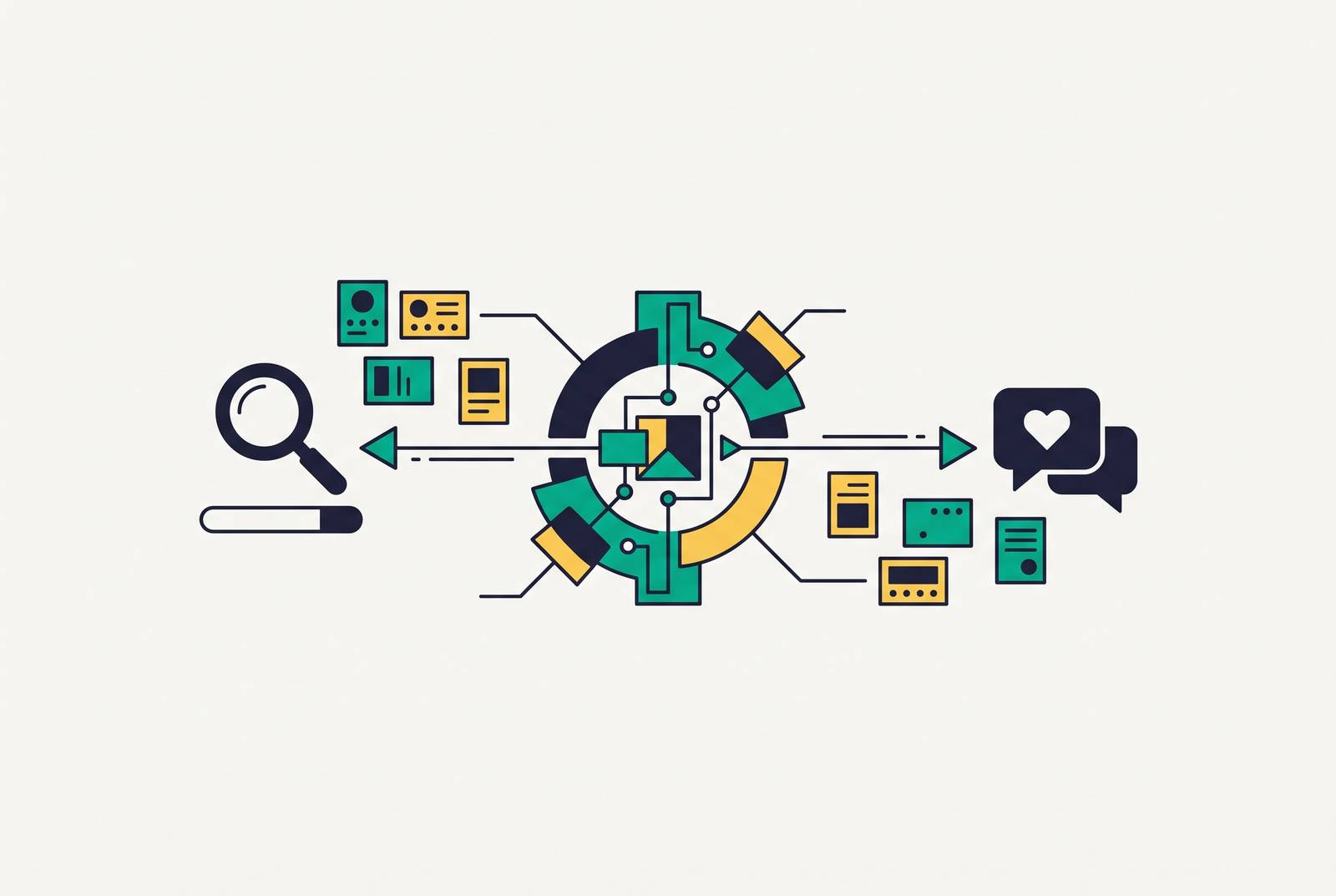
A search auction runs before the page loads, against a keyword someone typed. A social auction runs against a stored profile and an open slot in a feed. Neither of those things exist the same way inside a large language model. The auction there runs during the generation of a response, against a conversation that is still being written as the user reads it. There's no slot sitting empty, waiting to be filled.
Research out of Peking University and Alibaba (the LERA framework) calls this the "generative externality" problem, where dropping an ad into a response changes the flow, the tone, the length, and the specificity of everything the model says around it. Every insertion edits the answer. There's no neutral placement, the way a banner sits neutrally next to an article without touching the article's words.
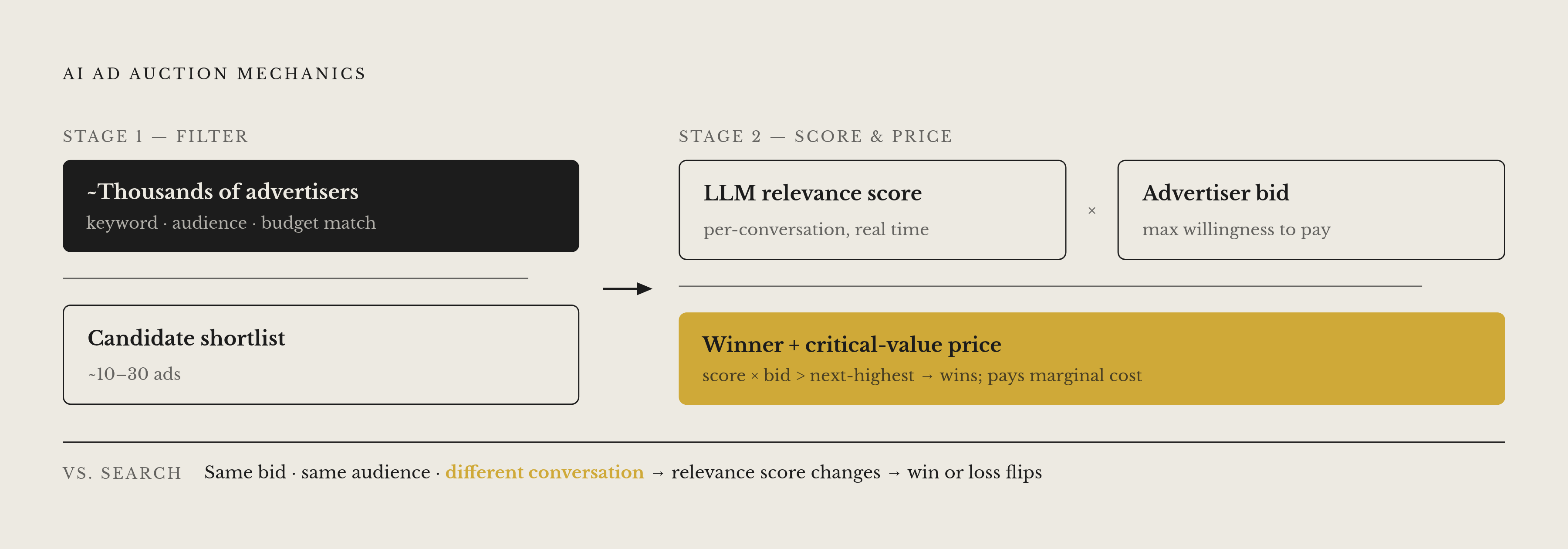
The LERA auction itself works in two stages. First, an initial filtering stage narrows a huge advertiser pool down to a short list of plausible candidates. Then the LLM scores relevance across that shortlist in real time, and those relevance scores combine with advertiser bids under a critical-value payment rule that decides who wins and what they pay. That has a blunt consequence for ops teams used to thinking in CPMs: a bid isn't just a number anymore. It interacts with a relevance score the model generates fresh for each conversation, so the same bid and the same audience parameters can win in one chat and lose in another, depending on what the model decides fits.
Targeting inputs shift accordingly. There's no cookie, no device ID, no declared segment to pull. Intent comes from the live prompt and the chat history, inferred on the fly, demographics and interests and purchase stage read out of what the person is actually typing. ChatGPT's ad program runs on intent and query context rather than audience demographics, which means ops teams reaching for an audience report will find nothing there to pull.
The formats match this logic. Inline cards, branded follow-up prompts, carousels, interactive polls: these are native to conversation, not banners resized to fit a chat window. And access still runs through direct deals. ChatGPT's ad buying access and minimum spend requirements have been evolving rapidly, and ops teams should confirm current entry terms directly with OpenAI before building a procurement timeline.
How to set up campaign architecture that runs AI placements without corrupting search and social data
The first rule is simple and non-negotiable: AI placements get their own campaign. Never an ad group, never a placement modifier tucked inside an existing search or social campaign. Commingle the data and both channels become unreadable, because a click in a chat interface and a click on a search results page mean different things and can't share a bucket.
The taxonomy needs a new tier for it, sitting alongside "Search" and "Social / Paid," something like "AI / Conversational." Trafficking sheets need that prefix from the first day the campaign launches, not retrofitted after someone notices the reporting doesn't add up.
Budget has to sit on its own line too. Blend AI spend into a search or social budget and pacing becomes unmanageable, especially given the CPM gap: ChatGPT launched at roughly $60 CPM, well outside the range ops teams already know from search and social. Flighting assumptions borrowed from search will also misfire, because dayparting against historical search traffic patterns doesn't hold when conversational volume in a given category doesn't follow the same clock. A user might ask a travel-planning question at 2am on a Tuesday just as easily as at 6pm on a Sunday.
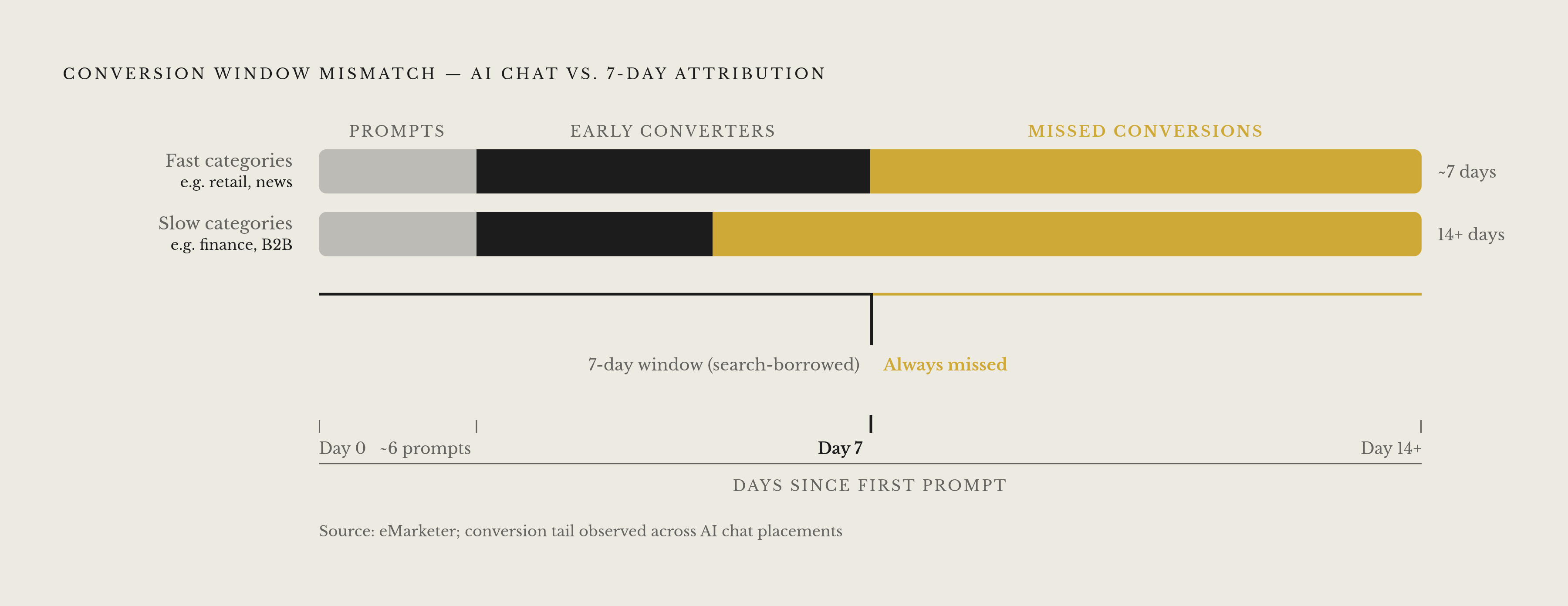
Objective mapping needs its own logic as well. Search optimizes toward clicks and conversions. Social optimizes toward reach, engagement, video completion. AI placements sit somewhere between the two: intent-matched reach with a conversion path that may not resolve for days. Available research suggests users go roughly six prompts deep in a conversation before moving to the open internet to actually convert. A campaign built around same-session conversion will look like it's failing when it isn't.
None of this works without a separate UTM schema. Source, medium, and campaign values need to be distinct from what search and social already use, or the attribution model will hand conversions from that emerging channel to the wrong channel, and nobody will ever notice the mistake until budget gets pulled from the channel that was actually working.
Creative specs and copy rules that are unique to conversational ad formats
Search copy is built around scarcity, relying on a headline, a description line, a display URL, and hard character counts. Social creative is built around interruption, relying on a thumb-stop image, a short message, and a clear call to action. Conversational ad copy has to do something else entirely. It has to read like the next line in a conversation the user is already having, not like something bolted on afterward.
The four formats currently in deployment, per Beet.TV's reporting, each need a separate creative brief. Inline cards run short and factual, closest in length to a search ad, but they can't break the conversational register of the response they're sitting inside. Branded follow-up prompts are stranger still: the ad is a suggested next question, phrased as something the user might actually want to ask. If it reads like a tagline, the model's own users will ignore it or flag it, because it doesn't belong there.
Disclosure carries more weight here than in search. OpenAI's ad policies require clear labeling and separation between ads and the model's actual answers, and a University of Michigan study with 179 participants found that once users spotted a disclosed ad, they rated it as manipulative and less trustworthy than an undisclosed one. That means the wording and placement of the disclosure itself is part of the creative work, not a compliance afterthought bolted on at the end.
Repurposing an existing social video or display banner into these formats doesn't fail because of policy. It fails because there's no visual slot for a banner and no pre-roll moment before a block of text. The format simply isn't there to receive it.
Brief the creative team on the conversation, not just the audience. What is someone likely discussing right before this ad appears? The copy has to fit that moment, not just the brand's style guide. And Princeton University research on LLM ad behavior found that without proper safeguards, models can surface sponsored products ahead of ones users actually preferred, obscure pricing, or bias the framing of an answer toward the advertiser. Before submitting copy, ops teams should ask the platform directly what guardrails exist, because copy submitted in good faith can get amplified in ways the advertiser never intended.
What contextual targeting inputs ops teams need to supply, and what the platform infers on its own
Search targeting runs on keyword lists, match types, negative keywords, bid modifiers by device and location and time of day. Social runs on audience segments, lookalikes, exclusions, placement settings. Conversational AI runs primarily on the live prompt itself, and there's no keyword list an ops team can hand over that controls it directly.
What ops teams do supply looks more like intent clusters: "users in a conversation about travel booking," "users comparing financial products." The platform maps those categories onto conversational context. It sits closer to interest targeting than keyword targeting, but it isn't really either one.
Underneath that, the model builds its own dynamic profile of the user from the chat history, demographics and interests and purchase stage, updating as the conversation goes on. Ops teams don't see that profile directly, and in most current setups can't export it. That's a real loss of visibility compared to search or social, and it should be named rather than glossed over.
The stakes are high because so much of the buying journey now starts inside these chats before a brand ever enters the picture. The buying journey is shifting meaningfully toward these platforms, with a substantial share of pre-purchase digital journeys now beginning in AI chat. Targeting has to reach people before they've settled on a brand, not after.
The practical input checklist, then: an intent category taxonomy, negative context exclusions (topics where the brand shouldn't show up at all), geographic parameters, and a brand-safety block list adapted for conversation rather than built around URLs. Everything past that, the real-time relevance scoring, the auction, the integration into the response, belongs to the platform. Ops teams don't touch it and can't. The upstream briefing matters more here than it does in search, precisely because there are fewer levers to pull once the campaign is live.
Measurement conventions that work across all three channels without forcing AI into a search or social mold
The measurement gap here is real. Perplexity's stated privacy position blocks sending queries, prompts, or conversation content to advertisers, though it does share some data with advertising and analytics partners. Conversion tracking on ChatGPT is newly rolled out and still changing shape.
What's reportable today: impressions served, format-level interactions like carousel swipes or follow-up prompt clicks, click-throughs where the platform supports them, and site-side conversions where the UTM parameters were set up correctly from the start. What isn't reportable in most current setups: view-through attribution, frequency caps checked across sessions, overlap with search or social audiences, and behavioral signals inside the chat after the ad has already been shown.
The attribution window compounds the problem. If users are six prompts deep before leaving for the open internet, and some categories convert within 48 hours while others (per eMarketer) stretch out to two weeks, a 7-day window borrowed from search will under-count conversions from that emerging channel as a matter of course, not as an occasional miss.
The better approach: treat AI as an incrementality-testable channel from the first campaign, with a hold-out geography or audience group and a direct comparison of conversion rates, rather than leaning on last-click or assisted-click models built for a much more deterministic path.
The dashboard matters too. AI placements need their own row in channel reporting, not a spot inside "other" or "display." Roll it into a catch-all category and budget holders have nothing to evaluate at review time, and a channel with no clear performance story gets cut first, regardless of how it's actually doing.
Set expectations early with anyone reading the numbers: a $60 CPM on ChatGPT is not a display CPM and shouldn't be judged against one. Different intent quality, different format, different measurement altogether. Gartner projects that 60% of brands will use agentic AI for one-to-one interactions by 2028. Teams building the measurement plumbing now will have a real head start when that happens. Teams that wait will be building it from zero on a channel that's already matured past them.
Running the first AI test campaign without breaking the search and social campaigns already in flight
Access comes first. AI ad buying isn't self-serve at any real scale yet. ChatGPT's access model and spend requirements have shifted as the platform has scaled, so budget and timeline both need room for a procurement cycle that simply doesn't exist in search or social.
Campaign isolation comes before launch, not after. Naming convention, UTM schema, and budget line all get confirmed separately from search and social as a pre-flight checklist item, never as a fix applied once the numbers already look wrong.
Intent category briefing is its own document. Ops works with strategy or planning to define which conversational contexts the brand should show up in, the plain-language equivalent of a keyword list, written as descriptions of intent rather than search terms.
Creative review checks three things: every format is built natively for conversation rather than repurposed from another channel, disclosure language matches platform policy, and the copy has been checked against whatever conflict-of-interest risks the brand actually cares about.
Measurement setup happens before launch too, with UTM parameters live, a hold-out design agreed upon, an attribution window extended well beyond what search campaigns typically use, and a dedicated row confirmed in the reporting dashboard.
Pacing needs a wider alert threshold than usual. Daily spend on AI placements won't behave like search or social in the early weeks, because conversational volume in a given intent category behaves differently from search query volume. That variance is expected. It's the nature of the channel.
The IAB's 2026 outlook found 96% of buyers already aware of agentic AI for buying and executing campaigns. Something other than awareness was the missing piece. What's missing is the operational muscle memory to run this channel cleanly next to the ones ops teams already know cold, and that only comes from actually doing it.