Bid Strategy Selection in LLM Auction Environments
Context hints beat bid prices in LLM ad auctions where relevance, not spend, wins placements.

You can't start bid strategy selection in LLM advertising environments from search auction logic, because the object being auctioned, the signal being read, and the mechanism clearing the price are all different. The angle of this piece is straightforward: bid price is a weak lever in these systems, and the real optimization surface is signal quality paired with the right bidding approach for the specific auction architecture in play.
Why LLM ad auctions differ from search auctions
A media buyer coming from paid search will reach for a familiar toolkit: bid on keywords that signal intent, raise bids on terms that convert, build negative keyword lists to trim waste. None of that toolkit transfers to LLM advertising, because the thing being auctioned is not a slot that keywords can describe. In search, the object sold is a fixed placement on a results page. In LLM environments, the LLM-Auction framework formalizes a different premise entirely: the object being allocated is a distribution over generated outputs, not a discrete placement a keyword could ever point to. That distinction is not cosmetic. Classic auction design assumes a fixed slot and a predetermined quality score computed in advance; neither assumption holds when the "placement" is a portion of a conversational response the model is generating on the fly.
With no keyword layer to bid against, the control an advertiser actually has is a natural-language context hint, a freeform description capped at 280 characters at the ad-group level, matched against the live conversation rather than a typed query string. Writing that hint is a different discipline from keyword research. It asks an advertiser to describe what someone is trying to accomplish and whether an offer fits that moment, not which words they typed into a search box. Teams that treat the context hint as a dumping ground for comma-separated topics get weak matching for it. Precision in describing conversational intent, not keyword coverage, is the highest-leverage skill in this channel, and it is a skill most media teams have not had to build before.
Relevance-Weighted, Second-Price Auctions and Bid Price
Once the targeting object changes, what a bid can buy changes with it. Placement in LLM auction environments runs through a relevance-weighted, second-price auction: a more contextually relevant ad can beat a higher bid, and the winner typically pays just above the next competing bid rather than paying its own ceiling. Two mechanics do separate work here, and if you conflate them you get bad strategy. The second-price structure means clearing cost is set by competition, not by how high the winner was willing to go. The relevance-weighting layer means the auction is reading the context hint, the ad copy, and the landing page alongside the number attached to the bid.
The practical consequence cuts against instinct: a precise advertiser running a small budget can beat a vague advertiser running a large one. That is an unusual property in paid media, and the field is still inexperienced with context-hint craft, which makes it worth exploiting now. Because the auction reads the hint against the live conversation, a poorly written hint depresses effective relevance regardless of what the advertiser is willing to spend. The optimization surface, in order, is the hint first and the bid second.
The honest complication is that relevance scoring is opaque from the outside. There's no dashboard that shows an advertiser the relevance score their hint received on an exchange. What they can read is the outcome: win rate and clearing price relative to bid ceiling reveal whether a hint is resonating, even without prompt-level detail. That opacity is a constraint on the channel, not a flaw unique to one platform, and practitioners describing the work already point to it. Zéa Hirsh, performance media supervisor at Collective Measures, told Adweek: "Our biggest concern right now is visibility. We don't have search- or prompt-level reporting, so we can't see exactly what users are asking when our ads are served." That is a structural limit on the information available to bid strategy, not a complaint about execution, and any bidding approach built for this channel has to account for it rather than assume it away.
Conversational intent signals versus keyword signals
A single keyword is a snapshot. A conversation is a timeline, and the timeline carries intent, constraints, and decision stage that no keyword can hold at once. Someone might open by asking how to start running, mention that past shoes never fit comfortably, specify the surfaces they run on, name a budget, and only then ask for a recommendation. No keyword captures that sequence, but the conversation itself does. Traditional contextual advertising reads the content around a consumer at one moment; conversational systems watch intent develop over the course of an exchange, which makes the signal longitudinal rather than point-in-time.
ChatGPT's advertising system draws on this directly: targeting signals include the current conversation topic and, for users who have opted into personalized ads, past chat history and previous ad interactions. A third layer runs through ChatGPT's Memory feature, where saved preferences, past chat history, and noted interests all shape which ads get selected. That is a materially richer input than a keyword match, in principle. In practice, advertisers do not get the same visibility into, or control over, how those signals translate into placement decisions that they have over search terms. The underlying signal is rich, but the advertiser trying to act on it does not get the same access to it.
This asymmetry has a direct consequence for how volume should be read. Volume has long served as a proxy for supply value in digital advertising, but an AI experience can have fewer total users and still generate highly engaged interactions, with consumers spending real time actively explaining what they need. If you treat those interactions the way you treat conventional pageviews, you risk undervaluing exactly the sessions that carry the most signal. Without prompt-level reporting, you can't ground a bid adjustment in observed query patterns the way you can with a search bid adjustment. Strategy instead has to be built from the available levers: audience exclusions, the precision of the context hint, and conversion-side signal measured after the fact.
The exclusion boundaries OpenAI has published function as a form of signal in their own right. Ads are excluded from users under 18, temporary chats, logged-out sessions, image generation conversations, and sessions flagged under sensitive topics including health, mental health, and politics. Knowing where ads cannot appear tells an advertiser where the eligible inventory actually sits, and that knowledge should shape where bid is concentrated even in the absence of prompt-level detail.
The three emerging auction architectures practitioners need to distinguish
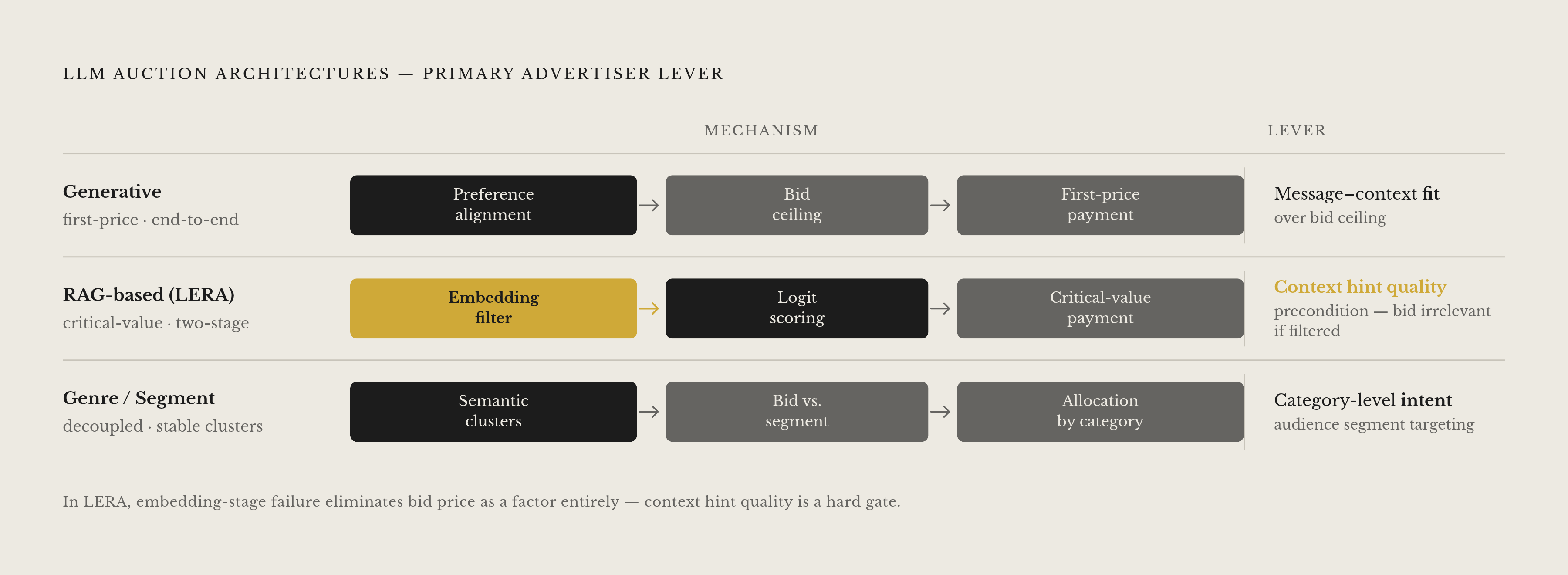
LLM advertising is not one auction type wearing different platform skins. LLM auction environments are not a single architecture, and a bid strategy calibrated for one will misfire in another: generative auctions, RAG-based auctions (LERA), and genre-based segment auctions.
Generative auctions, under the LLM-Auction framework, treat the auction object as the distribution over generated outputs itself. Allocation is formulated as preference alignment inside the model, so it balances advertiser bids against user satisfaction without a separate optimization pass bolted on afterward, and a first-price payment rule gives this structure favorable incentive properties. For a bidder, that means allocation depends on how well an ad's value aligns with user satisfaction during generation, not on simply outbidding competitors against a fixed relevance score. Strategy here should prioritize how well the message fits the context over maximizing the bid ceiling.
RAG-based auctions, under the LERA framework, run a two-stage process: first retrieve, then generate. Embedding-based coarse filtering pre-selects a candidate set first, then the model is queried with a designed prompt so it produces logits over that candidate set as refined relevance scores, and these combine with bids under a critical-value payment rule designed to keep bidding truthful. An ad must pass the coarse-filtering stage before bid price matters. An ad that fails embedding-level relevance never reaches the scoring stage, which makes context hint quality a precondition for participating in the auction, not a tiebreaker within it.
Genre or segment auctions decouple bidding from any specific user query, because they use high-level semantic clusters as a proxy, so advertisers bid against stable categories instead of sensitive real-time responses. So that structure cuts computational load and reduces privacy exposure for the platform. So for the advertiser, bidding here looks more like audience segment targeting than like keyword bidding, and you should build strategy around category-level intent rather than query-level precision.
The interface looks identical across these architectures: a chat window with an ad surfaced somewhere in or around the response, which creates an operational risk. A different architecture produces a different set of levers that actually move outcomes, so if you run campaigns across platforms, you may be operating in architecturally different systems without realizing it.
Mapping Static, Dynamic, and LLM-Encoded Auto-Bidding Strategies to These Environments
Whether a bidding approach can be static or must be dynamic is set by whether the underlying architecture supports real-time communication with the advertiser, and the newest LLM-encoded bidding research is shifting what counts as feasible at either end.
Static bidding sets each bid from pre-committed context descriptions or contracts, and it has no real-time exchange with the advertiser per query. That fits genre and segment architectures well, and it fits early-stage campaigns where signal volume is too thin to support real-time adjustment.
Dynamic bidding has the model deliver the live query and context to the bidder for each individual query, with a bid returned in real time. That fits generative and RAG-based architectures where per-query relevance scoring actually exists to respond to, but it needs infrastructure that can hit millisecond-level response times, which is a nontrivial engineering bar on its own.
Beyond both sits a frontier of LLM-encoded bidding research, and it treats strategy itself as a language object, not a set of numeric parameters. SemBid injects LLM-encoded Task, History, and Strategy semantics as tokens into offline bidding trajectories, and using self-attention over those tokens outperforms numerical-only baselines on performance, constraint satisfaction, and robustness. AIGB-R1, presented at KDD 2026, uses a Planner-Executor structure in which an LLM Planner reasons about candidate strategies by referencing an advertiser's contextual information and bidding history, then produces a set of promising, diverse strategy prompts for an executor to act on, moving strategy reasoning into language space itself. LAMA embeds advertiser influence into each individual token of a generated response through a latent mixture auction, achieving incentive compatibility and near-optimal welfare at what is currently the most granular allocation unit in the research record.
Existing methods are typically trained under fixed preference distributions, so they struggle when advertiser preferences shift in live bidding services, and retraining for new preference distributions costs a lot. Practitioners should treat the published results as a signal of direction rather than as a system ready to run a live account today.
The latency and market stability problems that constrain what any bid strategy can achieve today
Two engineering constraints cap what any real-time bidding strategy can achieve in these environments right now: latency and market stability. Running a full LLM inference pass for every candidate ad in every auction violates millisecond-level response requirements at any meaningful scale. That cost is why the Platform-Investment Mechanism, or PIM, runs a predict-then-execute workflow instead of inference-on-everything: the platform predicts the expected click-through lift from an LLM enhancement, agents bid against that predicted value, and the costly inference pass only runs for the ad that actually wins.
PIM wraps around existing auction formats such as generalized second-price auctions rather than replacing them, and platforms can treat LLM token length or model tier as a continuous strategic variable, tuned so the expected revenue lift clears the cost of the API call. A 2026 analysis using a TTSL-PPO framework found this approach produced a 2.66% platform revenue increase compared to running standard auctions with no LLM enhancement at all. The appeal to a platform is that it does not require rebuilding the auction engine from scratch.
Market stability is the second constraint, and the Stackelberg framing from the same body of research is the most useful conceptual tool a practitioner can take from it. If agents chase maximum profit within the current round through greedy investment, they shade their bids aggressively, and that shading eventually collapses clearing prices across the market. The Stackelberg, or two-timescale, approach is the proposed fix for that collapse, not its cause: it asks the platform to anticipate how agents will respond across future rounds rather than optimizing round by round. The lesson for any advertiser running dynamic bids in a quality-shifting auction is direct: myopic, round-by-round bidding is structurally dangerous when ad quality itself is moving, and a strategy built only to win the current auction can degrade the market it depends on.
A related problem is equilibrium selection. When budget-constrained auctions pair with dynamic quality, you can get multiple Nash equilibria at once, so outcomes become unpredictable even for a well-designed bidding agent. If you apply Tikhonov regularization to agents' dual objectives, you can guarantee a single, stable Pacing Equilibrium that a platform can reliably target, and mature platforms should be expected to adopt this kind of mechanism-design fix as the category develops.
The point that follows from all of this is the one that should anchor expectations going forward: the platform controls both the LLM quality investment decision and the clearing mechanism simultaneously, so an advertiser cannot optimize for platform behavior the way it can in search, where the auction rules are comparatively fixed and legible. The platform in this channel behaves as a strategic actor with its own objective function, sitting between buyer and inventory with interests of its own rather than as a neutral exchange.
What the live platforms offer advertisers
ChatGPT, run by OpenAI, is the clearest live example of how these mechanics appear in a shipped product. OpenAI launched ads on February 9, 2026, and according to Digital Applied, the ad pilot reached $100 million in annualized revenue within weeks of going live. A self-serve Ads Manager opened on May 5, 2026, with spend minimums removed, so smaller advertisers could get direct access without a managed-service relationship. The live formats include a shopping product carousel that appears below a generated response and a display-style card carrying an "Ask ChatGPT about this ad" button that opens a dedicated product question-and-answer thread.
Each of these formats sits inside the targeting and exclusion structure already described: conversation-topic signals, opt-in history and memory-based personalization, and a defined set of contexts where ads will not appear. None of it currently exposes prompt-level reporting to the advertiser, which is the exact gap Hirsh pointed to. That absence should guide bid strategy on this platform and on any comparable one that follows it: build context hints with the same rigor keyword lists once demanded, treat win rate and clearing price as the best available proxy for relevance performance, and match the bidding approach, static, dynamic, or language-encoded, to the auction architecture actually running underneath the interface, instead of assuming one playbook covers every surface the model presents.
Sources
- arxiv.org
- arxiv.org
- LERA: LLM-Enhanced RAG for Ad Auction in Generative Chatbots
- arxiv.org
- Autobidding Auctions with LLM-Powered Creatives — Lacuna
- LLM-Auction: Generative Auction towards LLM-Native Advertising · Pith Review
- AIGB-R1: Self-Evolving Generative Auto-Bidding via Hierarchical Planner-Executor Optimization