Adapting Existing Search Ad Copy for Conversational Placements
Search ads don't translate to conversational placements without structural rewrites.
The most common mistake in conversational advertising right now is simple: teams take a search ad that already works, drop it into a ChatGPT or Copilot placement, and launch it without touching a word. That habit is costly because the two environments run on different logic. Search copy assumes a keyword triggered the impression: a user typed a specific string, the ad responds to that string, and the relationship between query and ad is one-to-one and transactional. Conversational placements don't work that way. Microsoft Copilot's targeting model reads an entire session rather than the most recent query, so the intent an ad has to match is shaped by a whole arc of dialogue, richer and messier than any keyword could encode.
Search copy is also built to interrupt a scan. It competes against several adjacent results on a crowded page, so it leans on urgency, phrases like "Buy Now," discount callouts, anything that can win a click in a few hundred milliseconds of attention. Conversational placements show only one or two units per session, so each ad carries far more individual weight. The interruptive tactics that work in a search results grid land as friction instead of motivation when there's no competing list to interrupt.
The stakes are higher than they look, too. WeAreBrain's citation of Microsoft research found that users arriving from LLM recommendations convert at a meaningfully higher rate than users arriving from search referrals. That gap comes from trust the assistant has already built up over the course of a conversation. Copy that feels aggressive or out of step with that trust doesn't just underperform. It can undo the very thing that made the placement valuable before a click ever happens.
What conversational context signals for the copywriting brief
Keyword strings are compressed signals. "Running shoes" could mean someone is comparing brands, buying a gift, replacing a worn-out pair, or acting on a whim, and a search ad has no way to tell which. A conversational prompt carries the whole situation instead: the person's stated constraints, the comparison they're already mid-way through, the question they just asked the assistant. guptadeepak.com's guide to LLM advertising states that a context hint has to capture what the person is trying to accomplish and whether an offer is useful in that exact moment.
That difference appears in the shape of the queries themselves. Users are increasingly phrasing what they want as full situations rather than clipped keywords, something closer to "I want to sign up for a marathon where I can support cancer research" than "marathon signup." Copy that answers a question like that directly will beat copy that just asserts a benefit into empty space, because the question already told the advertiser what the person needs to hear next.
BusySeed's 2026 analysis of LLM advertising puts a name to this shift: users show up in an "exploring and learning" posture rather than a "comparing and buying" one⟳. That changes what the copy is for. A search ad's job is to close. A conversational ad's job is to guide someone who is still building out their own understanding of the problem, which is a fundamentally different task even when the product being sold is identical.
That reframes the brief itself. Writing for a conversational placement starts with figuring out what the person is trying to work out in their own head, not with deciding what action the advertiser wants them to take. Search copywriting starts from the advertiser's goal and works backward to a hook. Conversational copywriting has to start from the user's unfinished thought and work forward to a next step that actually fits it.
The structural rewrite: from headline-and-description to answer-first copy
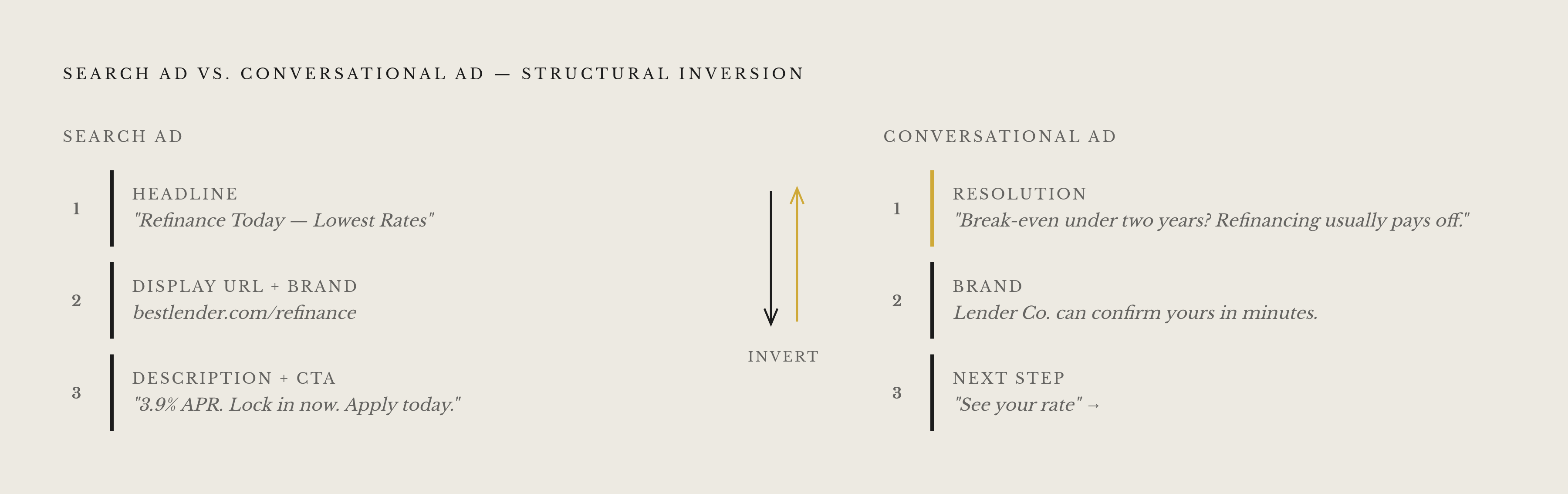
A standard search ad follows a fixed anatomy: a headline that echoes the keyword or asserts a benefit, a display URL, and a description carrying a supporting claim and a call to action. Every piece of that structure exists to win a glance on a page full of competing listings. That anatomy makes no sense once the ad is sitting below an answer the user already read and trusted.
Take a hypothetical example from personal finance, a mortgage refinancing search ad. Every element of that headline and CTA is designed to win a glance in a competitive list.
Now picture that same offer appearing under a ChatGPT answer to "how do I know if refinancing my mortgage is worth it right now." The user just read a real explanation of break-even points and closing costs. Restating the offer's rate and urgency ignores everything the assistant just told them and repeats the tone of a billboard. An answer-first version does the opposite: open with the resolution to the question the conversation raised, then introduce the brand, then offer a next step, which inverts the search convention of brand name first, benefit second, call to action third. Something closer to: "If your break-even point is under two years, refinancing usually pays off. That's copy shaped by the same discipline as before, aimed at a different target.
ChatGPT's sponsored card sits below the assistant's answer as a clearly labeled unit, and guptadeepak.com's pricing data pegs that after-answer placement at roughly $60 cost per thousand impressions, which is real money resting on the assumption that the copy connects to what was just said instead of restarting the conversation from scratch. Google's Conversational Discovery ads, announced at Google Marketing Live 2026, work the same way inside AI Mode, using Gemini to generate creative meant to answer a specific question directly, and Microsoft Copilot triggers its units off the whole "ad voice" of a session rather than the last query typed. All three are structured around answering, not asserting.
Some things do carry over cleanly. A specific, concrete product claim still works. A clear destination page still works. Brevity still works. What has to go is the urgency language built for a user who's already decided to buy, the competitive jabs built for a page full of visible alternatives, and keyword echoes that were only ever written to match a search string rather than to read like something a person would actually say. The waste sits in the structure of the ad, not in each individual line.
Tone calibration: what "conversational" means in copy, not just in channel name
"Write it conversationally" is the most misapplied piece of advice in this entire channel. Most teams hear "conversational" and translate it as "casual," so they rewrite a search ad with an exclamation point, an emoji, and a friendlier verb, and call it done. That instinct backfires the moment the underlying conversation is a serious one.
A person deep into a multi-turn exchange about refinancing a mortgage is in an entirely different register than a person asking an assistant for weekend plans, and copy pitched at the second register will feel jarring in the first. The same brand may genuinely need two different tonal calibrations for the two situations, because ChatGPT's targeting reads copy against the full text of the exchange, including the assistant's own response. If that response was detailed and technical, an ad written in a breezy consumer voice reads as tonally disconnected, and that disconnection costs relevance, not just charm.
Perplexity's own placement data sharpens the risk. WeAreBrain's early observation is that Perplexity shows just 1-2 sponsored placements per session versus Google Search's 4-7, so there's no adjacent ad on the page to save the sale if the tone misses. A mismatch here isn't a wasted impression among many; it can be the entire session's shot at conversion.
A workable calibration test: read the context hint description back as if it were a line inside the actual conversation, then write copy that could plausibly be the next sentence a knowledgeable friend would offer, not the next line out of a sales deck. That standard sounds informal, but it demands more precision than a search headline ever did, because it has to survive being read next to real, substantive human language rather than a row of other ads.
The context hint as the new keyword: writing targeting descriptions that do actual work
On surfaces with no keyword layer at all, the context hint is the primary targeting tool available, and writing one well is its own discipline, not a new box to fill in with old habits. ChatGPT's mechanism is a freeform, natural-language description, capped at 280 characters, written at the ad group level. The auction reads that description against the live conversation and matches on relevance rather than checking for keyword presence.
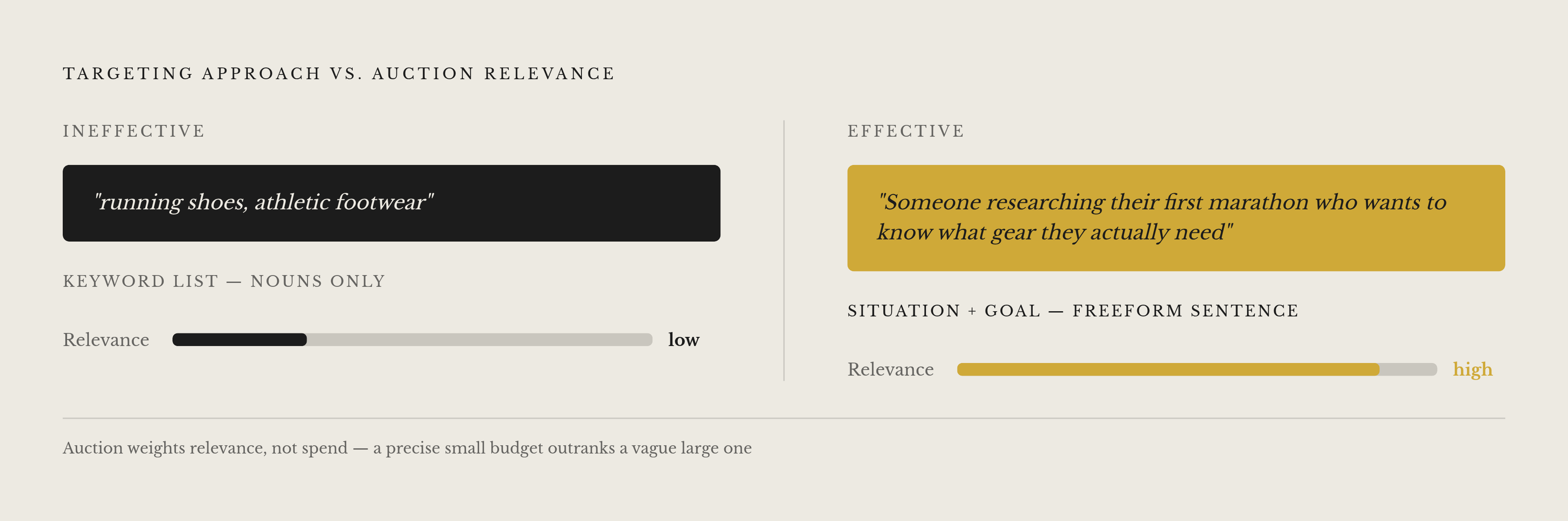
The habit that breaks here is the comma-separated topic list search marketers have used for a decade: something like "fitness, running, shoes, athletic gear." That's keyword targeting dressed up in a field that was never built to accept it, and guptadeepak.com's guide is blunt about the result, calling it a pattern that produces poor matching, consistently.
A hint that actually works describes a person's situation and goal rather than a product category. "Someone researching their first marathon who wants to know what gear they actually need" will out-match "running shoes, athletic footwear" every time, because the first one describes a moment a real conversation could be in and the second one only describes a shelf in a store. That's the whole shift in one comparison: a list of nouns versus a sentence about a person.
This matters more than it might look at first glance, because the auction is relevance-weighted rather than purely spend-weighted. A precise advertiser running a small budget can beat a vague advertiser running a much larger one, an unusual property for paid media, and one worth exploiting while most competitors are still writing hints like keyword lists.
The hint doesn't operate alone, either. The auction reads the context hint, the ad copy, and the landing page together, and a mismatch between any two of those three degrades the relevance score. Search campaigns are usually disciplined about keyword-to-ad alignment but sloppy about landing pages, which often were written for organic traffic and never touched again. That gap fails the three-way check even when the hint and the ad copy are both well written.
Rewriting the ad for ChatGPT, Google AI Mode, and Microsoft Copilot
The principles above hold across every conversational surface, but the execution differs enough that one adapted ad will underperform on at least two of the three platforms currently carrying real budget. Treating this as a single rewrite job instead of three related but distinct ones repeats the paste-and-launch mistake.
ChatGPT
The ad renders as a labeled sponsored card underneath the assistant's answer. The copy has to acknowledge that the user already received a complete, trusted response and is now deciding whether to go further. Reach is capped by tier: ads only appear to users on the Free and Go tiers, since every paid tier is ad-free. That's a real constraint for B2B advertisers targeting senior decision-makers or enterprise buyers, a group disproportionately likely to sit on paid tiers and simply never see the placement.
There's no keyword layer. Targeting runs on the 280-character context hint inside a second-price, relevance-weighted auction. The hint and the ad copy need to be written together as one unit rather than handed to different people on different timelines. Access has also widened considerably: the self-serve Ads Manager opened on May 6, 2026, removing the high minimum spend that had kept the format restricted to a small set of managed-tier launch partners, and mid-market advertisers can now buy in directly.
Google AI Mode and AI Overviews
Eligible Search, Shopping, and Performance Max campaigns serve automatically inside AI Overviews, with no opt-in or opt-out control available. That means plenty of advertisers are already showing up here without ever having made a deliberate decision to write for the surface, an audit-first situation rather than a launch-when-ready one.
Google's Conversational Discovery ads, announced at Google Marketing Live 2026, use Gemini to build tailored creative out of existing assets rather than out of a finished ad. That shifts the actual rewrite work down a level: the job is to rewrite the underlying headlines, descriptions, and images so the system has answer-shaped raw material to assemble, not to polish one final unit. Healthcare, one of Google's most tightly regulated ad categories, is already being tested inside AI Mode, a strong signal that advertisers in sensitive categories should have adapted copy ready ahead of a broader rollout rather than reacting once it arrives.
The pressure to get this right is compounding, too. Google AI Overviews cut organic click-through rates by an average of 18%, with steeper drops on informational queries. Brands that used to let organic search carry users through the early, informational stage of a decision now need paid copy able to do that same job, since organic traffic can no longer be counted on to cover it.
Microsoft Copilot
Every eligible campaign and ad type is automatically opted in inside Copilot, with no opt-out available, the same audit-first situation advertisers face on Google. Targeting here runs on the full "ad voice" of a session rather than the most recent query, so copy needs to hold up against a conversation that may have shifted well past its opening prompt by the time the ad actually appears.
Microsoft has reported click-through and conversion rates for Copilot ads that beat traditional search benchmarks, though that figure comes from the vendor itself and should be read as a directional claim rather than a guaranteed outcome. Perplexity wound its ad program down and told the Financial Times that sponsored placement risks making users suspicious of the whole answer; Anthropic sells no ad placement in Claude at all. Both are useful boundary markers for how far this format can stretch, not additional platforms to plan copy for.