Native Ad Design Principles for AI Chat Interfaces
AI chat ads must match the user's conversational tone to avoid breaking trust.
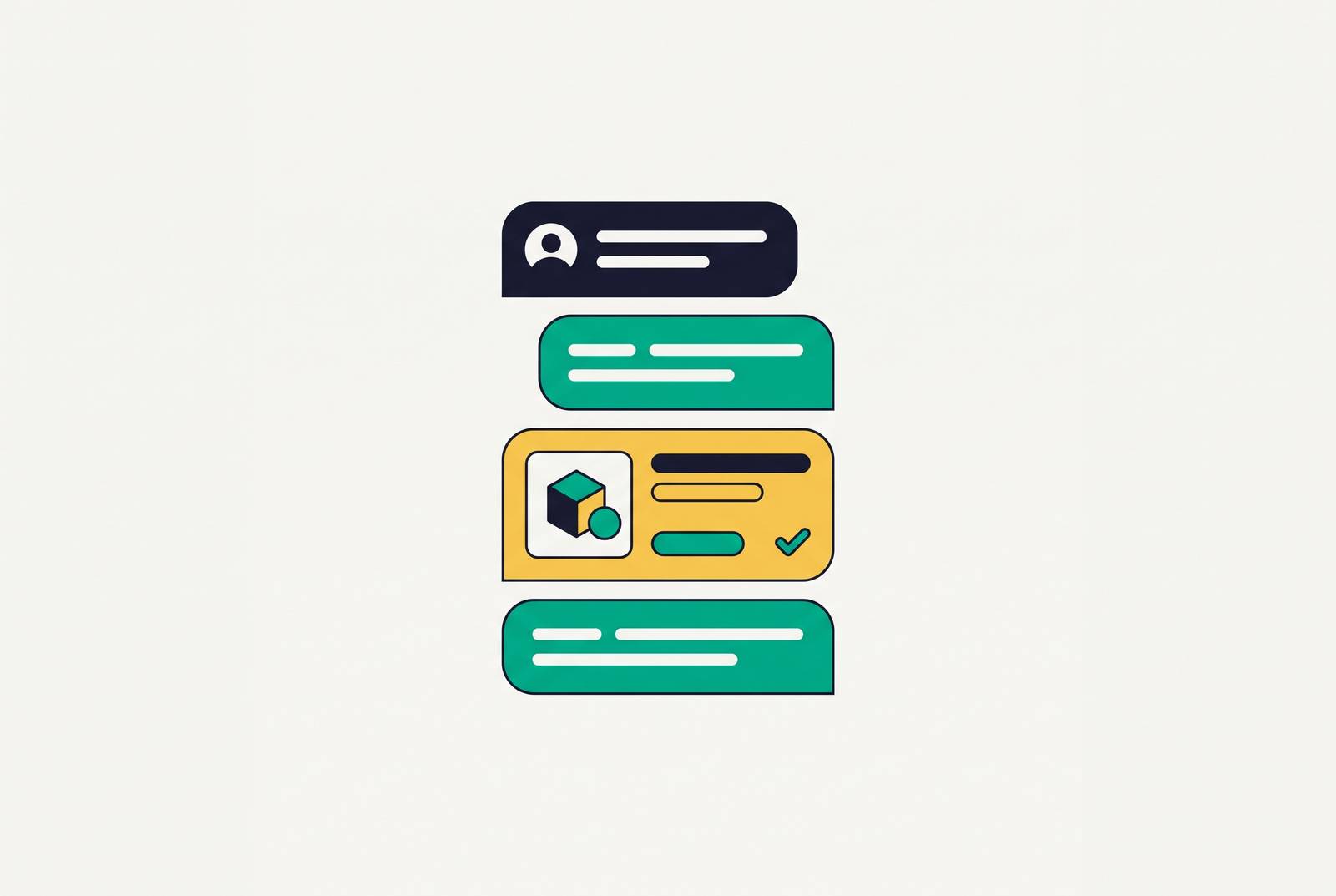
Native ads in AI chat need a different set of design rules than anything built for the web, because the surface itself works differently from a page or a feed. In an LLM interface, the user is mid-conversation, producing the content collaboratively with the AI, and the response they're reading was generated specifically for their query and their context. That changes what an ad is allowed to be. LLM ad environments work on a different mechanic entirely: usually one or two placements per session, matched to the conversation's intent rather than to a keyword, with the promotional content generated or rephrased so it sits inside the flow of the conversation rather than beside it. An ad that would do perfectly well on a search results page, a static headline, copy built around keyword density, a placement designed to interrupt and redirect, becomes a liability the moment it's dropped into a chat thread, because it breaks the register the user has already settled into.
The LLM Ad Environment for a Creative Team
Three mechanical facts define this environment for anyone writing or placing an ad inside it, and none of them have a real equivalent in search or social. The platform matches ads to conversations using prose descriptions, often called context hints, that advertisers write to describe the kinds of conversations where their product makes sense, and the system resolves these semantically rather than by exact match. The second fact reorders the sequence creative teams are used to: the AI's response gets generated first, in full, and only afterward does the matching algorithm scan that finished response to look for a relevant promotional opportunity. The ad never shapes what the assistant says. OpenAI calls this guarantee the Answer Independence Principle. The third fact concerns form: every live or emerging ad type, Sponsored Suggestions, sponsored links, interactive product showcases, Sponsored Agents, and conversational display ads, appears attached to the AI's answer, never substituted for it.
Bidding is moving in a direction that makes these constraints even sharper. Cost Per Engaged Conversation charges an advertiser only when a user actually interacts with the ad and keeps talking, and Conversation Value Optimization adjusts bids using a predicted lifetime value rather than a single click. An ad that stops a conversation cold, even if it's clicked, is worth less under these models than one the user keeps talking through. That's the platform rewarding exactly the quality that conversational fit produces, and it's the mechanical bridge from "how ads appear" to "how ads should be written."
Limits of the Standard Native Ad Playbook in Chat
Native advertising isn't a new idea, and its existing conventions, matching the visual style of the surrounding content, adopting an editorial tone, labeling clearly but quietly, were built for a specific kind of surface: the feed, the article page, the results list. Chat asks for something stricter: the ad has to blend with content the user is actively generating turn by turn, which raises the bar on tone considerably higher than feed-native or editorial-native ever had to clear.
Gilroy's description of large language models as controlling interpretation, rather than simply retrieving information, points to what's actually at stake. An ad that reads as a promotion instead of a natural continuation of that judgment doesn't just underperform, it damages the user's trust in the assistant itself. Existing native formats were never built to carry that weight, because the signals they were designed around were weaker to begin with. Social media and CTV only provide fragmented signals about a user's interests, and the native ad conventions built for those channels were calibrated to that fuzziness. Chat is different: the user states an explicit, immediate need, and the ad has to meet that need with a precision those older formats were never built to deliver.
The most common objection to all this is that targeting alone should be sufficient, that if the product genuinely matches the query, format and tone are secondary concerns. The platform mechanics say otherwise. Conversation-depth signals and CPEC bidding reward engagement that continues the dialogue, not just a correct match. A product that's relevant but delivered in a jarring tone gets skipped regardless of how well it was targeted.
Conversational tone as the first and hardest design requirement
The response a user just finished reading was written in natural, first-person, conversational language, and whatever ad follows it has to hold that same register or it reads as a break in the conversation rather than a continuation of it. In a chat thread, that same signal works against the ad instead of for it.
Consider the same claim written both ways. A conversational version of the identical offer, placed after a user has asked about managing a small team's workflow, might read: "Acme Pro adds the approval steps you mentioned, and it's built for teams under ten people." The second version mirrors the sentence structure the user has just seen from the assistant, answers the actual question asked, and swaps a generic call to action for one tied to what the user said. Conversational copy, as a category, mirrors the AI's own sentence patterns, speaks to the user's stated need rather than a broad brand claim, and replaces generic prompts like "Learn more" or "Shop now" with something specific, "See how it works for beginners," "Compare plans for your team size".
Workshop Digital's analysis of AI advertising formats describes the field moving toward advertising that's driven by context and built around intent rather than by broad audience targeting. OpenAI's context-hint mechanic reinforces the same discipline from the targeting side. Advertisers describe conversations in prose rather than bidding on keywords, so creative teams already have to picture the specific conversational moment an ad will land in, and that same imagination needs to carry through into the copy itself.
The Sponsored Agents format raises the cost of getting this wrong considerably. In that format, a user clicks an ad and ends up chatting directly with a brand-sponsored agent. If the ad copy that got them there was written in a promotional register while the agent itself talks conversationally, the transition creates a trust gap that undermines both the ad and the agent interaction that follows.
Contextual placement and matching the intent stage of the conversation
Identical ad copy can land as a natural fit or as an intrusion depending entirely on where in a conversation it appears, which makes placement a creative decision rather than a targeting afterthought. Four contextual signals, topic category, intent stage, query specificity, and conversation depth, function as the actual creative brief, not just as inputs to a bidding algorithm. A user doing broad research needs a different kind of framing than a user weighing two specific options or ready to buy.
LLM ad environments typically carry one to two placements per session, matched to conversational intent rather than keywords. One asks something broad: "What should I look for in a project management tool?" That's research mode, and the ad that fits there adds useful information rather than pushing toward a purchase. The other asks something narrow: "Is this tool better for teams under ten people?" That user is in comparison mode, weighing a specific variable, and the ad that works here speaks to that variable directly. Verve's conversational intent signal layer draws a sharp line between the fragmented signals that social platforms work from and the explicit, in-the-moment needs an AI search conversation surfaces, and the design consequence is that copy has to operate at the level of specificity that signal actually provides, not at the level of a campaign-wide generalization.
Conversation depth is a separate variable from intent stage, so it deserves its own attention. If a user is five turns into a thread working through a specific problem, they've shown far more commitment than someone who asked a single question and stopped. None of this is a targeting team's problem to solve in isolation.
Why transparent labeling protects rather than undermines performance
Clear labeling in an LLM chat environment is the condition that makes performance possible at all. The reasoning starts from the same place the tone argument does: the user has delegated interpretation to the AI. If a sponsored message is indistinguishable from the assistant's own recommendation, and the user later works out that it was paid for, the damage isn't contained to the brand that bought the placement. It extends to the user's trust in the assistant itself. That is why platforms have built labeling requirements into the architecture rather than leaving disclosure to each advertiser's discretion.
OpenAI's stated guardrails, ads clearly labeled, no targeting of users under 18, user data not sold to advertisers, sit alongside Anthropic's Super Bowl campaign built explicitly around rejecting AI advertising. Both signal that the market is already competing on trust, that platforms are differentiating themselves by the integrity of their ad environment, and that brands which label clearly are positioned to benefit from that differentiation rather than lose by it. The Answer Independence Principle is the platform's version of this guarantee: the assistant's answer can't be bought or shaped by an advertiser. Clear labeling at the level of an individual ad is the creative team's version of the same commitment: it preserves the user's ability to tell synthesis apart from promotion.
In practice, that means a label has to be legible without turning into a billboard. A banner treatment borrowed from display advertising does not. The governance analysis behind the LLM Advertising Brief puts the trajectory bluntly: once regulation catches up to this category, it won't arrive gradually. Brands that build clear labeling into their practice now are the ones that won't need to rebuild it later under pressure.
The objection creative teams raise most often here is that clear labeling will suppress clicks, that a user who knows they're looking at an ad is less likely to engage with it. The CPEC model already answers that objection by construction: it pays out on engaged conversation, not on a passive click, and a user who knows they're talking to a sponsored agent and chooses to keep talking anyway is a stronger signal of genuine interest than a user who clicked without realizing what they'd clicked on.
The Three Principles as a Design System
Tone, placement, and labeling aren't three separate checkboxes you can clear on their own. Each one amplifies or undermines the others, and the strongest native AI ads design for all three simultaneously. Get the placement right and the tone wrong, and the ad lands at exactly the right moment but reads in a register the user recognizes as advertising in the dismissive sense, and the trust the whole system depends on collapses right there.
Get tone and placement both right but skip or bury the label, and the ad may perform in the short term precisely because it's indistinguishable from the assistant's own output, but that performance doesn't hold. The platform's architecture already works against this outcome, and the user eventually notices too. Treating OpenAI's labeling requirements as an obstacle to route around isn't a workable creative strategy; it's a bet against the platform's own design.
The Sponsored Agents format is the clearest proving ground for all three principles operating together. A user clicks into an extended conversation with a brand's agent, and that agent has to sustain a conversational tone across several turns, stay contextually appropriate as the user's intent shifts over the course of the thread, and keep its labeling consistent throughout, all under direct user scrutiny the entire time. Adjust's analysis of LLM advertising on mobile makes a parallel point about growth teams needing to rethink visibility, creative strategy, and performance measurement as one connected problem rather than three separate workstreams. The same logic applies to how these ads get built: a native AI ad can't be creative-briefed by one team, placed by a second, and labeled by a third working in sequence. In practice, the context hint a targeting team writes to describe a conversational placement should be the same document the creative team works from to write copy, drafted jointly from the start rather than handed off after the fact. Treating the hint and the brief as one artifact, rather than two documents written by two teams at two different stages, is what keeps tone, placement, and labeling aligned instead of adversarial.
Applying the framework across the five live ad formats in AI chat
The five format types now live or emerging in AI chat each balance tone, placement, and labeling differently, and a single creative approach doesn't carry across all of them.
Sponsored Suggestions, the format live in ChatGPT, appear at the bottom of the interface as short, clickable prompts separate from the assistant's answer. The tone constraint remains strict, though, since the suggestion still has to read as a plausible next question or next step rather than a pitch, and the label has to stay visible given how close the suggestion sits to the assistant's own output.
Conversational display ads sit closest to the traditional native-ad category in appearance, but they still have to pass the chat-specific bar on register, because they appear inside a thread the user is actively building rather than beside static content. Across all five formats, the same constraint applies: each appears in relation to the AI's answer, not instead of it. Everything in this framework, tone, placement, and labeling, exists to answer that question in the ad's favor.