Copy Length and Tone for In-Response AI Ad Placements
Effective conversational ads demand specificity and restraint, not search-style urgency and claims.

In-response AI ads sit inside a single, unfolding conversation, not beside a results page or inside a feed, and that one fact changes what the copy has to do. A search results page holds several competing listings at once, but a social feed scrolls past at a pace you control. An AI assistant delivers one answer, in one place, at one moment, and the ad that follows it has to fit that moment specifically rather than a category of moments. Each placement lands inside one particular exchange between one user and one model, shaped by what the user asked and what the assistant said back.
The auction mechanics reflect that particularity. An advertiser bids on topic relevance, not on a keyword position in a ranked list, and a relevance-weighted second-price auction decides who gets the placement. Targeting runs on context hints: short, natural-language descriptions of the conversations, topics, or keywords where a product belongs, supplied at the ad-group level and used as semantic guidance against the meaning and intent of the live exchange. That is a different targeting primitive than a keyword list, and it asks the advertiser to describe a kind of conversation rather than a search term someone might type.
The ad load makes the stakes of that difference concrete. A search results page can carry up to four sponsored slots above the organic results, giving each one a modest share of attention and a built-in excuse for mediocrity: if one ad underperforms, three others are still competing for the click. An AI response carries one placement. There is no neighboring unit to pick up the slack, so a single card appended to a single answer has to carry the entire weight of the advertiser's case. That structure, a live conversation, a relevance-weighted auction, context-hint targeting, and a single placement per response, is what makes the copy rules that follow a matter of mechanics rather than preference.
Placement mechanics and copy length and format
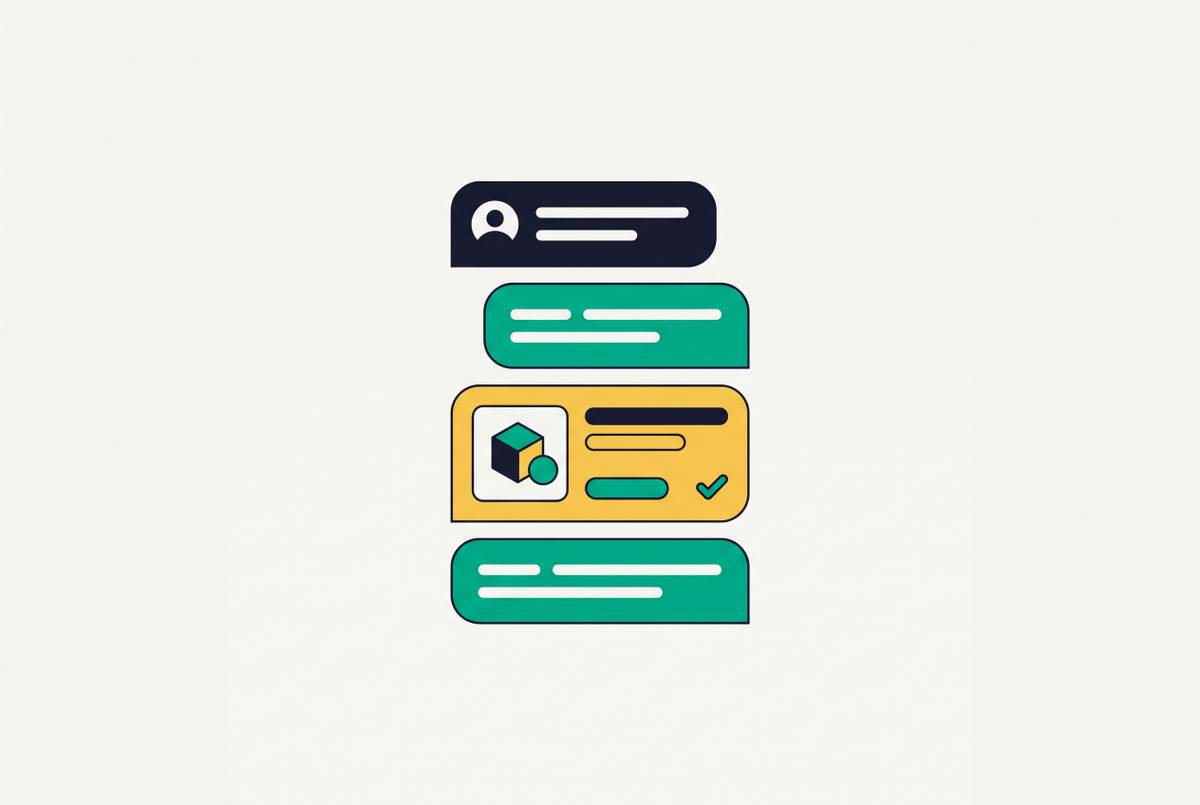
The format itself is narrow by design: a brief, labeled card appended to a completed AI response, built from a few-word title and a one-sentence value proposition. That structure forces compression, and the compression is not a stylistic choice an advertiser could opt out of. The card follows an answer the assistant has already given in full, and the ad has no role left to play as a source of additional information. It just has to point toward a relevant next step before the user moves past it.
The exact character limits for the title and the sentence are not fixed across platforms, and the live character counter inside each ad builder is the actual ceiling that governs a given campaign at a given time. What stays constant across platforms is the discipline the format imposes: a title of a few words, a value proposition of one sentence, and nothing beyond that to distribute the message across. Search ads can spread a pitch across multiple headline slots and a description line, but display ads can lean on a visual hierarchy, an image, a layout, a size. A conversational ad card has none of that scaffolding. Every word in the title and every word in the single sentence has to carry its share of the argument, because there is no second sentence waiting to pick up what the first one left out.
That discipline has a consequence for production volume that search and social campaigns do not share. Each placement is triggered by a specific conversational context, not a static keyword, so no single evergreen unit can cover every topic a campaign touches. A campaign running across dozens of context hints needs dozens of distinct creative units, each one written for a specific kind of conversation rather than a generic audience segment. The brevity the format demands is what makes that volume achievable: a one-sentence unit can be produced, reviewed, and varied at a scale that a longer, more elaborate unit could not sustain.
Why repurposing search copy fails in this environment
Treating a conversational ad card as a shrunk-down search ad produces copy that is structurally wrong for where it appears, not merely a weaker version of what would have worked elsewhere. Search copy is built for a user scanning a page of competing links, comparing options, and ready to click toward one of them. A user inside an AI conversation is in a different state entirely: mid-exchange, reasoning through a problem, having just received a synthesized answer tailored to the specific question asked. That user is exploring a problem rather than scanning a ranked list of alternatives.
Search rewards brevity, keyword mirroring, and strong imperative calls to action because those signals match how a scanning eye behaves on a results page. None of those rewards carry over to a context where the user has just finished reading a paragraph of reasoning from the assistant and encounters a labeled card beneath it. A command like "Buy now" or "Get started today" reads as an interruption rather than a continuation of the exchange the user was just having.
The mismatch runs deeper than tone. Generic copy is built to work across many keyword variants at once, so it sits uncomfortably next to an AI answer that was generated specifically for one user's exact question. Consider the gap directly: a search-style line like "Best accounting software for small business, free trial available" might pass unnoticed next to nine other ads making similar claims on a results page. It sits beneath an AI response that just walked a small-business owner through quarterly tax estimates for a two-person consulting firm, and that line shows the writer never read the conversation it's attached to. The specificity that makes the AI response useful is what exposes a vague, interchangeable pitch sitting next to it. A line built to survive anonymously among ten competitors becomes, as the only ad in the response, the one thing in the exchange that doesn't fit.
The tone register that fits a live AI conversation
Copy built for this format should read like a knowledgeable peer adding one relevant suggestion to a conversation already in progress, not like an advertisement competing for attention. The user has just read an AI response and extended some baseline trust to it. Copy written in the same register as that response can borrow from that trust; copy that sounds like a banner ad breaks the register and loses the benefit.
The goal is situational relevance rather than attention-grabbing. The user is already engaged, mid-conversation, and does not need to be interrupted or captured. What the copy needs to do is align with the problem or intent the conversation has already established. Naming the specific use case the exchange is actually about, rather than reaching for a generic benefit claim, signals that the ad belongs where it landed. A vague superlative does the opposite: it tells the user that the advertiser is guessing.
"Best accounting software for small business, free trial available" is a search-era line built to mirror a keyword. A version written for the conversation it actually sits inside might instead read: "See how two-person consulting firms handle quarterly estimates automatically." The second version names the audience and the task the conversation already established, rather than asserting a superlative no reader can verify.
Quantifying benefits concretely, a specific outcome, a named feature, a defined audience, outperforms abstract claims in this format because it mirrors the specificity users have come to expect from the AI-generated answer sitting just above the ad. Calls to action should follow the same logic. Softer, curiosity-driven phrasing, "see how," "explore," "find out," fits a user who is still reasoning toward a decision better than a hard imperative aimed at someone standing at a checkout. None of this means writing informally or dropping precision. Matching the conversational register means matching the register the exchange has already set: a technical conversation calls for precise technical language, a plain consumer question calls for plain language, and neither calls for marketing jargon.
Conversation depth and copy strategy within a campaign
Tone and intent should not stay fixed across a single campaign, because a user's commercial intent concentrates as a conversation deepens. An entry-point placement arrives early in an exchange, so it meets a user who is still exploring and learning, with diffuse commercial intent. Copy at this stage should frame a problem or name a category rather than push toward a transaction: awareness-level creative, built to educate rather than close.
A mid-thread placement meets a different user entirely, even though the surface looks the same: a labeled card beneath a response. By the time a user has asked several follow-up questions, narrowing a topic through the back-and-forth of the exchange, commercial intent has concentrated and become explicit. Copy at that stage can justify a higher bid and can afford more direct, conversion-oriented language, because the user has moved past exploring a category and is now deciding between options.
This kind of stratification has no analog in single-query search, where every placement fires off one decontextualized query with no memory of what came before it. The multi-turn structure of an AI conversation is what makes stage-aware creative both possible and necessary: a campaign can know, in a way a search campaign cannot, whether it is meeting a user at the start of a line of reasoning or near the end of one. Microsoft Copilot's approach to ad targeting illustrates where the industry is heading on this point: Copilot uses session-level context, the arc of the whole conversation rather than the last prompt alone, to decide which advertisers are relevant, introducing the result to users through a feature called "ad voice." That is a clear departure from single-query keyword matching, and it rewards advertisers who think in terms of conversation depth rather than isolated query intent. Campaign structure should therefore organize creative variants around conversation stage, awareness against decision, not keyword clusters, with each context hint matched to the stage of reasoning it is meant to catch.
Brand safety and sensitive-context exclusions as creative constraints
Platform exclusions for sensitive conversational contexts shape what copy can say and where it can appear before a single word gets written, so they work as a creative input. OpenAI's published ad policies draw a line between two distinct categories. "Contexts inappropriate for ads" cover brand-unsafe topics outright, including child safety, political content, and suicide or self-harm, among others. "Sensitive user contexts" cover a separate category: conversations involving personal, high-stakes, or emotionally vulnerable situations, including mental and personal health conversations and emotionally reliant user-model interactions, where an ad could undermine the user's trust even without touching a categorically prohibited topic.
A newer kind of signal is emerging alongside those categories: model confidence. When an AI response is generated with lower certainty or leans on probabilistic synthesis rather than a settled answer, an advertiser may choose to suppress ad placement entirely, rather than risk sitting next to a response that could turn out to be wrong. Search and social have no equivalent signal to weigh, because neither format attaches a confidence score to the content next to the ad. Building that into a copy and targeting strategy requires a kind of judgment advertisers have not had to exercise before.
The exposure is uneven across industries. Conversations touching health conditions, financial advice, or legal guidance carry the highest reputational risk precisely because they also carry the highest intent: a user asking about a medical symptom or a tax strategy is further along in a decision than a user asking a general knowledge question. Advertisers in those categories face both the greatest opportunity and the tightest constraints, so they need tighter scoping in their copy and more careful construction of their exclusion lists than a campaign running in a lower-stakes category would.
Trust at the platform level is a live concern beyond any single company's policy page: Anthropic has taken a public position against advertising inside its own assistant, a stance that signals how unsettled the question of ad adjacency still is across the industry. Formal frameworks are starting to catch up to that concern. The IAB's AI Transparency and Disclosure Framework, released in January 2026, recommends consumer-facing disclosures for AI use in advertising, backed by machine-readable metadata built on C2PA standards. Copy that already signals its sponsored status clearly, rather than trying to blend into the surrounding conversation, is better positioned as those disclosure requirements formalize across platforms. An ad that goes undetected as an ad might perform well in the short term, but that opacity is the exact risk that threatens the channel's standing over time. If copy earns attention through relevance and plain labeling, it satisfies the policy, and it protects the advertiser's position as the rules around disclosure tighten.
A different success definition for this channel's measurement
An AI assistant can research a question, compare options, and arrive at a recommendation without the user ever producing a click, and that changes what counts as success for an ad placed inside the exchange. A user might ask several follow-up questions, close the chat, and convert days later through a channel that never fires a pixel back to the conversation where the decision actually got made. The click was the moment that mattered to last-click attribution, so it structurally undercounts a channel where the moment that matters is a recommendation buried inside turn four of a six-turn conversation.
The performance event this channel runs on is whether the brand gets recommended, shortlisted, chosen, or purchased as a result of the conversational moment the ad occupied. That is a different target than the one search copy optimizes for, and it is the reason the length and tone rules described throughout this piece matter beyond stylistic polish: a short, contextually matched, trust-building unit is written to be the option an assistant names in its next turn, or the option a user carries forward into the next stage of a decision, not the option that produces the highest click volume on a results page.
Attribution for this kind of outcome is harder to build than it was for search, because targeting runs on context hints rather than fixed keywords and because the path from exposure to conversion can span multiple turns and multiple sessions. So much of the real influence happens upstream of any trackable click, so holdout tests and creative-level tagging give you a more reliable read on what a given unit of copy actually did than platform-reported last-click numbers can.
None of this is search with a different interface, and none of it is social with a different feed. The placement mechanics, the copy rules, and the measurement model are three parts of one structurally distinct channel, and treating any single part of it as a minor adaptation of legacy practice will produce copy that looks right and performs on the wrong terms. Getting the length and tone of an in-response ad right is inseparable from measuring the channel on the terms it actually runs on.
Sources
- Evaluating and Pricing Advertisements in AI-Generated Responses
- Generative AI Advertising as a Problem of Trustworthy Commercial Intervention
- Ad Insertion in LLM-Generated Responses
- Ad policies
- Advertising in AI Chatbots: Early Observations and Considerations for Responsible Implementation - The NAI: Network Advertising Initiative