Incrementality Testing Design for AI Ad Budgets
How to design incrementality tests that actually work for AI ad budgets.
Incrementality testing asks one question: did the ad spend create new results, or just take credit for demand that already existed? That distinction matters more now than it did two years ago, and it matters most inside conversational AI environments, where the unit of exposure isn't a page impression or a keyword auction but a prompt-matched conversation embedded inside a private exchange. Attribution assigns credit across touchpoints after the fact; incrementality isolates causal lift by comparing an exposed group against one held back. Getting the test design wrong on AI ad surfaces doesn't just produce a bad number. It tells finance teams to fund a channel that never earned the credit it's claiming.
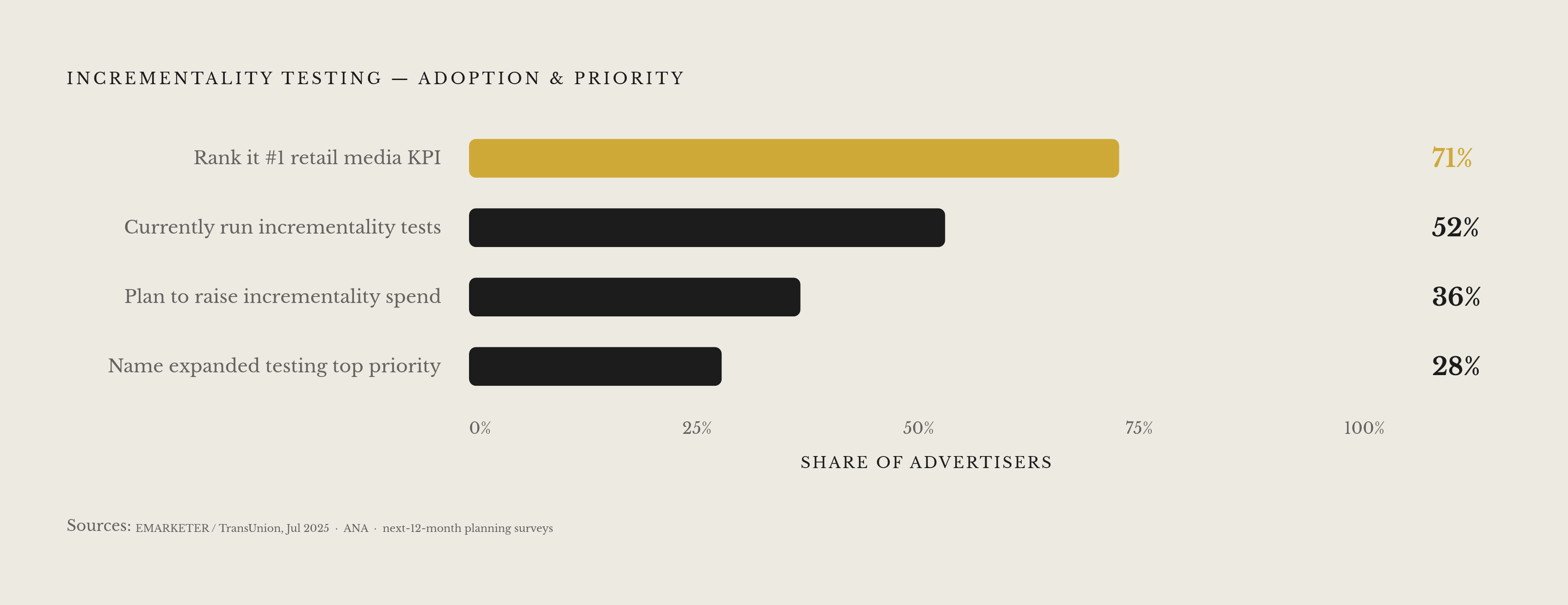
Adoption of incrementality testing has moved from a niche discipline into the mainstream. A July 2025 survey from EMARKETER and TransUnion found 52% of US brand and agency marketers now run incrementality tests and experiments. Two forces are pushing that number higher: privacy restrictions have degraded user-level tracking to the point where old attribution models can't be trusted at face value, and finance teams have grown less willing to accept a hypothetical credit line as proof that a channel worked. The ANA found 71% of advertisers now rank incrementality as their most important retail media KPI, which says something beyond measurement teams caring about rigor. It means accountability has moved up into budget conversations. The same EMARKETER and TransUnion survey found 27.6% of marketers naming expanded incrementality testing a top measurement priority, and 36.2% planning to raise incrementality spending over the next 12 months.
One survey of marketing leaders found 70.4% confident their budgets were deployed effectively, while 41.6% admitted a portion of that same investment wasn't delivering full value, citing measurement limitations as the primary reason. Confidence and competence are not the same thing. A market where most leaders feel good about spend while nearly half also admit they can't fully measure it is exactly the market where untested AI ad budgets get misallocated, quietly, for a long time before anyone notices.
Why standard test design assumptions hold for search and social
The basic architecture behind incrementality testing hasn't changed in years: split an audience or a market into a treatment group that sees the ad and a control group that doesn't, then measure the gap in outcomes between them. That gap is the lift. Three methods dominate how this gets built in practice.
Randomized user-level holdouts withhold ads from a subset of the target audience at random. This works well on addressable, high-volume digital channels, search and social chief among them, because the platform can control who sees an ad and who doesn't down to the individual. Geo-split experiments take a different approach: designate whole regions as test and control markets, then measure market-level revenue rather than tracking individuals. This method has become something close to the 2026 gold standard, mainly because it doesn't depend on cookies or get disrupted by iOS privacy changes. Synthetic control groups use statistical modeling to build a virtual counterfactual, a stand-in for what would have happened without the ad, and they fit cookieless environments where randomized allocation isn't practical.
All three share the same underlying assumptions, and those assumptions are about to stop holding. Exposure is discrete and measurable, with a keyword auction firing a search ad, a page load firing a display impression, and a spot in a social feed firing a post. Conversion timing is roughly predictable from historical data on that channel. And holdout groups can be built without much contamination, because exposure doesn't hinge on the content of a private, ephemeral exchange between a person and a system.
Even where these assumptions hold cleanly, the gap between what a channel reports and what it actually caused can be large. Peer-reviewed research by Gordon, Zettelmeyer, Bhargava, and Chapsky, running fifteen Facebook advertising experiments, found that observational attribution methods often overstate ad effect substantially, with roughly half the studies showing estimates off by a factor of three. Checkout conversions were the worst offenders. That's the baseline distortion in a channel built for measurement. None of the assumptions above map cleanly onto a conversational AI surface, and the reasons aren't a calibration problem that better math will fix. They're structural.
Structural differences between conversational AI ad delivery and the channels incrementality was built for
ChatGPT advertising went live on February 9, 2026, for US users on the Free and ChatGPT Go tiers: sponsored content shown alongside AI-generated responses, labeled and visually set apart from the answer itself. The scale involved isn't a rounding error. ChatGPT counts 800 million weekly active users, and Google's Gemini has reached 650 million monthly users, mainstream reach rather than an experimental sideline. This is mainstream reach, not an experimental sideline.
The placement mechanics work differently from anything search or social built. Ads appear at the end of a response, tagged "Sponsored," matched by topic relevance through a second-price auction. It's a conversation-context match, drawing on the live topic of the exchange, past chat history, and prior ad interactions as targeting signals, rather than a demographic profile or a typed search string.
Privacy architecture on the platform constrains what advertisers can even see. OpenAI provides aggregated performance data only, with no access to individual conversations or prompt-level content. Account-based targeting and website-visitor retargeting were noted as unavailable, and CRM audience matching through custom audience lists was not available at launch.
Bidding structure has moved fast, and each shift changes the incentive underneath the ad. Launch pricing sat around $60 CPM, paying for impressions whether or not they drove anything incremental. OpenAI opened its Ads Manager to all US businesses on May 5, 2026, dropped the minimum spend requirement, and introduced CPC bidding starting around $3 to $5 per click. CPMs fell as low as $25, with some advertisers reaching rates near $15 through Criteo, the first ad tech partner to join the platform, in March 2026. Cost-per-action bidding began rolling out to select advertisers on May 28, 2026. Pricing now varies by category: software and finance run $8 to $18 per click, while ecommerce and retail sit closer to $3 to $5.
The CPM origin matters for incrementality specifically. A model built on paying for impressions claims credit whether or not the ad changed anything, and that structural incentive doesn't disappear just because bidding options expand. More fundamentally, the unit of exposure is a prompt-matched conversation. The ad appears inside a decision-making exchange that's already underway, not next to a page the user happened to land on. That makes the causal chain between exposure and conversion longer and more contested than in direct-response search, because the user may already be deep into a purchase decision before the sponsored content ever appears.
Inventory quality compounds the problem before a test even begins. The ANA's Q1 2026 Programmatic Transparency Benchmark put its TrueAdSpend Index, the share of impressions that are fraud-free, measurable, viewable, and free of made-for-advertising placement, at 43.3% across programmatic overall. Any incrementality read built on top of that inventory carries contamination baked in from the start.
The conversion window problem specific to AI ad environments
AI ads carry longer conversion lag than direct-response search, and the reason is structural: exposure happens earlier in the decision journey, often before the user has settled on a brand. Tests that close too early undercount conversions. A window that shuts before the category's natural buying cycle finishes will show near-zero lift, and teams reading that number at face value will conclude the channel doesn't work when it may simply not have had time to work.
Verve's analysis of conversational behavior found users typically go about six prompts deep before moving toward action, and initial prompts are frequently unbranded, category-level exploration rather than a search for a specific product. A growing share of users now start their pre-purchase digital journey inside an AI chat, and in travel specifically, 37% of queries begin in an LLM. A user exposed to a sponsored response during that early exploration phase may not convert for days or weeks. A conversion window borrowed from search, same-session or seven days, will miss that outcome entirely and report a false zero.
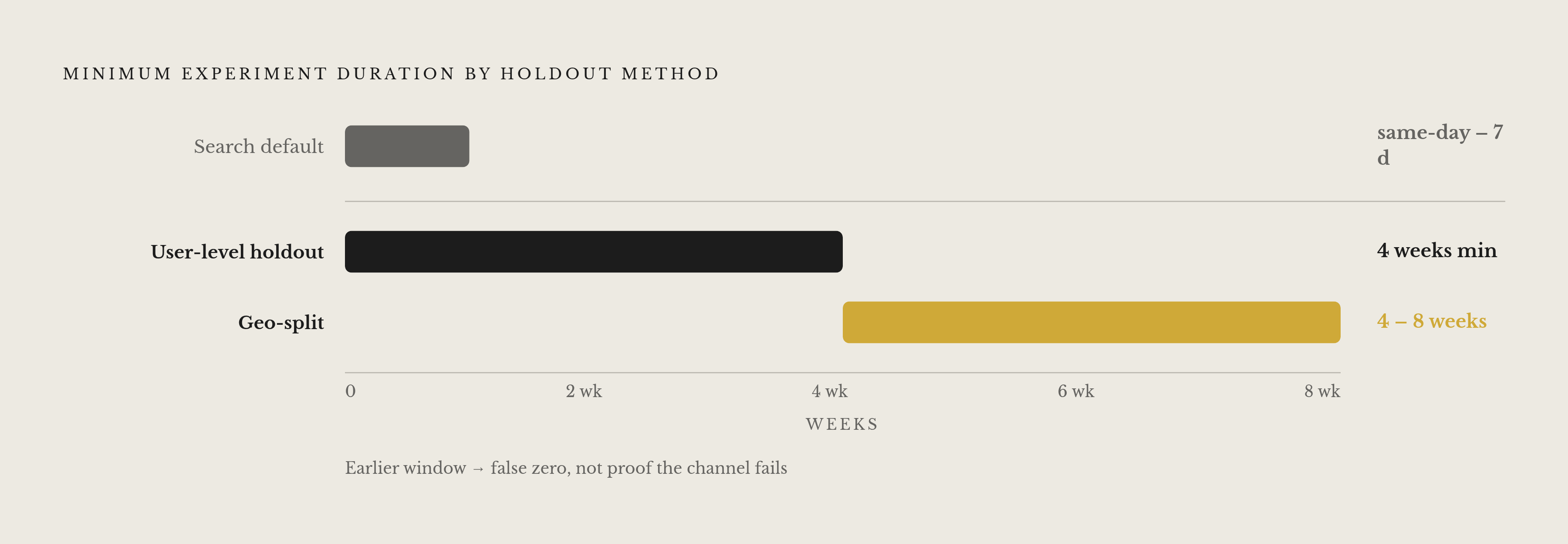
Before setting a window, teams need a baseline read on how long their category's AI-assisted purchase journey actually runs. Teams must collect exploratory data before the experiment gets designed, not after. As a floor, user-level tests require a minimum of four weeks, and geo-split experiments require a minimum of four to eight weeks, calibrated to a longer lag than search was built to handle.
The math makes the stakes concrete. Incremental ROAS equals incremental revenue divided by ad spend. If the window closes before the incremental conversions land, the revenue side of that equation reads artificially low, and a channel that's actually working gets marked as inefficient. The right window follows from the category's real conversion cycle, not from whatever default sits inside the platform dashboard, and for AI ad surfaces, that default hasn't yet been checked against real causal data.
Holdout construction in an environment where exposure cannot be fully controlled
Standard user-level holdouts assume the platform can reliably keep ads away from a designated control group. On AI surfaces, that assumption breaks down fast: OpenAI hands advertisers aggregated data only, so there's no way for an advertiser to verify, at the individual level, that the holdout actually held.
Geo-split testing sidesteps that problem by design, since it measures revenue at the market level rather than tracking individual exposure. Building one for an AI ad budget follows a familiar pattern: pick test and control regions with similar demographics and similar competitive dynamics, run the AI channel in the test markets only, hold it back in the control markets, and compare blended revenue once the full window closes.
A few tools support that design work. Meta's open-source GeoLift builds a statistical counterfactual from pre-campaign data across untreated regions. Google previewed and then launched Meridian GeoX in 2026, a publisher-agnostic geo design tool that supports holdback, go-dark, and heavy-up test structures. Cost has also dropped: Google cut the minimum budget for its incrementality experiments from roughly $100,000 down to around $5,000 by switching to Bayesian statistical models, a redesign reported to make results up to 50% more conclusive. That price drop puts geo testing within reach of advertisers who couldn't have afforded it before.
Ghost bidding offers a complementary approach in cookieless environments: an advertiser places bids intentionally designed to lose, which constructs a pseudo-control group out of users who would have seen the ad but didn't. It's useful where geo cells are hard to match cleanly.
Contamination risks on AI surfaces run deeper than on TV or out-of-home, where audiences stay put geographically. A user sitting in a control region can still reach ChatGPT through a VPN or while roaming on a mobile network, which quietly leaks exposure into the group meant to stay clean. Organic, unpaid mentions of a brand inside an AI response can reach control-region users too, and that alone can shrink the measured lift gap without any paid exposure involved. Multi-device and multi-session behavior adds another layer: the same person might get counted as exposed on one session and unexposed on another, depending on which device or account they used.
The design principle that produces this consistency requires matching the test architecture to what the channel can actually support, not to whatever method worked for the last channel tested. User-level holdouts suit controlled, addressable exposure. Geo tests fit broad delivery where regional cells can be matched cleanly. Synthetic controls step in when randomization isn't practical.
Signal availability and the aggregated reporting constraint on reading results
The platform hands advertisers aggregated performance insights, with no access to individual conversations. The platform architecture keeps individual conversations inaccessible to advertisers. That rules out cross-referencing ad exposure against CRM records at the user level, session-level path analysis, or the kind of inputs standard attribution models were built to consume.
What it makes necessary instead is the Conversions API OpenAI introduced, which lets advertisers send first-party conversion events, purchases, leads, sign-ups, back to the platform to measure what happened after someone interacted with a ChatGPT ad. That API is currently the main bridge connecting the AI surface to real downstream conversion data.
The cross-channel measurement baseline is already shaky before AI even enters the picture. Nielsen's 2025 Annual Marketing Report found only 32% of global marketers measured media spend holistically across digital and traditional channels combined. AI ad signals are landing inside a measurement environment that wasn't unified to begin with.
Given the signal limits, a few adjustments make the read more honest. Treat market-level revenue as the primary outcome rather than chasing user-level conversion events that the platform won't hand over. Read pre- and post-test revenue trends in test versus control regions as the core signal, instead of trying to reconstruct an impression-to-conversion path. And layer Marketing Mix Modeling alongside the incrementality tests rather than picking one or the other: MMM maps the full marketing ecosystem, seasonality and external factors included, while incrementality tests answer a narrower causal question about one channel. They answer different questions, and neither one substitutes for the other.
There's real appetite for tools that make sense of thin signal. An EMARKETER and Rakuten survey found 60.9% of US marketers naming generative AI insight summaries their top priority for improving next-generation MMM, a sign that demand for explanation, not just raw output, is rising exactly as the raw signal from AI ad platforms stays thin. The honest position for now: measurement infrastructure on these surfaces is still maturing, results will be directionally useful but carry wider confidence intervals than an equivalent search or social test, and that uncertainty needs to be said out loud to whoever signs off on the budget.
Structuring a test calendar that sequences AI ad experiments without contaminating the broader media mix
Running an AI incrementality test while other parts of the media mix are also shifting, new creative, a budget reallocation, a promotional push, makes it impossible to say the measured lift came from the AI channel specifically. Periods like BFCM, a product launch, a price change, or a major inventory shift answer a different question entirely and should be treated as separate test moments from a steady-state read on media efficiency.
A sensible sequence starts narrow and widens. The first test should establish baseline incremental ROAS for the AI channel on its own, during a stable, uneventful stretch of the business, before anyone makes a scaling decision based on it. The second test should look at interaction effects: does running AI ads alongside branded search inflate the measured lift on one channel while quietly cannibalizing the other? After that, ongoing holdout tests catch performance decay as the platform matures and competitive density among advertisers on it increases.
Budgeting for the test needs to be explicit, and it needs to be framed correctly to finance. A four-week test running a 20% holdout is the cost of buying causal data that lets the remaining 80% get allocated correctly for the next twelve months. It's the cost of buying causal data that lets the remaining 80% get allocated correctly for the next twelve months. Minimum viable configuration stays consistent with what's already been laid out: four weeks at least for user-level tests, four to eight weeks for geo-split, with regions picked for demographic and competitive similarity before the test starts, never adjusted after the fact to fit the results.
The most urgent sequencing question specific to AI budgets involves branded search. A user who sees a ChatGPT ad and later converts through a branded search query gets credited entirely to search under standard attribution, and the AI channel gets nothing, despite having potentially started the whole decision. Only a concurrent holdout run across both channels at once can separate what each one actually caused.