Measuring Brand Lift in Conversational AI Campaigns
Brand lift measures one thing: the change in awareness, ad recall, favorability, consideration, or purchase intent that a campaign actually caused, not just what happened to move alongside it. An audience is split into an exposed group and a control group, both are asked the same questions, and the gap between them is the causal signal. Clicks and conversion rate only tell part of the story, since a brand's real effect is visible higher in the funnel, in the shift toward a name a buyer now trusts rather than one they clicked once and forgot. Conversational AI, ChatGPT ads chief among them, breaks enough of the old measurement toolkit that treating it like just another feed is the wrong call, and this piece lays out exactly which pieces survive the transition and which ones don't.
Three methods have carried brand lift work for years, and none of them is interchangeable with the others. Randomized controlled trials are the cleanest version: individual users get split, some see the ad, some don't, and the gap in survey response or behavior is about as close to a lab result as marketing gets. Geo-holdout tests trade precision for practicality, holding out entire markets when splitting individual users isn't possible. Survey panels, exposed versus unexposed respondents answering the same brand questions, are the method most people have actually encountered, even without knowing the term, and that last one is the backbone of the tools most advertisers already use.
Platform-native lift tools and their spend floors
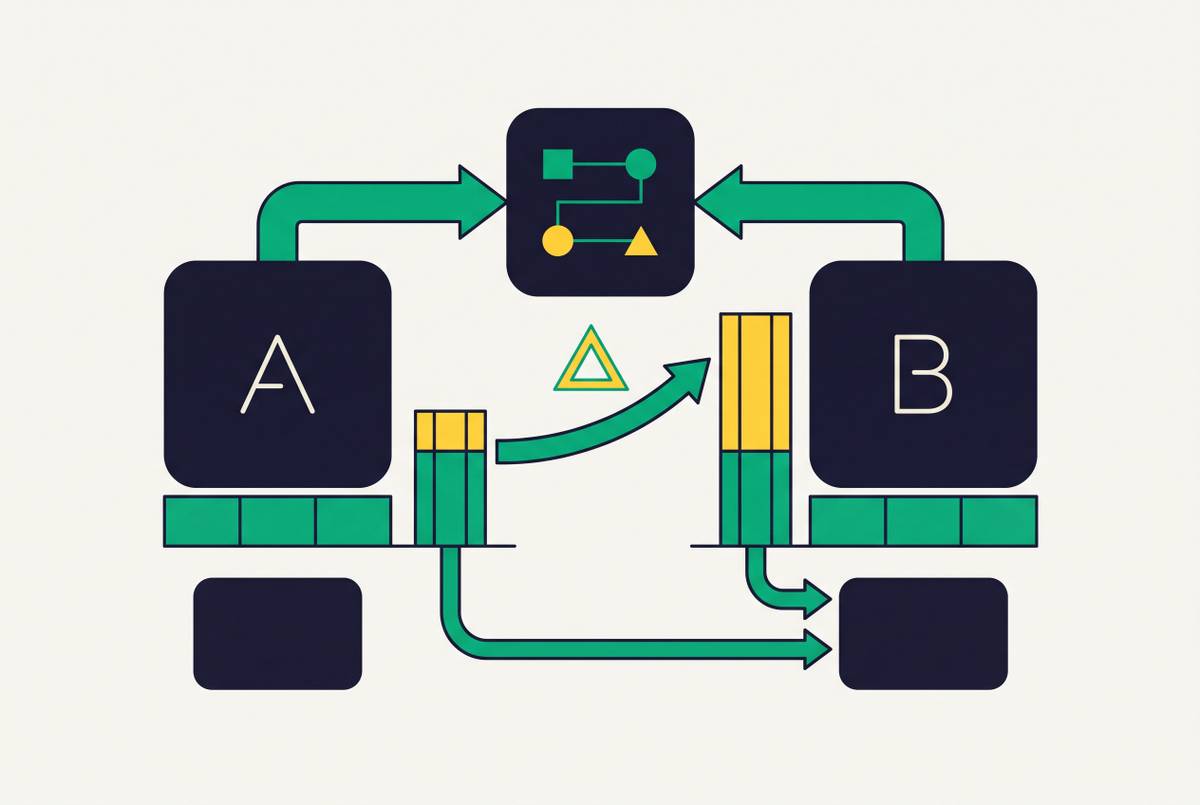
Meta's Brand Lift Study is the reference point most media buyers already know, and it runs roughly on the RCT model. The platform splits an audience into test and control automatically, serves in-feed survey polls to both sides, and reports lift in awareness, ad recall, favorability, consideration, and purchase intent. Going into 2026, Meta has layered AI-driven audience segmentation and dynamic sampling on top, aimed at cleaner responses and faster turnaround.
Most new advertisers underestimate the price of entry. Platform-native studies, Meta's or Google's, generally require a minimum ad spend somewhere in the $5,000 to $10,000-plus range before the platform will even stand up a study, and agency-led custom lift work tends to start closer to $10,000 on its own. For anyone testing a new channel on a modest budget, that's a real gate: the study itself can cost as much as the media it's measuring, which is backwards for a brand trying to figure out whether the channel is worth the spend.
These tools assume a persistent user identity the platform can track from exposure through to survey response, a discrete ad unit the system knows was actually served, and a panel that splits cleanly into two comparable groups. Geo-holdout testing asks less of the data. It needs a sufficient number of markets, a calibration period before the test starts, and markets matched on population size, past conversion behavior, and seasonality, but it never needs to track a single person. That's the one piece of the old toolkit built to survive what comes next.
What makes conversational AI a structurally different ad environment for measurement
Conversational AI breaks the first assumption. Conversations are private by design: advertisers never see a user's chat history, and matching happens on the platform's side using aggregated signals rather than anything the advertiser can inspect. There's no exposure log to audit. A marketer running a campaign here has to take the platform's word for who saw what, because no independent record exists to check it against, and that's a materially different trust position than anything Meta or Google ever asked of a media buyer.
There's also no query-level intent signal in the way search marketers are used to. Search advertising runs on keywords, bought and measured against a specific term a user typed. Conversational ads match to the topic of an ongoing conversation instead, richer in context but opaque to the buyer footing the bill. And there's no published benchmark to lean on: No published benchmarks exist across advertisers, industries, or campaign types for this channel. A brand running its first lift study here has no external number to check its result against, strong or weak.
Attribution problems compound all of it. Users tend to go something like six prompts deep into a conversation before they leave for the open web to actually buy something, and the conversion, when it happens, lands as branded search or direct traffic on a different channel. Standard attribution, built to credit the last click or the last touch, misses the channel that started the whole thing. That's not a rounding error. A campaign that looks like it did nothing may have quietly driven the branded search spike nobody thought to connect back to it.
What transfers from legacy brand lift methodology without fundamental change
The experimental logic doesn't need reinventing, and anyone tempted to throw out the whole playbook because the channel is new is making a mistake. Exposed versus control, a defined measurement window, a statistical confidence threshold before calling a result real: none of that is specific to feeds or search or chat. It's a design pattern, and design patterns travel.
Geo-holdout testing is the most portable piece of the old toolkit precisely because it never depended on tracking individual users. It works the same way in conversational AI as anywhere else: hold out markets, not people, and the same baseline requirement applies, sufficient historical data before the test starts, so the comparison actually means something.
Survey methodology holds up too, in principle. Asking exposed and unexposed groups about awareness or ad recall is a question format, not a platform feature, so nothing about conversational AI makes the questions themselves obsolete. The hard part is building the two groups when the advertiser can't directly see who was exposed, and that's a construction problem, not a methodology problem, that should be kept separate in anyone's head.
Even the math survives intact. Lift as a percentage over a control baseline is a calculation, not a channel-specific artifact, and the rough heuristic that a result needs to clear something like 20% above control to count as meaningful incrementality is as reasonable a starting point in AI chat as anywhere else. Treat it as a starting point rather than a verdict, but don't throw it out just because the environment changed.
The specific failure modes that break and require new design
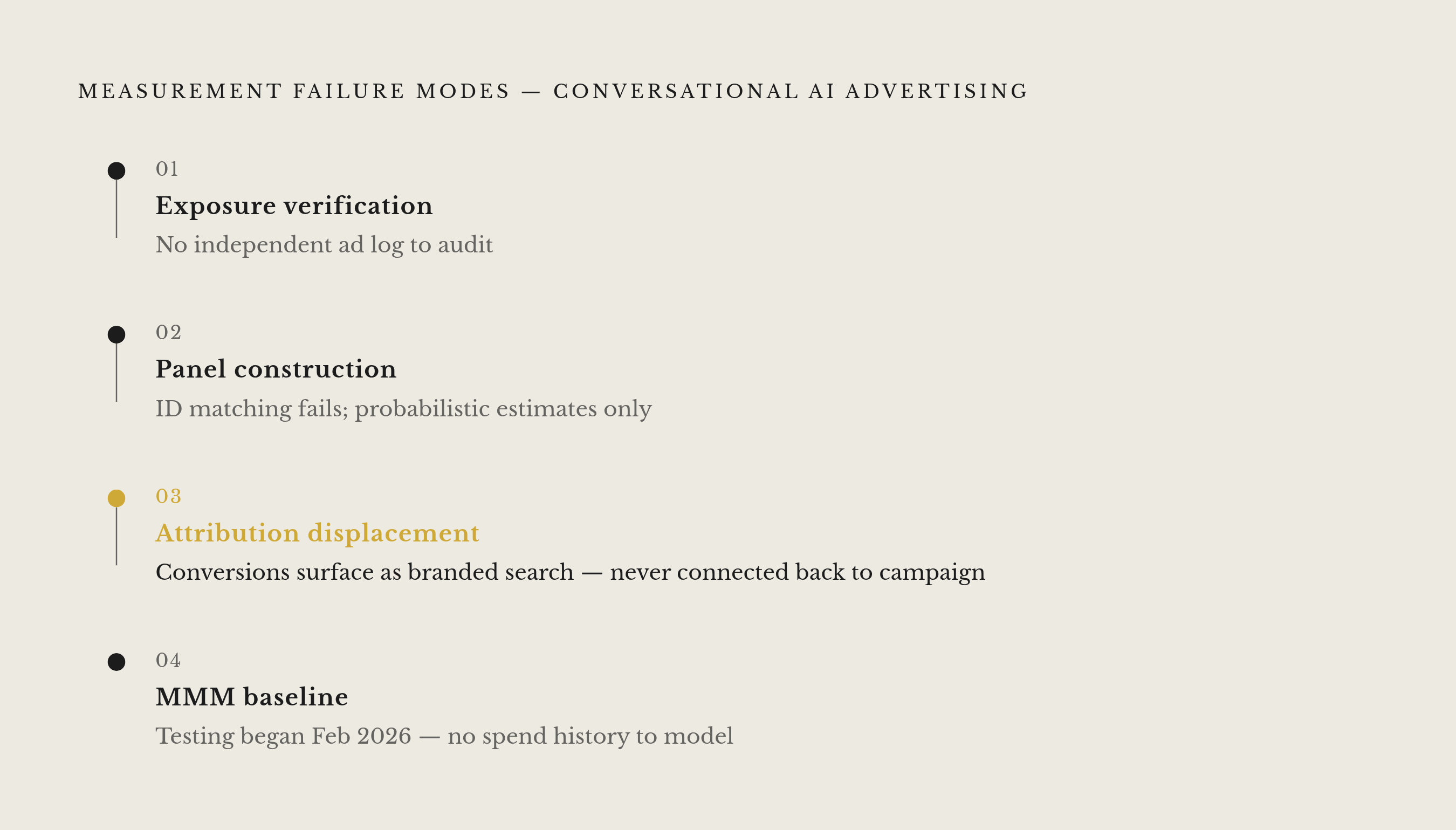
Four things break, and each breaks in a specific, nameable way, not some vague sense that "things are different now."
Exposure verification goes first. Without an independent log of who saw an ad, any holdout design depends entirely on what the platform reports, and in year one there's no way for an outside party to audit that. The advertiser is trusting the platform's math, full stop, with no second set of books to check it against.
Panel construction goes second. Legacy Brand Lift Study tools identify exposed users by matching platform IDs, a mechanism that assumes the ID is visible to whoever's running the study. In an environment built around conversation privacy, that ID match may simply not exist for a third-party measurement vendor, which forces panels to get built from self-reported answers or probabilistic estimates instead of a clean match.
Attribution displacement is the third, and it's arguably the costliest of the four. A chat session may never carry a trackable click all the way to conversion, so the lift a campaign actually generated ends up landing in branded search or direct traffic, somewhere the study never looked. A brand lift study that only watches behavior inside the AI surface itself will undercount its own effect, systematically, every single time it runs.
The fourth failure is that marketing mix modeling has no baseline to draw on. MMM needs history, and ChatGPT ads, having begun testing in February 2026, simply don't have meaningful spend history to model yet. That leaves controlled experiments as the only source of causal evidence available in year one. Not a nice-to-have alongside modeling. The whole toolkit.
New measurement primitives the channel demands
Four new primitives follow directly from those four failures, and skipping any one of them means shipping a study with a blind spot built in.
Incrementality testing has to be the primary instrument, not one line item in a bigger plan. With no spend history to model, controlled experiments are the only causal read available, so they belong at the foundation of the measurement design, not bolted on after the fact.
Total business lift has to be the unit of measurement, not tracked clicks off the AI surface. Assistant-mediated conversions surface downstream as branded search and direct sessions, so a study has to read revenue, branded search volume, and direct traffic in aggregate. Narrowing the lens to on-platform activity guarantees an undercount, and any brand that reports only on-surface numbers is reporting a number it already knows is wrong.
Conversation-depth signals are worth tracking as a proxy for intent. Session depth and topic persistence, the fact that a user is six prompts into a conversation rather than one, correlate with downstream conversion the way dwell time or scroll depth once did on other surfaces. Categories differ sharply here: something like flights or electronics might convert within 48 hours, while other categories take up to two weeks, so a measurement window calibrated to the category beats a single default window applied across the board. Bidding tools built around this logic are reportedly in development, aimed at multi-turn dialogues that lead to conversions rather than single impressions. Measurement design should get there first, not wait on the bidding product to arrive and then scramble to catch up.
Semantic intent clustering should replace keyword-match monitoring. A user can carry on a long, high-intent conversation about a product category without ever typing the category's name, so defining an exposed cohort by keyword misses exactly the people the campaign reached. Defining cohorts by conversational topic cluster instead maps to what's actually happening in the conversation, rather than to a proxy that made sense in search and doesn't here.
Running a credible brand lift test on an AI chat campaign right now
Start with a baseline, before a single dollar goes toward media. That means a meaningful baseline period of historical branded search volume, direct traffic, and category purchase data before any media runs. Skip this step and any lift number the test produces later is unreadable, because there's nothing to compare it against.
From there, instrument every downstream channel the campaign might touch, not just the AI surface itself. That means dedicated landing paths or UTM structures for AI-originated traffic wherever the platform permits it, branded search volume tracked as a downstream signal, and direct session volume watched in parallel. Conversational AI behaves something like dark social: real influence, hard to trace back to its source, and a measurement plan that ignores that is measuring the wrong thing on purpose.
Design a geo-holdout or matched-market experiment next. Since individual-level exposure can't be independently verified, geography is the more defensible unit to split on. That means five to eight markets at minimum, matched beforehand on relevant baseline characteristics, run to a 90 to 95% statistical confidence threshold. Duration should track the category's purchase cycle rather than a fixed calendar length: longer for a considered purchase, shorter for something fast-moving like flight bookings.
Run a brand perception survey panel alongside the incrementality test, not instead of it. Ask both exposed and unexposed cohorts the standard upper-funnel questions: awareness, ad recall, favorability, consideration, purchase intent. Ask some respondents whether they even noticed the content was sponsored, then compare the disclosed and undisclosed groups on trust and favorability. With research indicating a detection rate around 35% for embedded or personalized ads, that's a live variable in how people actually experience these ads, not a footnote to mention once and move past.
What the benchmark vacuum means for brands
No published benchmarks exist across advertisers, industries, or campaign types for this channel, and waiting for one to show up is not a strategy. It means there's no external number a brand can hold its result up against and say, with any confidence, that a given lift is strong or weak for the category. Anyone hoping an industry report solves this in the next quarter is going to be disappointed.
The norm has to get built internally, campaign over campaign, rather than sourced from outside. A brand's own second test becomes the benchmark for its third, and its fifth becomes the benchmark for the sixth, with the historical baseline gathered at the start of any credible test doubling as the foundation for that internal norm going forward. That's a slower path than pulling a published number off an industry report, and it demands the discipline to run controlled experiments consistently rather than treating measurement as a one-off exercise. It's also the only path available while the channel is this new, and brands that treat that as a permanent excuse to skip measurement altogether will be the ones with no idea what their spend is actually doing a year from now.