Third-Party Measurement Integration for AI Placements
Measurement vendors must rebuild their systems from scratch to verify ads in conversational AI.

Conversational AI advertising breaks the assumptions that legacy measurement vendors built their entire businesses on. There's no page, no URL, no DOM, no referrer chain to hang a pixel on, and that gap between how measurement companies verify ad delivery and how AI platforms actually serve ads is now a live operational problem for anyone buying this inventory. Fixing it takes deliberate re-architecture. A plugin or a tag copied over from display won't do the job, and vendors still pitching that approach are selling something that doesn't work here.
The scale of inventory that now needs measurement infrastructure
ChatGPT ads hit a $1 billion annualized revenue run rate in under 200 days, with tens of thousands of advertisers now buying across more than 40 countries. Measurement infrastructure has not caught up to that pace, and the gap is widening.
Google AI Mode now shows ads in 25.5% of AI results, up from 5.17% in early 2025. That's inventory footprint expanding faster than most measurement vendor roadmaps were built to handle. The surfaces themselves diverge technically, too: Google AI Mode, ChatGPT's sponsored cards, and Microsoft Copilot placements each run on different architectures, so a tag strategy built for one won't port cleanly to the next. Anyone assuming otherwise is building on a false premise.
Surface attrition belongs in this picture as well. Perplexity pulled out of advertising on February 18, 2026, citing user trust concerns. Any measurement framework built for this category has to assume surfaces will enter and exit the market, not just grow, and a framework that only plans for growth is already out of date.
The conversational context signal and why it cannot be read by a page-level tag
A typical Google search query is far shorter than a ChatGPT prompt, which tends to carry substantially more context. That's a richer signal by a wide margin, but it's also structurally incompatible with keyword-based measurement logic built for search, and treating the two as interchangeable is where most measurement plans go wrong first.
Contextual targeting inside LLM environments works off semantic classification of the live conversation: what phase of the decision journey the user is in, what topic cluster the exchange falls into, how dense the intent signals are running. Advertisers feed the system short context hints describing the kind of conversational scene they want to appear in, and a model matches those hints against prompts carrying similar meaning. A measurement system that only sees the impression event, without visibility into the conversation around it, never sees this matching happen. It sees that something got served. Nothing more.
OpenAI's platform uses cookies and shares identifiers with marketing partners, but ad matching runs on in-session conversational context rather than cross-site behavioral profiles, and personalization stays limited to inference drawn from that session's own history. The standard audience-verification integration, built to check a behavioral profile against a targeting claim, has nothing to check here. There's no profile to verify.
A third-party tag stapled to an impression event confirms the impression happened. That's all it confirms. It says nothing about the intent state of the conversation at the moment it fired, and attribution models that weight impressions by intent can't reconstruct that weighting without a separate feed from the platform itself, because the signal never reaches the tag. This is what makes AI placement measurement genuinely different from search, where the keyword stands in for intent, and from display, where the page category stands in for it. Neither proxy exists here in its usual form, and building a measurement stack on the assumption that one does is the single most common mistake in this category right now.
What a server-to-server integration for AI placements requires
Server-to-server integration is the floor in this environment, not an upgrade path someone gets to later. Page-level tags don't work here at all, so there's no fallback to lean on while the S2S build gets finished.
A working S2S setup needs a publisher-side event fired at the moment of impression, a secure handoff of that event's metadata to the measurement vendor's endpoint, and a conversion signal returned on the advertiser's side that can be matched without a shared cookie. None of that is exotic engineering. But all three pieces have to work inside a tight latency budget: the full ad-serve cycle across the LLM ad stack needs to stay under roughly 250ms at the 95th percentile, so instrumentation that adds meaningfully to that number either blows a publisher's acceptance criteria or visibly slows the chat down.
The metadata payload should carry a timestamp, a placement surface identifier, the ad unit type (inline card, sidebar unit, follow-up chip, response-grounded mention), a pseudonymized session token, and campaign identifiers. It should not carry the conversation content itself, which stays server-side. That's the architectural choice keeping LLM contextual targeting privacy-compliant, and by extension, commercially viable.
IAS received MRC accreditation for server-to-server integration covering impression, viewability, and invalid traffic on Amazon DSP on November 13, 2025, the first independent verification provider to reach that milestone on the platform. The technical pattern can transfer to AI surfaces, but each platform still needs its own certification process run from scratch, and nobody should assume otherwise just because the Amazon precedent exists. For anyone building toward that now, the checklist is short: confirm the AI platform actually supports S2S event emission, map the metadata fields the vendor needs against what the platform will expose, and pressure-test the combined latency against the publisher's own service-level agreement before committing to anything.
Brand safety and invalid traffic verification inside a conversational interface
URL blocklists don't work here, because there's no fixed page to block. The response is generated fresh in reaction to a single prompt. It didn't exist a second before the user typed it, and it won't exist in that exact form again.
Brand safety integration has to shift its target. Instead of classifying content, it classifies the placement surface itself, confirms that excluded-category rules get enforced server-side, and audits whether disclosure requirements (the label, the visual separation from the organic answer) show up the way the platform claims they will. Platform-level exclusions carry more weight here than in display. ChatGPT's 2026 exclusion list bans political advertising outright, with health and financial services subject to platform-level restrictions as well. A brand safety integration's job is confirming those exclusions get applied, not trying to re-classify individual AI responses on the fly, which nobody can do fast enough to matter anyway.
Invalid traffic detection needs a rebuild too. A bot simulating a conversational session leaves a different signature than one clicking a display ad. Session length, timing between prompt and response, depth of engagement: these become the signals that replace click-fraud detection. The concern isn't theoretical. Basis's programmatic trends analysis found that 54% of advertisers say generative AI has already contributed to declining media quality across the programmatic supply chain. That figure covers AI-adjacent inventory broadly, but it turns IVT verification into a real operational requirement rather than a line item on a vendor scorecard.
No measurement vendor had reached universal MRC certification for brand safety verification inside pure LLM chat surfaces as of this writing. Anyone reporting on these placements should say so directly, and note what is and isn't independently verified, instead of letting a display-era certification imply coverage it doesn't have.
Attribution in a session where a single prompt can compress the entire purchase funnel
Users move through multiple prompts before leaving the AI session for the open internet to actually convert. That makes the AI session an upstream event, not a last-click event, and the conversion itself happens somewhere the platform simply can't see.
House of Communication's analysis found that a single AI prompt can cover the entire customer journey, with 40% fewer touchpoints than a comparable legacy digital path. Multi-touch attribution models built around longer sequences will structurally undervalue, or just misplace, the credit an AI placement deserves, because the model expects a chain of interactions that the AI session has already compressed into one exchange. That compression is the whole problem, and no amount of tuning the existing model fixes it.
Conversion timing varies sharply by category, and attribution windows need to flex accordingly instead of sitting at whatever default the platform ships with. Conversion timing varies by category, with some verticals resolving quickly after the AI interaction and others extending over a longer window.
Connecting a pseudonymized AI session event to an on-site conversion requires a probabilistic match or a clean-room join, since the user converts on the brand's own site, not inside the chat interface. There's no deterministic pixel doing that work, and pretending there is invites exactly the kind of error Improvado's analytics trends analysis documented: 18% of enterprises rolled back unified measurement initiatives after discovering attribution inflation exceeding 40%. Over-crediting a channel is a documented failure, not a hypothetical one, and AI placements are especially exposed to it because they tend to show up early in the funnel, right where over-crediting happens most.
The mitigation that actually holds up is running incremental lift studies alongside whatever attribution model is in place. Lift isolates the causal effect of the placement on conversion probability without needing a clean cross-surface match to work. Improvado also found multi-touch attribution converging with marketing mix modeling at 27% enterprise adoption in 2026, and that MMM layer earns its keep here precisely because individual-level attribution runs into a wall that MMM doesn't.
How self-service third-party measurement infrastructure is evolving on established platforms for AI surfaces
Amazon Ads launched a self-service workflow for third-party measurement studies inside Amazon DSP on May 15, 2026, covering more than 50 vendor measurement products across 18 countries. It shows what a mature version of this infrastructure looks like, and it's a useful yardstick for how far AI platforms still have to go.
The workflow covers brand lift, offline sales lift, and omnichannel metrics, all accessible from a dedicated Studies page inside the DSP, no managed-service team required in the middle. The vendor catalogue names specific products: NCS Offline Sales Lift Full, DISQO Brand Lift, Kantar Brand Lift Full Report, each running a distinct methodology, from offline CPG measurement to panel-based brand perception work. Advertisers choose between "Managed within Amazon DSP," where configuration, billing, and results stay inside the platform, or "Managed with Vendor," for advertisers with existing vendor contracts who need measurement spanning platforms. That second path is the relevant model for anyone measuring AI placements, since most campaigns now run across ChatGPT, Google AI Mode, and other surfaces simultaneously.
The lesson here is that Amazon's workflow only works because there's a standardized S2S impression event, a defined metadata schema, and a certified vendor layer sitting on top of both. It's that Amazon's workflow only works because there's a standardized S2S impression event, a defined metadata schema, and a certified vendor layer sitting on top of both. AI platforms are at the start of that standardization, nowhere close to the end. A stable vendor catalogue, MRC-certified integrations built for the specific surface type, a self-service workflow that doesn't require a bespoke build: Amazon DSP already has all three. Anyone buying AI placements in 2026 is mostly configuring one-off integrations rather than picking from a menu. IAS's MRC accreditation for S2S measurement on Amazon DSP, granted November 13, 2025, proves independent verification is achievable in a non-page-based programmatic environment. That's the precedent AI platforms need to be pushed toward matching, and pressure from buyers is what gets them there faster than waiting ever will.
Building a workable framework now for the cross-surface measurement problem
No measurement vendor currently offers one integration certified across every major AI surface. Anyone who wants a cross-surface view has to build it. Nobody is selling it off a shelf yet.
The stakes of getting this wrong are concrete. Blended CPCs across AI surfaces range from $1.10 on Microsoft AI Max up to $12 on Perplexity Sponsored Answers, and without a shared measurement layer sitting across those surfaces, deciding how to split spend between them is a guess dressed up as a media plan.
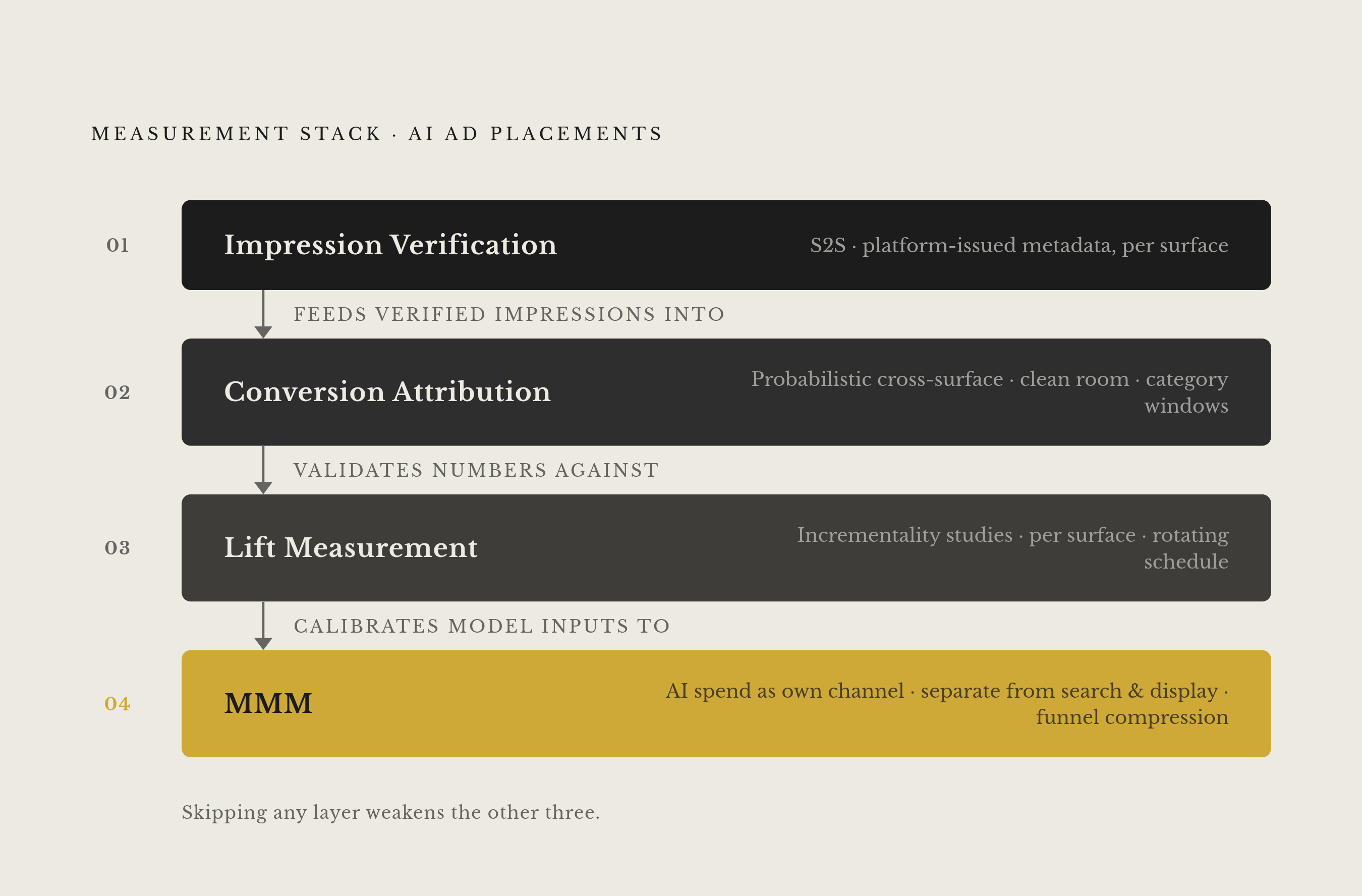
A workable framework runs in four layers, and skipping any one of them weakens the other three. Impression verification comes first: S2S integration built per surface, using whatever impression metadata that platform issues, without forcing a single tag to cover all of them. Conversion attribution comes second, using probabilistic cross-surface matching through a clean room or data collaboration environment, with attribution windows set by category rather than platform default. Lift measurement comes third, with incrementality studies run per surface on a rotating schedule to check honestly whether the impression data and the probabilistic attribution are producing trustworthy numbers. MMM is fourth, and AI placement spend belongs in the mix model as its own channel category, not folded into search or display as a sub-line, because the funnel-compression dynamic changes how it behaves at the aggregate level.
A few decisions need to get made before any of this gets built: which surfaces get measured on their own versus pooled together, what pseudonymized session token standard governs cross-surface matching, and which existing vendor relationships get extended into AI surfaces versus rebuilt from zero. A DSP that already operates across multiple AI surfaces and holds direct supply relationships with AI publishers sits in a better position to expose the metadata this framework needs. A generalist DSP buying AI inventory through intermediaries hands a measurement vendor fewer usable fields, simply because the conversational context never makes it back to the buy side.
The gaps that remain open and how to report around them honestly
Improvado's analytics trends analysis found that only 32% of digital marketing leaders now rank GEO as their top priority for the year. AI placements are landing inside a measurement environment that was already strained before this inventory existed. Adding a structurally new surface on top of that strain means the baseline has to be acknowledged, not glossed over in a footnote.
Two gaps deserve naming explicitly in any measurement documentation. Conversational content classification sits at the center: the intent signal that makes AI placements valuable for targeting in the first place isn't available to third-party measurement vendors, and that's a deliberate privacy architecture choice, not a bug waiting on an engineering fix. Universal IVT certification is the second: no independent provider had reached MRC certification for invalid traffic detection inside pure LLM chat surfaces as of this writing, and existing display IVT certifications shouldn't get treated as transferable just because the acronym matches.
Reporting on this category with any credibility means stating both gaps clearly, every time, rather than letting a vendor's existing display credentials imply a coverage they don't actually have here.