Contextual Targeting Parameters in Conversational DSPs
Conversational ads target based on dialogue flow and intent signals invisible to legacy systems.

Contextual targeting in a conversational DSP works from a different unit of analysis than anything programmatic buyers have used before: the conversation thread, not the page. Legacy contextual targeting reads static content that already exists on a page, its keywords, its headline, its metadata, its topic classification, and applies those signals once, before the impression ever serves. A conversational AI surface has no equivalent fixed artifact to classify, because the content a user is engaging with is produced turn by turn, in response to what they just said and what the model just answered. What counts as relevant is no longer a matter of where an impression sits on a page but the full arc of an exchange: what was asked three turns back, how the model responded, and where the conversation appears to be heading.
Adventure Media's 2026 analysis gives this phenomenon a name: discourse coherence. The transformer models that power a conversational assistant already hold a working picture of the whole dialogue so they can produce a coherent next response, and the ad-targeting layer draws on that same picture instead of building a second, separate model of the content. A question like "What about vegetarian options?" has no keyword to match against. It only makes sense in relation to whatever came before it, a restaurant recommendation, a meal-planning thread, a trip itinerary, and a targeting system has to read that thread to understand what the question even means.
This also explains why audience segments, built from historical browsing and purchase behavior, fall short in this environment. A conversation that opens as a restaurant recommendation can shift into trip planning, then into budget constraints, then into transportation logistics, and each phase presents a genuinely distinct targeting context. A static page-level system was never built to capture that kind of movement, and a behavioral segment, however well constructed, is still looking backward at what a user has done rather than at the conversational state unfolding in front of the model right now. Conversational targeting asks a different question than keyword or segment targeting ever did: not who is this person, based on where they've been, but what is actually happening in this exchange, right now.
The actual parameters: what a conversational DSP reads
Writing a targeting input for a conversational DSP is a different discipline from writing keyword lists, and advertisers who treat it as the same task tend to get weak matching for it. The core input many of these systems rely on is a short, natural-language description of the conversations where an ad belongs, and teams that approach that field as a comma-separated list of topics see consistently worse performance than teams that write it as a narrative: what is the person in this conversation trying to accomplish, and is the offer actually useful to them at this moment. That's a problem statement, not a search term, and the auction evaluates it alongside the ad's title, its copy, and its landing page as a single package, so that a smaller-budget advertiser running a tightly relevant ad can out-compete a larger-budget advertiser running a vague one, an unusual property for paid media that reflects how heavily relevance weighs against raw price in this auction.
Beyond that written input, a conversational DSP evaluates several other kinds of signal. One is semantic progression across turns, the trajectory of a dialogue rather than only its most recent query, including which follow-up questions a user asked once the model had already responded. Another is conversational phase: an opening query tends to establish broad intent, a mid-thread exchange narrows and qualifies that intent, and late turns often carry the clearest signals that someone is close to a decision. A third is sentiment and intent-stage register, whether the exchange reads as informational, evaluative, or transactional. None of these has a keyword equivalent, because none of them describes a static piece of content. They describe movement through a conversation, and a system that only reads a single query in isolation has no way to see that movement.
One structural consequence follows directly from how these parameters work: because relevance is derived from the conversation happening right now rather than from a stored history of past browsing, a conversational DSP doesn't need a persistent user identifier or any cross-site tracking to do its job. The privacy posture here is not a compliance layer added after the fact. You get it because the system reads live conversational state instead of assembling a profile from historical signals.
What prompt-level signals reveal beyond keywords and audience segments
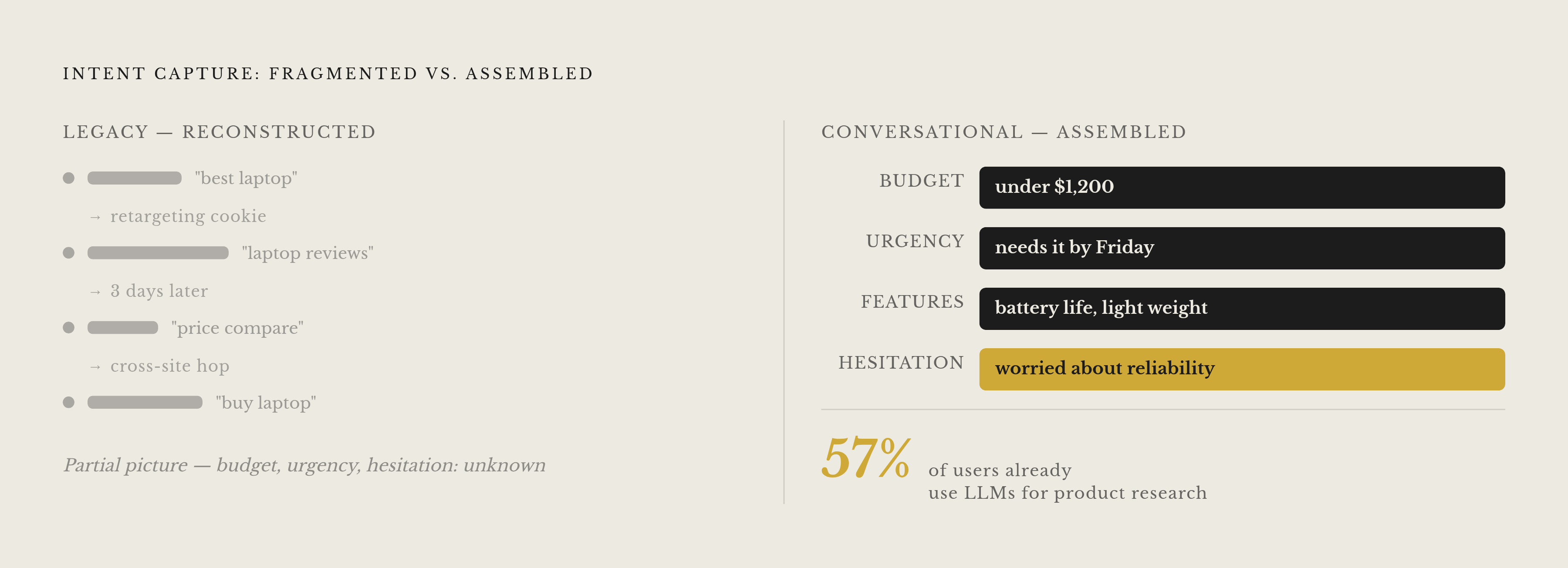
A multi-turn exchange reveals decision criteria that a user would never type into a search box. Someone researching project management software might describe, across several turns, how large their team is, what budget they're working with, which features they consider non-negotiable, and what other systems the new tool needs to integrate with, none of which would appear as a keyword anywhere in that conversation. A search query compresses intent into a handful of words chosen for a search engine, but a conversation lets intent accumulate in its own, unforced language.
A larger shift in where intent signal actually lives now is worth taking seriously on its own terms. A 2025 user behavior study found that 57% of users have used LLMs to get information about products and services. What used to play out as a string of search sessions, stitched together over days or weeks through retargeting cookies, now often happens inside one conversational thread. For any system that isn't reading that thread, this sequence of intent signals doesn't degrade or get noisier. It simply isn't visible, which is the intent signal black hole: the exact data legacy platforms were built to reconstruct from fragments is, in a conversational environment, sitting fully assembled in one place, readable only by whatever system is actually built to read conversations.
That gap carries real commercial weight for anyone still buying media as though search behavior were the dominant signal of intent. A keyword captures a moment; a conversation captures a process. Budget, urgency, feature requirements, and hesitation become visible across that process, and a targeting system that can read that process has access to a richer, more structured account of intent than keyword matching or demographic segmentation were ever capable of producing.
DSP execution of conversational context at impression level
Reading conversational context is only half the task. A DSP is the execution layer that takes contextual signals, topic relevance, semantic intent, sentiment, conversational phase, and turns them into a bid decision at each individual impression: whether to bid, how much to bid, and whether the inventory in front of it actually meets the advertiser's contextual parameters, all resolved inside a millisecond auction window.
The distinction between generalist DSPs and conversational-native buying infrastructure is load-bearing here. A generalist DSP has broad reach across surfaces, but it was built to read page-level content signals, and it has no native way to interpret a conversation thread's semantic progression or the way constraints emerge across turns; those parameters simply don't exist anywhere in its data model. A single-surface AI ad network can read conversational context deeply, but only within the one platform it operates on, so an advertiser's targeting parameters only ever apply where that network happens to have inventory. A DSP built for conversational AI surfaces, buying across multiple AI publisher environments on top of direct exchange relationships, can apply conversation-thread parameters at scale across surfaces, and that is the structural gap neither alternative fills.
The infrastructure to support this is being built out in public. In March 2026, Optable and PubMatic announced the integration of Optable's Audience Agent into PubMatic's AgenticOS, demonstrated as a live example of the Ad Context Protocol operating across real programmatic infrastructure, an industry signal that the plumbing for conversational contextual buying is being actively constructed rather than theorized about. AI Digital's overview of contextual targeting describes 2026 as the year AI itself became the planning and decisioning layer for this kind of targeting, with semantic models interpreting meaning, intent, sentiment, and format in real time to improve bidding and optimization by dynamically weighting contextual signals. Inside a conversational DSP, that means the system does not just sort a conversation into a topic bucket the way a legacy contextual engine might sort a page. It's weighting several parameters at once, simultaneously, to arrive at a fit score and a bid value for that single impression.
Commercial legibility of conversational context parameters
The strength of a conversational parameter as a targeting signal depends on how explicitly and how consistently people describe their own decision criteria inside that category. Some categories produce rich, highly specific parameters almost by default; in others, you get something closer to noise, or something too risky to act on.
Travel is near the top of the legible end. Itinerary-planning conversations tend to surface interests, group composition, budget, and timing across several turns, while accommodation-comparison threads often signal proximity to an actual booking decision, both strong signals for tour operators, activity providers, hotels, and vacation rental platforms. Finance behaves similarly in a different register: a user who opens with "I want to start investing but I'm completely overwhelmed" is signaling exploration-stage intent, and the register itself, overwhelmed, beginner framing, functions as a targeting parameter that maps to educational or beginner-positioned financial products in a way no keyword search for "investing" ever could. B2B software conversations often describe team coordination problems, deadline tracking difficulties, or remote collaboration friction without the user ever naming a product category, but those descriptions carry more targeting value than any keyword match type a search campaign can offer. E-commerce and CPG queries can bundle category, experience level, and budget into a single sentence, as in a request for the best beginner DSLR camera within a set price range, where the parameters are explicit and purchase intent reads as high.
Other categories demand more caution. Health is the clearest case: conversational context there can be extremely specific, but brand safety and suppression protocols have to take priority over targeting precision, because monetizing a low-confidence or sensitive health response creates brand risk that no amount of targeting accuracy offsets. More broadly, any exchange where the signal is still ambiguous, early in the thread, broad in its exploration, before any real constraint has emerged, carries a weaker parameter than a mid- or late-thread exchange where specificity has had room to develop.
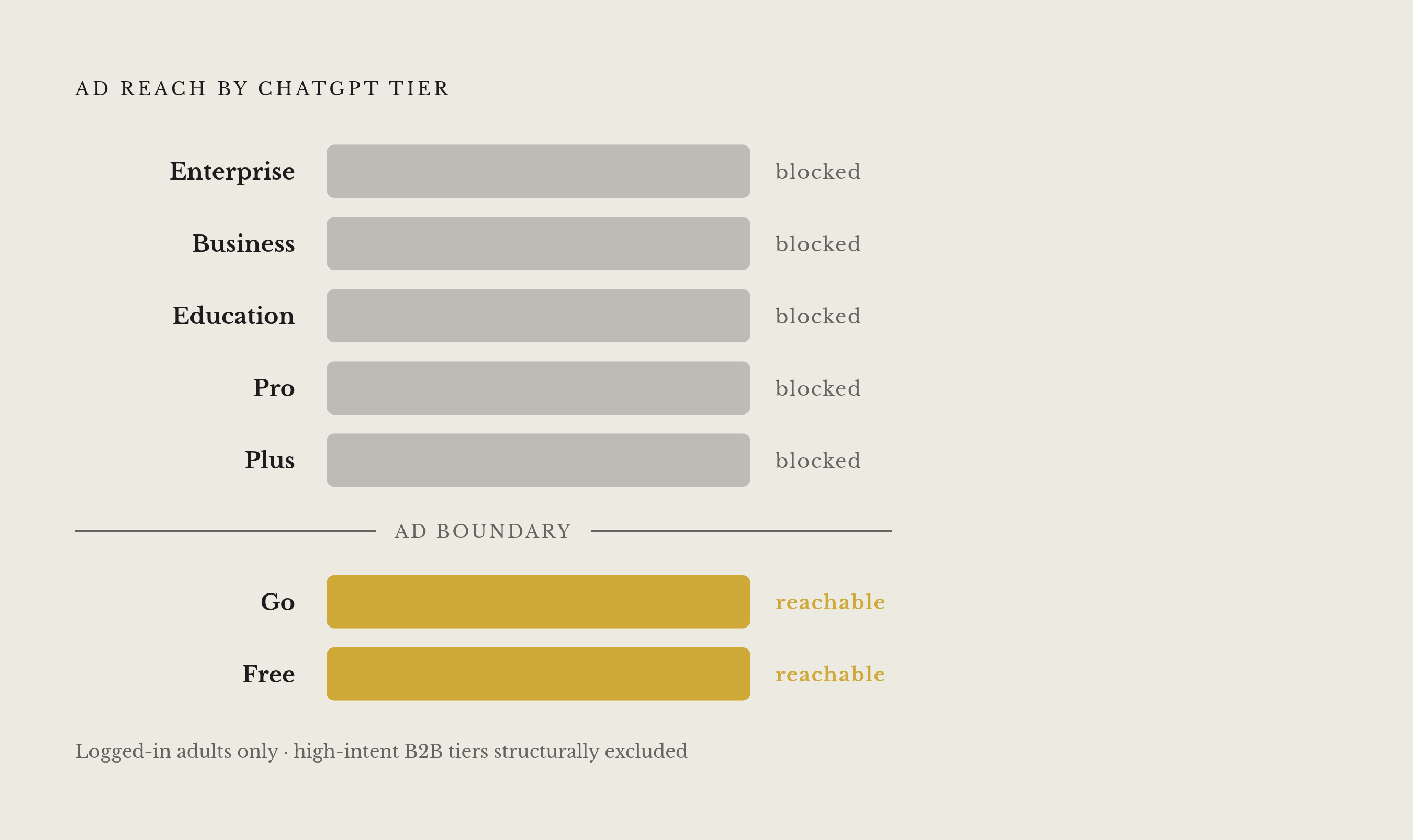
One structural constraint applies no matter the category, and it matters specifically for B2B advertisers. On ChatGPT, ads reach only logged-in adults on the Free and Go tiers; the Plus, Pro, Business, Enterprise, and Education tiers remain ad-free. So the highest-intent, highest-value business users on that surface are structurally unreachable through conversational ads there: a real boundary that should shape where B2B advertisers choose to direct conversational budget, not something to work around.
Across every category where conversational parameters are legible, the core advantage holds: the signal sitting inside a well-developed conversation thread is more specific, more structured, and more decision-relevant than anything a keyword or an audience segment was ever able to surface. Acting on that advantage responsibly is the final condition this channel imposes.
Brand safety and suitability when there is no fixed page to evaluate
Legacy brand safety was built around a fixed-content model: a page gets classified, flagged, or approved before or at the moment an impression serves. A conversational environment has no equivalent moment, because the content doesn't exist until the model generates it in response to whatever the user just said, so pre-classification in the traditional sense has nothing to attach to.
Suitability in this environment can't be evaluated against a page category. It has to be evaluated against the live conversational state itself: what is actually being discussed, at what emotional register, and with what degree of confidence the model has in its own response. Researchers in this space argue that once monetization runs inside the same interface that interprets and ranks user intent, you can't treat visibility into that decision logic as optional, and suitability has to function as a real-time check rather than a filter applied before the buy.
A few minimum requirements follow from that. Sponsored content needs to stay clearly labeled and separated from the model's actual answer, the design constraint that preserves user trust, and OpenAI reflects this in its own placement model: a labeled card below the answer, never folded into it. Sensitive categories, health, legal matters, financial distress, need active suppression protocols, because the conversational context there can be highly specific while commercial placement still creates a trust or ethical problem regardless of targeting precision. Advertisers need to know how paid mentions interact with organic brand references inside a model's responses. And when the assistant's own answer is hedged or uncertain, monetization needs to be suppressed, because a commercial unit next to an answer the model isn't sure of compounds the risk to both the user and the brand.
The sharpest illustration of this tension at the platform level is Perplexity's decision to wind down its ad program entirely, after concluding that sponsored placement risked making users doubt the answer altogether, in one executive's words, "a user would just start doubting everything." In a product built around the premise of a trustworthy answer, placing a commercial unit next to that answer created a trust problem, and the company judged it unsolvable at an acceptable cost. Perplexity now runs on a subscription model, and reported figures put its single-month revenue jump after it abandoned advertising at 50%. That outcome gives the clearest evidence yet that, in a conversational surface, brand safety is a condition for whether the targeting system gets to keep operating.