Structured Ad Asset Fields for AI Publisher Formats
AI ad placements require new asset fields because conversational context replaces page slots.

Legacy creative specs fail inside LLM ad environments because the things they describe, a page with fixed inventory slots, a keyword that maps to a search query, a cookie that carries a user profile, don't exist there. Traditional contextual advertising works by scanning a page's text and metadata at the moment it loads, then matching that page against predefined content categories. An LLM interface has no such fixed page to scan. It generates the content live, turn by turn, in a dialogue that never repeats itself in the same form twice, so there is nothing stable to pre-categorize.
Look at how a ChatGPT ad actually appears: as a labeled sponsored card sitting below the assistant's answer, not woven into the text of that answer. The ad sits next to a response the model wrote moments earlier, a response that was produced specifically for that user in that exchange and won't recur in exactly that wording again. There's no slot waiting to be filled the way a banner ad waits on a web page. There's a moving conversation, and an ad unit that has to find its place next to whatever that conversation happens to produce.
What this means for advertisers is that every field they control becomes the entire relevance signal, because there's no page context to lean on and no cookie trail to fall back on. The auction reads the context hint, the headline, the body copy, and the landing page, and that's the full set of information it has to work with. Nothing else fills in the gaps. A display campaign built around audience segments needs infrastructure that conversational AI just doesn't give you, and a search campaign built around keyword lists needs it too. The fields themselves have to carry the weight that used to be split across page, cookie, and query.
What the conversational targeting layer reads
Placement decisions inside an LLM ad environment come from matching a natural-language description against a live, multi-turn conversation, and that conversation holds more information, and less predictable information, than any keyword ever did. A keyword is just a single string a user typed into a search box. A conversation carries an entire trajectory: what the user asked three turns ago, how the assistant answered, and where the exchange seems to be headed next. Transformer architecture tries to hold that trajectory together through attention over the conversation history, maintaining some thread of coherence from one turn to the next. Research on these systems consistently finds that coherence degrades as conversations stretch longer, so the signal the targeting layer reads gets less stable the deeper a conversation goes.
Conversational intent also moves through phases. An opening query sets a broad or narrow frame, informational or transactional. Follow-up exchanges narrow that frame further: they introduce constraints, rule out options, compare alternatives. Later turns often shift into evaluation and decision. A user working through a long exchange about team coordination problems and missed deadlines may never type the phrase "project management software," yet that exchange carries exactly the kind of high commercial intent a brand in that category would want to reach. The signal is there. It just isn't packaged as a keyword.
That leaves advertisers with a targeting signal that's rich in meaning but loose in structure, nothing like the clean rows of a keyword list. The only precise instrument available to meet that signal is the set of asset fields the advertiser writes. Those fields are where the next part of the argument has to go.
The five structured asset fields an LLM ad unit requires
An LLM ad unit runs on four structured fields: the context hint, the headline, the body copy, and the landing page URL. Each one does a distinct job inside a relevance-weighted auction, and none of them is a renamed version of something from a legacy spec.
The headline sits inside a labeled sponsored card right next to the AI's answer, so it has to read clearly and relevantly on its own, because there's no surrounding editorial frame like a web page gives a banner ad. The auction treats the headline as a relevance signal in its own right, so chasing click-through at the cost of topical precision can hurt placement. There's a tone constraint built into the format too: the card lands immediately after a conversational answer the user just read, so a headline written like a hard sell creates a jarring shift in register. A headline that sounds native and helpful tends to outperform one that sounds promotional, simply because of what it sits beside.
Body copy carries a different job than it does in a banner ad or a search ad description. The user has just received a substantive, synthesized answer from the assistant, so body copy that restates the obvious wastes the one chance it has to add something the user doesn't already know. Because the auction reads this copy as a relevance signal alongside the context hint, copy that matches the conversational register and speaks to the specific phase of intent, informational versus transactional, performs better than generic brand messaging written for a wider, vaguer audience. The card format is compact too, so copy written for a display unit's available space often overwrites an LLM card or reads as clutter inside it.
The landing page works as the fourth relevance signal the auction reads, so if a precise context hint gets paired with a generic destination, that mismatch degrades the whole placement's relevance score. A user arriving from a conversation has already processed a specific, synthesized answer and is moving with sharper intent than a typical search click carries. Sending that user to a general homepage introduces friction the conversation itself never created. Landing page structure also affects auction eligibility directly: well-built product spec pages, clear FAQ content, and machine-readable metadata all help the system judge relevance accurately before a single click happens.
Together these four fields make up a complete creative spec, purpose-built for a format where there's no page to borrow context from and no keyword to match against. None of the four is optional, and none substitutes for another.
How the auction weighs those fields for placement and price
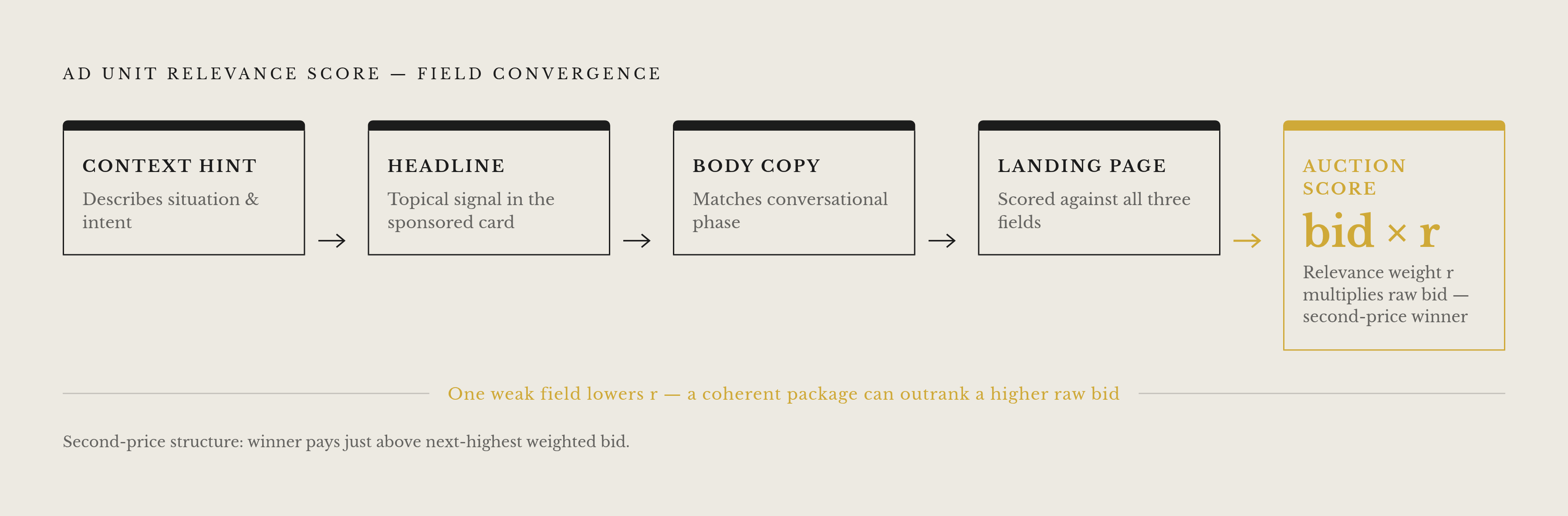
The auction that decides placement and price is relevance-weighted and runs on a second-price structure, so the four fields end up working as one coherent signal, not four separate creative elements. A weak field anywhere in the set drags down the whole package's relevance score, no matter how strong the other three are. A strong, coherent package, on the other hand, can beat a competitor with a larger raw budget, because the auction isn't just ranking bids, it's ranking bids weighted by relevance.
The second-price mechanic matters here in a very concrete way: the winning advertiser pays just above the next-highest competing bid, not the full amount they bid. That means a campaign with sharper, more relevant fields can win placement at a lower effective cost than a less precise competitor bidding more aggressively. Relevance doesn't just win the slot, it can win the slot cheaply.
The practical consequence for creative production is that every field functions as a targeting input, not a cosmetic one. Treating body copy as decoration, or treating the landing page as an afterthought once the ad itself is approved, is a bid-efficiency mistake, not just a creative-quality one. Money gets left on the table, or spent less efficiently than it needed to be, specifically because one of the four fields wasn't built with the auction's reading of it in mind.
Where the conversational context hint outperforms keyword logic
The context hint is the field with no real precedent in legacy creative specs, and the clearest break from keyword logic appears there. A keyword asks what string of characters a person typed. A context hint asks what that person is trying to accomplish, and whether a given offer is useful to them at that specific moment in their conversation. That's a shift from matching queries to modeling intent, and it calls for a different kind of writing.
Because conversations move through phases, informational, refinement, comparison, decision, a single context hint written at the ad-group level has to describe one of those phases precisely enough to catch the right turns in a conversation without being so narrow that it misses most of the conversational arc a real user actually produces. When teams write context hints as comma-separated lists of topics, the way they might write keyword lists, they consistently get poor matching out of the system. The targeting layer isn't parsing a taxonomy. It's interpreting a description of a situation.
Compare two ways of writing the same hint. A topic-list version might read: "project management, team collaboration, task tracking." A problem-narrative version might read: "someone working through which tool fits a small team juggling multiple deadlines and unclear ownership of tasks." The second version describes a situation you could actually find inside a real conversation. The first describes a category. If you start a context hint with the problem narrative, what the person is actually working through, before you even name the product category, you're borrowing the same instinct a good native-ad copywriter already uses. Applied to a targeting field instead of a headline, that instinct becomes the whole discipline.
What the landing page owes the conversation
The structured-field logic doesn't end once you build the ad unit, and the landing page is where it either holds or breaks. A user arriving from an AI conversation has already had a synthesized, specific answer and is carrying intent more precise than a typical search click. Sending that user to a generic landing page creates a relevance mismatch that costs it in the auction before the click happens, because the auction already scored the landing page against the context hint, the headline, and the body copy when it decided whether to serve the ad.
Users arriving this way aren't browsing in discovery mode. They've already had their broad question answered by the assistant, so the conversation has typically moved them further along, toward comparing options or making a decision. A landing page built for a broad discovery audience meets them at the wrong stage. What serves them, and what the auction itself needs to assess relevance accurately, are the same qualities: well-structured product spec pages, clear FAQ content, machine-readable metadata, and accurate pricing and availability information.
The travel sector shows this gap concretely. Consumers who arrive at a travel site after using an AI assistant show a meaningfully lower bounce rate than visitors who arrive without one, a signal that these visitors show up with sharper, more resolved intent and respond well to pages built to match it. The lesson carries past travel: a landing page built for an LLM placement has to assume the user already knows roughly what they want, because the conversation that sent them there already did a good part of the deciding for them.
Why attribution breaks without a click
A user can read a sponsored card inside a conversation, keep asking the assistant questions, close the chat, and convert later through an entirely different channel, with no click anywhere in that sequence for an analytics platform to attribute. Last-click attribution models have no way to credit that sequence properly, and they systematically undercount conversational AI as a channel as a result. The conversion gets logged against whatever channel happens to carry the final click, search or direct traffic most often, so the conversational placement that actually built the intent gets no credit.
Lift-based measurement, holdout tests that compare conversion rates between a group exposed to the ad and a group that wasn't, gives you a more honest way to measure what's actually happening. But lift testing only works if the creative assets feeding it are tagged and versioned carefully enough to trace a measurable lift back to a specific headline, a specific body copy variant, or a specific context hint. That's a production discipline, not an analytics upgrade. Consistent field naming and version tracking across campaigns are what make any lift signal legible.
None of this fully solves the attribution problem. Conversational AI as a measurement environment is still unsettled, and lift testing narrows the gap without closing it. What it does establish is that the fix starts in how the fields are built and tracked, not in a new dashboard bolted on afterward. A brand that treats conversational exposure as a real, high-intent moment, rather than an unmeasurable impression to write off, is already closer to measuring it honestly than one waiting for attribution tools to catch up on their own.
Getting the fields right as a standing operational practice, not a one-time setup
The conversational context an auction reads changes with every turn a user takes, so relevance-weighting makes creative quality compound over time. That makes structured asset field management a continuous practice, not a campaign that gets built once and left to run. A banner campaign can be set and left to flight for weeks without much drift in what it's being judged against. An LLM placement can't, because the conversations it's being matched against keep shifting, seasonally, culturally, by product category, and a context hint written six months ago may no longer describe the conversations actually happening now.
Field consistency across platforms raises the stakes further. Microsoft Copilot builds its ads directly from assets that already sit in an advertiser's existing account. Google's AI Overviews and AI Mode serve ads from existing Search, Shopping, Performance Max, and AI Max for Search campaigns. That means the structured fields an advertiser already built, or already neglected, appear inside AI conversations right now, whether or not that advertiser ever deliberately decided to put them there. The practical starting point is auditing which existing campaigns are already eligible for AI placement across Google and Microsoft and checking whether the fields feeding them were ever built with this kind of scrutiny in mind.
The layer where competitive advantage actually concentrates is the creative layer. The platforms supply the demand and the auction mechanics. The conversation itself supplies the targeting signal. The four structured fields, context hint, headline, body copy, landing page, are the one part of the system an advertiser owns and controls directly. If you build a demand-side platform specifically to read conversational context and to buy across multiple AI publisher surfaces, rather than one built for display and search or locked to a single surface, you can apply that field discipline consistently across the whole channel. A generalist platform can't read the conversation. A single-surface network can't offer the reach across surfaces. The brands that start treating these four fields as a standing discipline, reviewed and revised as conversations shift rather than set once and forgotten, are building an advantage that only widens as the channel matures around them.