Brand Voice Consistency Across AI Conversation Contexts
Language models reshape brand messaging turn by turn, whether advertisers intend it or not.
A family trip abroad starts as a question about flights and ends, four turns later, as a conversation about lodging, rail passes, and whether a seven-year-old can handle a ten-hour layover. Brand voice consistency in AI conversation contexts breaks down at exactly this kind of shift, because the message a brand wrote never actually gets delivered. It gets reconstructed, turn by turn, by a language model that is optimizing for conversational coherence, not for fidelity to what the brand meant to say.
That distinction matters because of where the ad or recommendation actually sits. In a ChatGPT conversation, a sponsored card appears adjacent to a live answer, or in direct response to it, and the model's framing of everything around that card shapes how a user reads it, no matter what the ad copy itself says. Researchers at the University of Michigan's School of Information have argued that this makes generative AI advertising a problem of trustworthy intervention in the generative process, not a problem of content placement. Their point is specific: the model can shift emphasis, reframe context, and change what counts as evidence in its answer, all without ever showing a sponsored object to the user. A brand's language can be exactly right on the page and still land wrong, because the words never traveled through the channel unmediated. That family planning a trip abroad might see a hotel ad surface beside an answer that hedges on seasonal pricing, or beside one that speaks with total confidence, and the ad reads differently in each case despite being identical in both. The gap between what a brand wrote and what a user experienced is the subject of everything that follows.
Conversational targeting and the signals a brand sends
Before a brand writes a word of ad copy, it has already made a brand voice decision, whether it realizes it or not: the targeting input that tells the platform where and when to show up. In ChatGPT's ad system, that input is a 280-character natural-language context hint, resolved through a relevance-weighted second-price auction at the ad group level. There is no keyword field to fill in. A keyword captures what someone typed; a context hint has to capture what someone is trying to accomplish and whether a brand's offer actually helps them get there. Teams that write context hints as lists of topics separated by commas get weak matches, because the auction rewards relevance, not just budget. A precise hint backed by a smaller budget can beat a vague hint backed by a bigger one.
The deeper shift is that this targeting works on the conversation as a whole, not on a single page or a single query. The same transformer architecture generating the AI's response also holds the conversational state that the ad system reads to judge relevance, so a user planning that trip abroad never has to type "luggage" or "travel insurance" for those categories to become relevant. The system reads the problem being described across turns and treats that narrative as a signal, often a stronger one than any single keyword would have offered in a search engine a decade ago.
That has a direct consequence for brand voice: the context hint is a compressed statement of where a brand belongs, not just which auctions it enters. It specifies the kinds of conversations and the stage of decision-making at which a brand's tone will actually fit. And because relevance here comes from the live conversation rather than a stored browsing history, this model doesn't depend on persistent user identifiers, a real privacy advantage. The tradeoff is that a brand can't lean on behavioral retargeting to patch over a generic context hint. The hint has to do the work that a cookie used to do.
What the labeled-ad boundary protects and leaves unresolved
The clearest design decision in generative AI advertising today is the visible line between the sponsored unit and the AI's own answer, and that line does real work. A ChatGPT ad renders as a labeled card below the assistant's response, never stitched into the answer text itself. The model's answer stays unpurchased. That separation protects user trust and protects brand integrity at the same time, by making it obvious which words came from the AI and which came from a paying advertiser.
What it doesn't resolve is framing. Research on ads embedded directly inside LLM outputs has found that users often fail to notice them at all when the line between answer and advertisement disappears, and the mechanism design literature already has alternatives on the table, including token-level auctions, retrieval-augmented segment auctions, and sponsored summaries that blend commercial and organic content more tightly than a labeled card does. Production systems have stayed cautious about adopting these approaches, and the caution looks justified given what the detection research found. But caution about blending placement doesn't touch a separate risk: even a clearly labeled sponsored card sits inside an interpretive frame built by the surrounding answer. A brand that appears next to a confident, reassuring response benefits from that confidence. A brand that appears next to a hedged, cautionary one absorbs that hesitation, and the ad copy itself has no say in which happens.
Anthropic has taken the most direct stance against this risk by declining to run ads at all, describing Claude as "a space to think" and keeping the product free of sponsored placement. Whether that position holds up commercially over time is a separate question. What it signals is narrower and more useful here: an ad-supported conversational product has to actively justify its trust architecture, because trust isn't the default state of a channel where the product itself can describe its own advertiser.
Why static brand voice documentation fails in multi-turn conversations
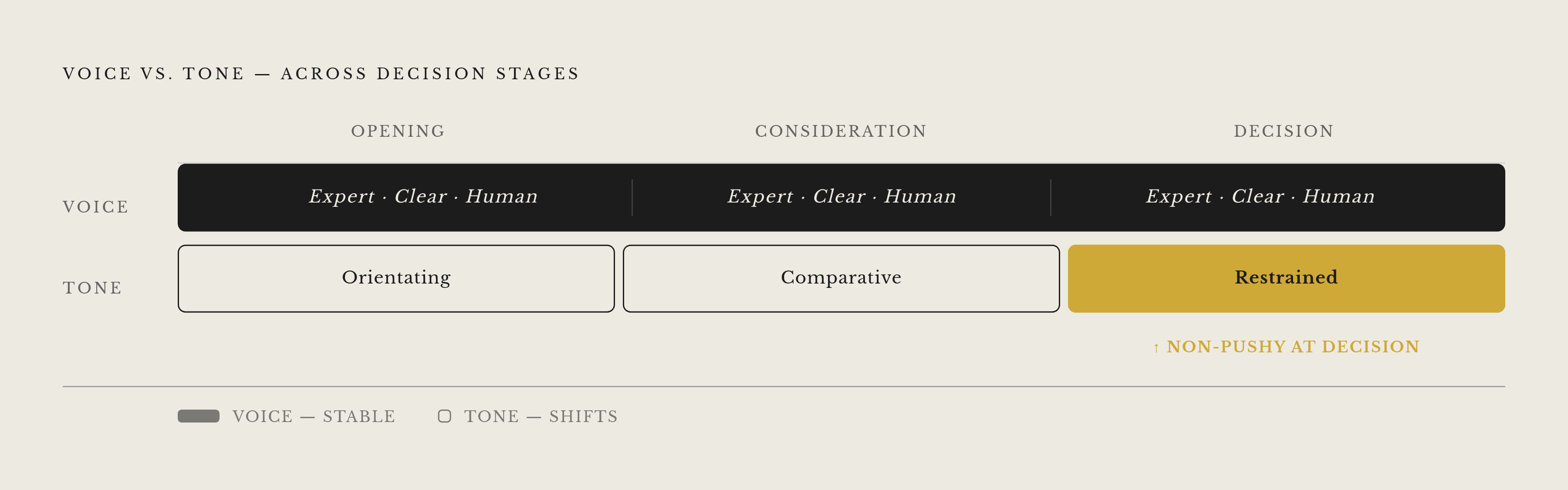
Most brand voice guidelines were written for a human copywriter sitting down to write one piece of content at a time, and that assumption breaks the moment an AI system takes over conversational interactions, because those guidelines almost always confuse two things that need to stay separate: voice, which should stay constant, and tone, which has to move with the conversation.
Zendesk's CX Trends report found that a large majority of CX leaders now expect AI agents to function as a direct extension of their brand's identity, carrying its values and its voice into every interaction. That's a real standard, and most brand documentation in circulation wasn't built to meet it. The common failure looks the same across companies: voice and tone get folded into a single instruction set, and that one instruction then gets handed to a system that has to navigate dozens of distinct conversational moments with it. Voice is the stable part, the personality and the values that make a brand recognizable no matter the context. Tone is the situational part, the warmth or restraint or urgency that fits a specific moment in a specific conversation. An AI system needs both inputs defined and kept apart, not merged into one style label that tries to do both jobs at once.
One vendor's work with a beauty retailer offers a useful look at what building this separation actually involves: operationalizable voice documentation that gives the system structure to act on, not just a style guide to skim once and file away. This scale difference makes consistency more urgent than it would be for a single copywriter. A human support agent handles maybe a few dozen conversations a day; an AI system handles orders of magnitude more, so a small inconsistency that would barely register at human scale turns into a visible, repeated pattern at AI scale, and people notice patterns faster than they notice one-off mistakes. As generative AI spreads across marketing, product, sales, and support at the same company, more systems and more people are generating brand-facing language at the same time. Without documentation the AI can actually act on, that overlap compounds into inconsistency across every place a customer encounters the brand.
What brand voice documentation must contain to survive AI mediation
Brand voice documentation built for this environment has to read like a set of operational instructions a system can follow at each stage of a conversation, not like a style guide a person reads once and sets aside. That means tone gets mapped to the actual stages of a conversation, not to general mood words. What register fits when a user is still figuring out their own problem, during the opening, informational stage? How should the brand's voice shift once a user is comparing options during consideration? What limits on urgency, directness, and offer framing keep a brand from sounding pushy or manipulative once a user reaches the decision stage? Each of these is a different instruction, and a single tone label can't carry all three.
Positive voice attributes only solve half of this. What a brand refuses to say, which kinds of framing it avoids, and which claims it won't make next to certain kinds of conversations matter just as much, because a language model will fill any gap the documentation leaves open, and it will fill that gap with something, whether the brand wants it there or not.
Conversations also don't hold still. A question that starts as a restaurant recommendation can turn into trip planning, then a budget conversation, then a question about transportation logistics, all inside one session. Voice documentation has to specify how a brand should feel at each of those phases rather than assuming the conversation will stay inside one category the whole time.
One structural advantage works in a brand's favor here: users in conversational AI interfaces tend to describe their problems explicitly, in their own words, across several turns. Ad copy that names the specific problem a user just described and offers a relevant answer to it fits naturally into that format in a way a generic pitch never will. Voice guidelines should build around that alignment.
Tone accuracy carries as much weight as content accuracy. A response that gets the facts right but reads dry can make a frustrated user more frustrated. A response that sounds warm but says nothing specific can come across as manipulative. The right tone depends entirely on the conversational context it lands in, and documentation that skips this detail leaves the AI guessing at a moment where guessing has real cost. Taken together, this is what it means to say that voice documentation functions as a targeting input now: it determines not just what a brand says, but where it should be allowed to speak.
How placement logic enforces brand voice when copy cannot
Because the AI's surrounding answer shapes how a sponsored message gets read, deciding which conversations a brand should appear in is a brand voice decision in its own right, and often a more controllable one than the copy itself. The context hint remains the primary lever here: a precisely written hint doesn't just name relevant topics, it specifies the intent states and conversational stages where a brand's voice actually belongs, and it excludes the moments where a brand's tone would clash with what the user is going through.
A healthcare brand built around a reassuring, evidence-based voice should stay out of conversations marked by urgency or vulnerability, because the surrounding context would make even accurate, careful language feel incongruous or exploitative. This risk is sharper for healthcare advertisers specifically: users asking health questions are often in a vulnerable state, and any advertising placed near those conversations needs real discipline around implied recommendations, urgency tactics, and efficacy claims that can't be backed up.
Microsoft Copilot adds another layer to this by evaluating ad placement against the whole arc of a session rather than the most recent query alone, a design Microsoft has described as reading the "whole conversation within a single session and not just the last prompt." That means brand voice consistency depends on which conversational arcs a brand is willing to enter, not just which topics it bids on.
The University of Michigan taxonomy mentioned earlier identifies two influence tiers that sit above simple product mentions and information framing: behavioral redirection and long-term preference shaping. Production ad systems don't currently govern either tier. A brand relying on copy alone to carry its voice is exposed to framing effects at these deeper tiers, because no disclosure mechanism surfaces them, leaving them unmeasured and uncontested.
Restraint becomes a real brand voice mechanism here. Paid media defaults to maximizing reach, but a brand that shows up in every conversation it's technically eligible for dilutes the specificity that made its voice recognizable. Placement exclusions, the conversations a brand deliberately opts out of, deserve to be treated as seriously as the ones it opts into. Proactive placement logic is the only point in the system where a brand still has a say.
Industry contexts where voice consistency breaks down most acutely
Healthcare sits at the sharpest edge of this problem, for the reason already laid out: users arrive in a vulnerable state, and a brand's reassuring voice can read as exploitative the moment it appears beside the wrong kind of answer. Financial services carries a related risk, where a confident tone that works fine in a product ad reads as pressure when it appears next to a conversation about debt or a major purchase decision. Travel and hospitality face the opposite challenge, the one the family trip illustrates directly: a single conversation drifts across flights, lodging, budget, and logistics, and a brand voice built around one of those categories has to hold up across all of them or it will feel out of place somewhere along the way. Retail and consumer goods are often the highest-frequency categories in conversational commerce, where small tone inconsistencies repeat often enough to become a pattern a user can actually notice. In each of these contexts, the fix is the same one this piece has been building toward: voice has to be encoded into targeting and placement decisions well before a single word of copy gets written, because by the time the copy appears, the conversation has already decided how it will be read.