Why Conversational AI Advertising Is Not a Chatbot Strategy
Conversational ads and chatbots require different strategies, budgets, and success metrics.
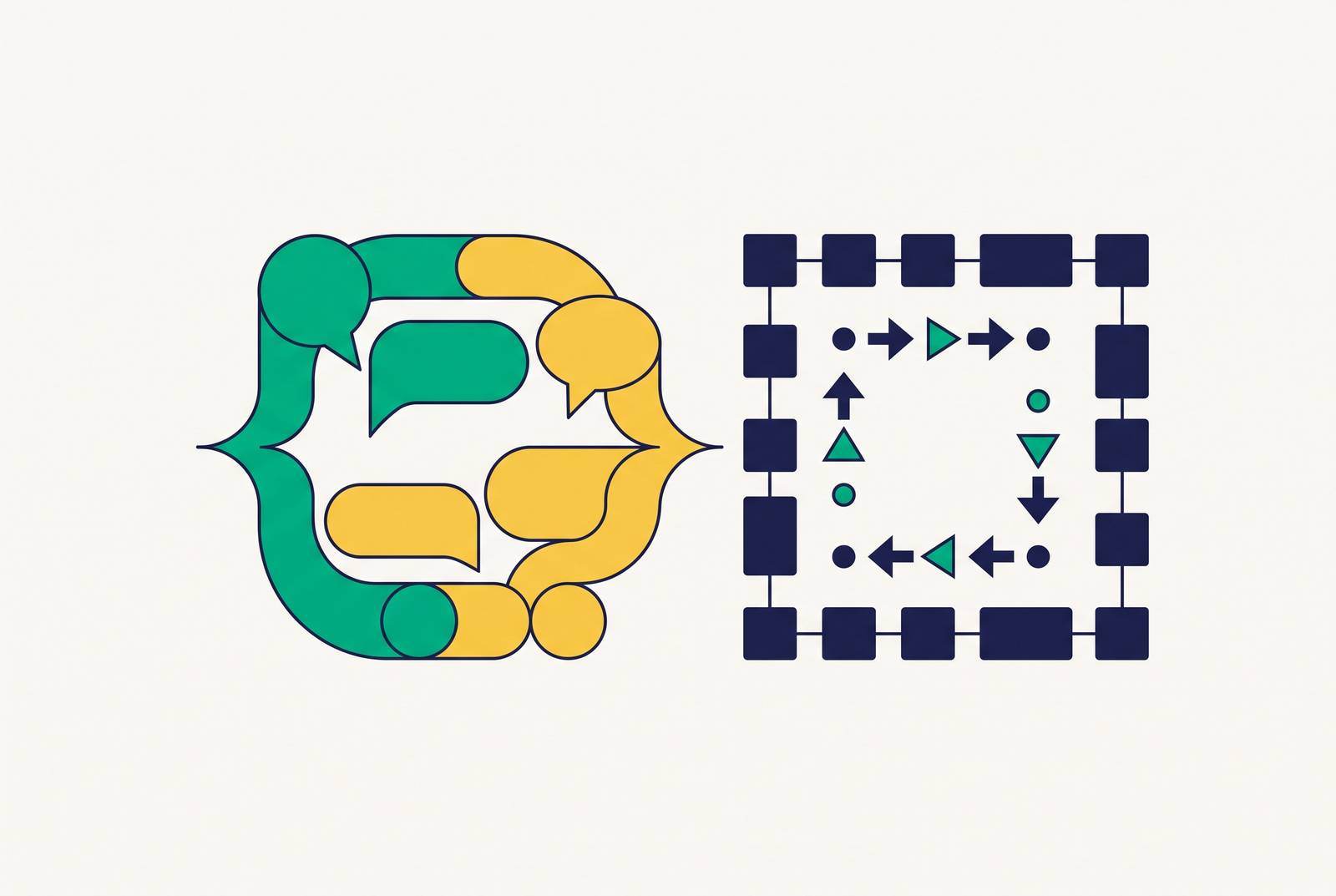
Conversational AI advertising and on-site chatbot deployment share an interface, but they run on different mechanisms, so treating them as one category gets you the wrong media plan. A media planner sitting in a budget meeting, asked to slot "AI chat advertising" next to "chatbot roadmap" on the same line item, is being asked to compare two things that behave nothing alike once a campaign actually goes live.
Collapsing "Chatbot" and "AI Ad" Into One Category Produces the Wrong Strategy
The confusion starts from something true. Both happen inside a chat window, and in both an AI system puts a brand's message in front of a user. That surface overlap is enough to make a reasonable planner assume the two are variations on one discipline, filed under the same owner, measured the same way, budgeted from the same line.
They are not variations on each other. A chatbot is a tool a company builds and controls from first message to last. Mixing the two up doesn't just cause a labeling problem. It produces the wrong KPIs, the wrong budget category, the wrong creative format, and the wrong definition of success, because a planner ends up measuring a paid-media, intent-capture channel using the yardsticks built for a customer-service automation tool.
What a chatbot strategy is and what it is designed to do
A chatbot strategy is a tool the brand builds and controls, and it carries a user through a predefined sales or support path. Its logic runs in sequence: step one leads to step two, which leads to a resolution the brand designed in advance. That's a legitimate and well-proven discipline, and plenty of companies run it well.
The brand owns every part of the experience: the interface, the dialogue tree or the model it fine-tuned, and every exit point a user might take. A user who shows up inside that chatbot has already signaled intent just by arriving at the brand's own site or app, so the bot doesn't need to find that signal. It just needs to qualify and route it.
Because of that, chatbot success gets measured in terms that make sense for a sales or service process with a clear endpoint: conversion events, deflection rates, completed sessions. None of that is a knock on the discipline. It's simply a description of a tool built for a different job than the one conversational AI advertising does.
What conversational AI advertising is and how its mechanics differ
Conversational AI advertising is a paid, contextually matched commercial placement that appears inside a live conversation the brand had no part in starting. The targeting runs on where the dialogue is headed.
Before an ad gets served, the brand has no presence in that interface. The AI assistant is a third-party environment the user chose on their own, not a surface the brand owns or designed. That alone sets the channel apart from a chatbot, where the brand's presence is the whole premise of the interaction.
Targeting doesn't run on keywords the way search does. The system matching an ad to a conversation has to read the entire trajectory of the dialogue: what the user asked a few turns back, how the assistant answered, what follow-up questions came up, and where the exchange appears to be going next. The main lever an advertiser has over that matching is something closer to a brief than a keyword list: a freeform, plain-language description of the kinds of conversations where the ad belongs, which the system then checks against the live dialogue as it unfolds.
One model of this approach treats it as a threshold-based policy. If the ad a platform could serve at some point in a conversation would score below a target value, the model just keeps the conversation going and serves nothing. But once a potential ad clears that threshold, the model stops and offers it. It's a relevance gate, built to trigger when conversational value crosses a line.
Relevance in this model comes from what's happening in the conversation right now, not from a stored profile of past behavior, so the architecture leans privacy-preserving by design. No chat content gets handed to advertisers. Persistent identifiers like cookie IDs still appear elsewhere in the ad infrastructure, so the model is not identity-free, but the targeting signal comes from the conversation, not from history.
How intent signals inside AI conversations differ from search queries and chatbot sessions
A prompt typed into an AI assistant carries a denser and more situated signal of purchase intent than either a search query or a chatbot session produces, and that gap in signal quality is what makes this a structurally different channel rather than just a different-looking version of the same thing.
A search query is a string of keywords. It tells an advertiser what someone typed, but nothing about where that person stands in a decision, what they've already ruled out, or what constraints they're working within. A chatbot session carries a stronger signal than that, but it's a signal the brand itself induced: the user already chose to land on the brand's own surface. The intent captured there is high-value but self-selected and tilted toward the bottom of the funnel by construction.
An AI assistant conversation sits in between those two in a way that actually beats both. Research into trustworthy commercial intervention in generative AI points to exactly this as the distinctive opportunity the channel offers: the conversation shows not only what a user wants but the frame of mind they're in while they want it.
So advertisers get access to early-funnel intent at a depth search has never supplied, because search waits for a user to already know roughly what they want.
The honest limitation sits right alongside that opportunity. Advertisers currently don't get prompt-level reporting the way they do in search, so they can't see the exact prompts that triggered a given ad placement. That gap limits the feedback loop you can use for optimization, so you need to factor that constraint into expectations rather than treat the richer signal as a full substitute for the reporting maturity search has built up over two decades.
Generative AI Advertising Research and the Commercial Intervention Problem
Academic and industry researchers are treating ad placement inside AI-generated responses as its own class of problem, one that calls for new evaluation methods, new auction structures, and new standards for what counts as a trustworthy commercial intervention.
Work framing generative AI advertising as a trustworthy-intervention problem identifies the core tension at stake: the same conversational coherence that makes the context signal so valuable also makes a poorly matched ad far more disruptive than a mistargeted banner or a weak search ad would ever be. A bad match inside a flowing conversation breaks the user's trust in the whole exchange, not just in the ad.
Taken together, these research directions converge on one finding: conversational context is what creates the richer targeting opportunity, and that same context is what raises the bar for relevance and transparency. Those two things move together; they do not trade off against each other.
The Live Platform Landscape
The platforms that stood up AI advertising in 2026 each made a distinct architectural call about where the ad sits relative to the conversation, and those calls reveal very different working theories of what this channel actually is.
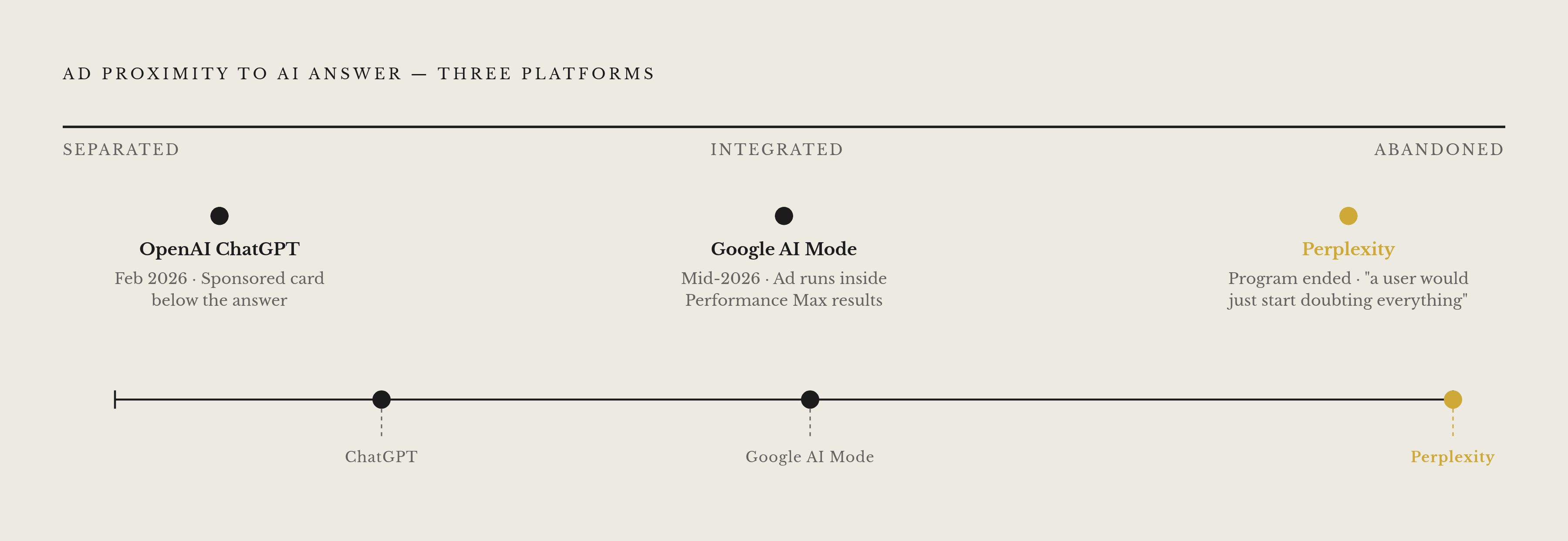
OpenAI launched ads on ChatGPT in February 2026, and you see them as a labeled sponsored card placed below the assistant's answer, kept visually separate from the response text, though some observed placements have appeared closer to or within the response area than that separation suggests. The design choice still leans toward treating the ad as a declared commercial unit, not folding it into the assistant's own recommendation. The pilot launched with a high minimum spend and partners including Target, Adobe, Williams-Sonoma, and Albertsons, and by May 2026 self-serve buying opened up through ads.openai.com, with daily campaign budgets starting low enough for far smaller advertisers to participate.
Google took a different route. AI Overviews already monetize through Search, Performance Max, and Shopping campaigns that are already running in market, so you need no separate opt-in. AI Mode ads, by contrast, were still in limited U.S. testing as of mid-2026, and only Performance Max and AI Max for Search campaigns could qualify. Where a campaign does qualify, the ad runs closer to the organic answer than ChatGPT's model allows, and that is a meaningfully different bet about how much separation an ad needs from the assistant's own voice.
Perplexity took the opposite position and walked away from its ad program. Executives told the Financial Times that sponsored placement risked making users suspicious of the whole answer, with one saying: "the challenge with ads is that a user would just start doubting everything. That decision stands as a real data point about what it costs, in user trust, when you place an ad too close to the answer it sits beside.
None of these choices are cosmetic. A below-the-answer card, an integrated placement inside Performance Max-eligible results, and a platform's decision to abandon ads outright represent three different answers to the same question research keeps raising: how close can a commercial message sit to an AI's answer before it damages the trust that answer depends on.
Why a chatbot-strategy mental model produces specific, predictable planning errors
A marketer who walks into conversational AI advertising carrying a chatbot playbook will make a predictable set of mistakes at every stage of planning, because the frameworks built for chatbots were designed around a different mechanism.
Targeting goes wrong first. A planner used to keyword lists will write context hints the way they'd write search terms: specific, transactional, aimed at the bottom of the funnel. That approach misses the exploratory, category-level conversations where early intent is richest and where competition for placement is thinnest, because almost nobody else is bidding on that part of the conversation yet.
Creative goes wrong next. If a team is trained to write scripted, closing-focused chatbot copy, it brings that same register into a conversation it wasn't invited into, so the ad reads as a sales pitch rather than a useful, relevant contribution to whatever the user was actually working through.
Measurement goes wrong after that. Applying chatbot metrics, session completion, deflection rate, immediate click-to-purchase, to a channel whose value includes intent capture and brand presence during a decision process that might conclude somewhere else entirely means last-click attribution ends up missing most of what the placement was worth.
Budgeting compounds all of it. Filing conversational AI advertising under "chatbot" or "CRM automation" routes the spend to the wrong approver, judges it against the wrong success criteria, and benchmarks it against the wrong set of competitors, none of which reflects what the channel is actually built to do.
Channel fit breaks down last. A planner expecting to control the flow of the conversation the way a chatbot deployment allows will be caught off guard when an ad serves into a context that's adjacent to, but not identical to, the scenario intended. The platform matches a context hint against a conversation already in motion.
What buying conversational AI advertising requires from a campaign planning perspective
Buying this channel well starts with organizing the plan around conversational intent stages rather than funnel stages, paired with infrastructure that can read context across multiple AI surfaces rather than just manage bids on one platform at a time.
Context hints need to read like the problem narratives people actually bring to an AI assistant: exploratory, framed at the category level, carrying multiple constraints at once, rather than the tight transactional keywords that belong in a search campaign. Measurement needs to widen out, because prompt-level reporting remains limited and last-click attribution misses most of the value a multi-turn journey creates; brand lift studies, assisted-conversion tracking, and holdout testing all need to sit alongside direct-response numbers, and attribution methodology for this channel is still being worked out across the industry.
Cross-surface buying is a structural planning problem. A demand-side platform built to buy across AI surfaces, layered on top of direct publisher supply, answers that fragmentation directly.
That points to a specific gap in the current tooling. A generalist DSP brings reach across inventory but has no way to read conversational context in real time. A single-surface AI ad network can read that context, but it can't give you reach beyond its own platform. Platforms built specifically for conversational AI advertising, reading live dialogue trajectory, scoring it against advertiser intent signals, and placing ads through a relevance-weighted auction that runs across several AI surfaces at once rather than inside one brand-owned chatbot interface, are built to close exactly that gap, which is a structurally different position from either a generalist DSP or a single-surface network.
The category confusion that started this piece runs deeper than a labeling mistake. Budgeting and structuring conversational AI ad placements as though they were chatbot deployments cascades from the wrong KPI all the way through to the wrong creative format and the wrong measurement framework, because the two channels run on opposite assumptions about who controls the interface, who starts the conversation, and what counts as success. The intent signal in this channel comes out of an unscripted exchange with a third party, not a brand-run funnel or a typed keyword, and that is why advertising platforms purpose-built for LLM environments, rather than search or social tools retrofitted for the job, are what's needed to capture that signal.