Framing AI Advertising for Performance-Focused Clients
How prompt-level intent signals translate into familiar performance metrics.

Framing AI Advertising for Performance-Focused Clients.
Evaluating a channel that didn't exist eighteen months ago
Performance clients evaluate conversational AI advertising through familiar lenses of cost, intent, and measurable return, and the right framing for them maps prompt-level intent signals directly onto the performance metrics they already care about, while being honest about what measurement challenges remain unsolved. ChatGPT passed 1 billion weekly users, according to OpenAI, and the company opened self-serve advertising through ads.openai.com. Ad revenue on the platform hit a $1 billion annualized run rate in under 200 days, with tens of thousands of advertisers buying across more than 40 countries, which is the clearest signal yet that real budget is willing to move into a chat interface rather than a search results page or a social feed OpenAI / Beet.TV.
It helps to separate this moment from what came before it. 2025 was largely about using AI to make existing channels sharper: better bidding algorithms, generative creative variants, cleaner measurement dashboards. 2026 is a different kind of shift, because ads are now sitting directly inside the LLM environment itself, which is a new inventory type rather than an upgrade to an old one. That distinction matters for how a performance client should budget against it. Early Google advertisers and early Facebook advertisers built durable competitive advantages precisely because they moved while inventory was cheap and competition was thin, and the same structural window appears to be open again.
None of that is an argument to abandon skepticism. It's an argument for translating the mechanics honestly, mapping what's genuinely new onto the KPIs a performance team already tracks, and being direct about where the measurement infrastructure hasn't caught up yet. That's the task ahead.
The prompt signal versus the keyword signal for intent targeting
Search advertising was built on a thin signal. A typical Google query runs three or four words, disconnected from context and often ambiguous about what the searcher actually wants. A ChatGPT prompt behaves nothing like that. It tends to run a full paragraph, and inside that paragraph sits the objective, the constraints, the timeline, and the tradeoffs the buyer is actively weighing, all delivered in a single turn.
A search for "college dorm essentials" and a prompt that reads something closer to a parent explaining that a son is starting college in the fall, living in a small dorm in the Northeast, and the parent wants to be sure he has what he needs without overbuying, express the same underlying purchase intent, but only one tells an advertiser the buyer's actual decision criteria, unprompted and unfiltered. Both express the same underlying purchase intent. Only one of them tells an advertiser the buyer's actual decision criteria, unprompted and unfiltered.
The same pattern holds in categories like skincare, where a single conversational turn asking whether a product suits a specific concern reveals purchase stage, skin type, and concern hierarchy all at once, a signal that used to require several separate queries and a retargeting cookie trail to approximate. It's now visible inside one thread, though invisible to traditional platforms built around keyword matching.
This isn't a hypothetical shift in behavior. Pacvue's 2026 Funnel Rewired report, based on a survey of 1,008 US consumers, found that 53% already use AI tools to research products, and 28% turn to AI for shopping research on a daily basis, so the intent is habitual rather than experimental. OpenAI's own internal figures put roughly 20% of ChatGPT conversations as carrying shopping intent, spread across retail, home, beauty, travel, cooking, auto, electronics, and fitness, which is a commercially significant share of daily conversation volume.
For a performance client, the reason this matters is simple: intent signal quality determines targeting precision, and targeting precision determines conversion efficiency. The prompt is structurally closer to the moment of decision than a keyword or a demographic proxy has ever been. But richer signal isn't the same thing as accessible signal, and that distinction is where the next question has to go.
Targeting inside ChatGPT without advertisers getting the raw data
ChatGPT's targeting model, as launched, works on the topic of the current conversation, a user's past chats, and prior ad interactions, which makes it contextual and behavioral rather than built on demographic checkboxes or a browsing-history graph. It leans on semantic understanding and real-time intent interpretation, a departure from the audience-matching logic performance marketers are used to building around pixels and lookalike lists.
The restriction that catches most performance teams off guard is this: advertisers get no user-level data. OpenAI has stated it will not share any type of user data with advertisers, full stop. The conversation itself is the targeting signal.
Framed against where the rest of the industry is heading, this is less of an outlier than it first appears. Third-party cookies are fading everywhere, and contextual data is already becoming the real foundation of effective targeting across the web, not just inside AI surfaces. Intent quality, in other words, is observable even without granular access to the underlying data.
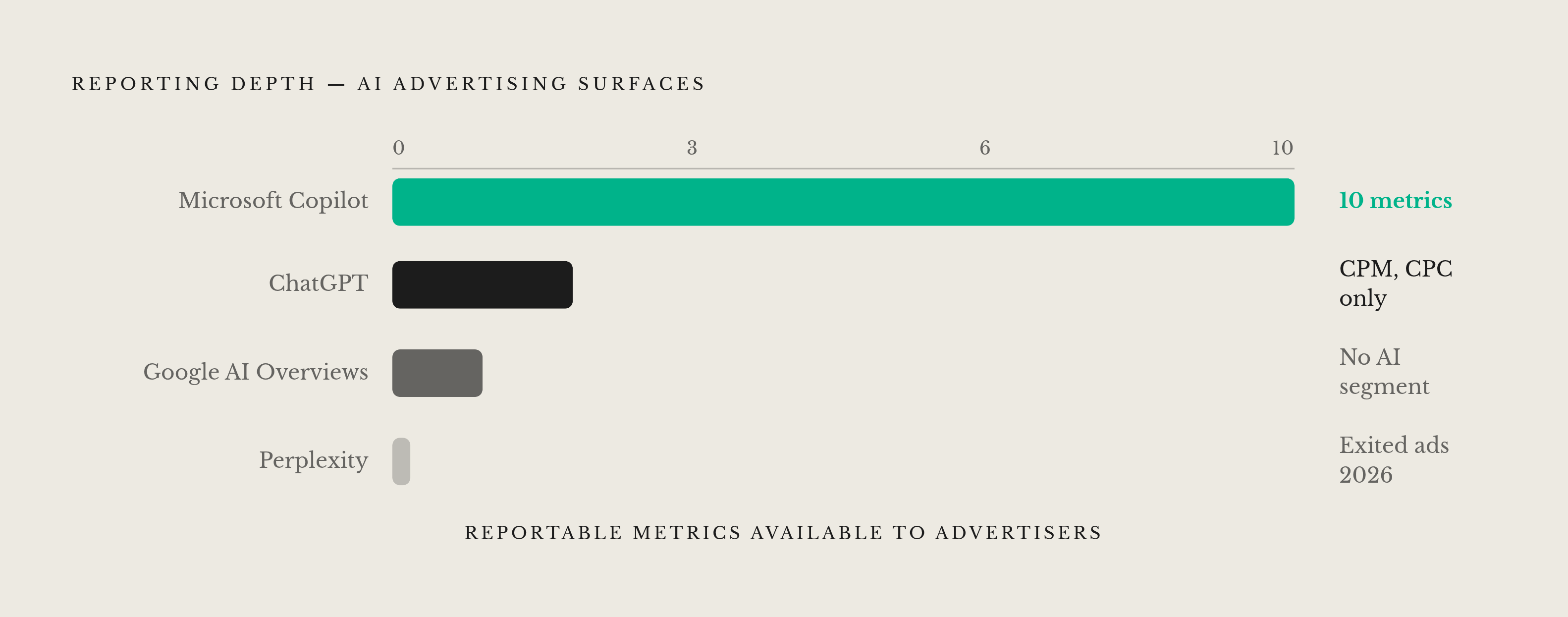
Microsoft Copilot offers a useful point of contrast. Measuring ad performance there is currently easier than on ChatGPT or Perplexity, because Microsoft hasn't made the same strict privacy commitment; Copilot campaigns report spend, impressions, clicks, CTR, average CPC, average CPM, conversions, conversion rate, revenue, and ROAS, all metrics performance teams already know how to read. That gap in reporting depth between platforms is a real input into which surface a client should test first. 49% of marketers report declining traditional search traffic due to AI answers, while 58% say AI referral traffic is significantly higher intent, per kliqinteractive.com benchmarks, and the intent quality is observable even without granular data access.
The four ad surfaces inside LLM chat and their implications for performance measurement
Four distinct ad formats exist inside conversational AI chat today, and each carries a different measurement profile.
The sidebar sits outside the conversation column, runs on desktop only with no mobile equivalent, and carries conventional display economics rather than the premium pricing of an inline unit Evaluating and Pricing Advertisements in AI-Generated Responses. The sponsored follow-up suggestion chip is a pill that submits a brand-favorable prompt or routes the user straight to an advertiser; Perplexity shipped this format in November 2024, and then abandoned advertising altogether in February 2026, citing concerns about user trust. The format works mechanically. Its platform-level durability is another matter.
Latency isn't a UX nicety here. It functions as a fill-rate variable, meaning slow ad infrastructure directly suppresses how often a campaign delivers.
Surface choice also determines what a campaign can even report. Inline cards and sidebar units generate impressions and clicks in familiar formats that slot into an existing dashboard, while sponsored chips and brand mentions require a different attribution logic entirely, because the surface a client buys determines what's measurable, not just what it costs. ChatGPT's self-serve buying, for what it's worth, currently offers a Reach objective priced on CPM and a Clicks objective priced on CPC, which are the two most familiar performance pricing models in digital advertising and make entry-level measurement genuinely tractable. The engineering requirement that performance clients rarely see is that the ad request must resolve in under 200–300ms or the turn commits to no ad, making latency a fill-rate variable, not just a UX preference. Key evaluation criteria for any AI ad network include latency SLA of sub-250ms p95, disclosure compliance, brand-safety filter granularity, fill rate on commercial-intent prompts, and revenue share.
Translating conversational AI ad mechanics into the performance KPIs clients already use
The framing that keeps this channel legible for a performance client is straightforward: this isn't a reach channel, at least not yet, and it behaves far more like lower-funnel search than upper-funnel display.
The comparison points a performance team already has on hand are useful here. Google Ads averaged a 6.64% CTR, according to WordStream's benchmark data, which is the number most search buyers use as their baseline Google Ads Benchmarks 2026: Competitive Data & Insights for Every Ind…. Meta and Facebook averaged roughly 1.4% CTR, with the strongest industries reaching toward 1.7%, according to theedigital.com's benchmarks 2026 Facebook Ads Benchmarks.
The intent-to-KPI chain follows logically from the prompt signal itself. A prompt reveals purchase stage and category specificity, which produces a better contextual match, which produces higher relevance, which should, in principle, produce a stronger CTR and conversion rate than a keyword match on an equivalent broad-match search term. The conversation also carries the buyer's own stated constraints and objections in plain language, meaning ad creative can address those objections directly inside the response context, shortening the path to conversion rather than requiring a second or third touch.
Pricing expectations should stay grounded in where this inventory sits in its lifecycle. Early-stage inventory tends to price below its actual intent value while liquidity builds in the auction, which is exactly the dynamic early search and social advertisers exploited before those markets matured. What clients shouldn't expect yet is cross-surface frequency capping with the fidelity of search or social, deterministic attribution to a final sale, or audience-segment-level performance breakdowns, and being upfront about those absences now avoids an uncomfortable conversation later.
AI campaign optimization has moved past rules-based automation into agentic systems that analyze more than 200 signals and reallocate budget every 15 to 30 minutes, which gives clients already running automated bidding on search or social a transferable mental model for how AI-native campaigns will behave. ChatGPT inline card CPMs of $25–60 sit above typical display and social benchmarks but are framed against the intent quality of the inventory, not against broad reach. AI referral traffic is significantly higher intent than traditional search traffic for 58% of marketers who are experiencing the shift, so the CTR baseline for AI surfaces should be evaluated against intent-matched search, not broad social, per kliqinteractive.com.
The measurement gaps that are genuinely unsolved
Some of this is genuinely unresolved, and pretending otherwise doesn't serve anyone.
Attribution is the biggest gap. Assistant-mediated discovery happens inside a private conversational thread, so the path from prompt to purchase isn't visible to standard pixel-based or UTM-based attribution, and the eventual conversion might happen on an entirely different surface, at a different time, with no traceable link back to the original conversation. Because OpenAI won't share user-level data, advertisers can't build the closed-loop attribution models they've built on search and social; a click leaving the platform is measurable, but everything that happened inside the conversation before that click is not.
Google's own AI surfaces have a parallel problem. Advertisers buying through Performance Max or AI Max campaigns get no segmented reporting that isolates AI Overview ad performance from standard search performance, so the AI surface is effectively invisible inside the reporting a client already relies on. Perplexity's full retreat from advertising in February 2026, driven by trust concerns, is a live precedent that a platform can close inventory without warning, which is a genuine factor in how a client should think about channel diversification.
The regulatory and standards picture is still forming as well. Gartner projects that 60% of brands will use agentic AI for one-to-one interactions by 2028, and IAB's 2026 Outlook found 96% of buyers are already aware of agentic AI for ad buying and campaign execution, though confidence runs higher for performance analysis and creative optimization than it does for something like deal negotiation, which is the industry itself acknowledging a gap between awareness and operational trust Evaluating and Pricing Advertisements in AI-Generated Responses.
The honest comparison for a client is search measurement circa 2002: directional, not deterministic. The right structure for a first engagement is a test budget attached to a defined learning objective. Both things are true at once here: the intent signal is genuinely richer than anything keyword advertising ever offered, and the measurement infrastructure built to capture it hasn't caught up. The IAB Tech Lab Disclosure Spec v1 shipped in 2026, FTC guidance is explicit, and state-level AI disclosure laws are accumulating, yet the compliance landscape is still forming, and measurement standards that depend on disclosure taxonomy are not yet settled.
A structurally sound early test for a performance-focused client
Treat the first test as a lower-funnel intent buy, funded out of the search or performance budget rather than the brand budget, because that's what the evidence so far says this channel actually is.
Platform choice should follow measurement maturity, not just reach. ChatGPT, available now on Free and Go tiers in the US to users 18 and over through self-serve at ads.openai.com, offers both CPM and CPC buying and currently holds the most liquid inventory among pure chatbot surfaces. Microsoft Copilot runs through existing Microsoft Ads buying and offers more measurement transparency than ChatGPT, reporting on impressions, clicks, CTR, conversions, CPC, and ROAS, which lowers the barrier to a first test considerably. Google's AI Overviews and AI Mode are reachable through existing Search, Shopping, and Performance Max campaigns at zero incremental setup cost, though segmented reporting isn't available yet. Perplexity has exited advertising entirely, having paused new advertisers in October 2025 before fully abandoning ads in February 2026, though its publisher program and organic optimization remain viable as a parallel, non-paid track. Anthropic has stated that Claude will stay ad-free.
Test design should stay disciplined. Pick a single learning objective before the campaign runs, whether that's intent signal quality, CTR against an equivalent search term, or a straight cost-per-click comparison, and resist the urge to measure everything at once. Where a CPC objective is available, use it, since it keeps reporting inside the accounting a performance team already trusts. Creative should speak to the full context of the prompt category rather than to a single keyword, because this format rewards specificity in a way keyword-matched search never did. And any ad request built for this environment needs to be latency-aware: sub-250ms or fill rate starts to degrade, which is an engineering requirement a media buyer can't solve alone and needs to raise with the team building the ad request itself.
There's also a structural argument to raise directly with clients thinking past a single test. A demand-side platform built to read conversational context and operate across multiple AI surfaces, rather than a single-platform buy or a generalist DSP with no way to parse a conversation, offers both the contextual targeting intelligence and the cross-surface reach that buying platforms one at a time simply can't match.
The budget conversation, ultimately, comes down to where this spend is heading. eMarketer projects US AI ad spending will reach $68.25 billion by 2030, and chatbot-native spending, while still the smallest slice of that total, is also the fastest-growing, up 1,641% in 2026 to $0.96 billion. That's a small number today and a familiar shape: early, underpriced relative to where the category is going, which is precisely the argument early search and social advertisers made, correctly, the last time a channel this new showed up.
Sources
- Ads Inside AI: The Next Media Channel Marketers Can’t Ignore – Beet.TV
- Evaluating and Pricing Advertisements in AI-Generated Responses
- 2026 Facebook Ads Benchmarks
- Google Ads Benchmarks 2026: Competitive Data & Insights for Every Industry | WordStream
- ChatGPT Ads in 2026: Early Results, Best Practices, and How to Get Started
- IAB - The AI Ad Gap Widens
- Measurement Trends & Statistics