Positioning AI Ads Alongside Search and Social in Media Plans
Advertisers can now reach users making purchase decisions inside chatbot conversations.

Conversational AI advertising means you buy placement inside the answer a chatbot gives, not inside a website a user might click to afterward. Four platforms now sell some form of it: ChatGPT runs labeled sponsored cards below its answers, Google sells through AI Overviews and AI Mode using campaign types advertisers already run, Microsoft Copilot auto-enrolls eligible campaigns with no opt-out, and Perplexity walked away from the category after concluding that sponsored placement made users suspicious of the answer itself. This is a different purchase than adding a chatbot widget to a company's own site: it buys access to a conversation happening on someone else's platform, at the moment a user is actively narrowing a decision, before they've typed a single branded search query. The rest of this piece lays out why that moment exists, what makes it different from search and social, what's actually buyable today, and which industries should move on it first.
Why Search and Social No Longer Cover the Full Purchase Journey
Google Ads click-through rates drop sharply when an AI Overview appears on a results page, and more than four-fifths of searches now end without a single website visit. The traffic a brand has counted on for years is already being intercepted before it reaches a landing page, absorbed into a synthesized answer the user never clicks past instead of lost to a competitor.
The reason involves a structural shift in how discovery works. Discovery used to mean a ranked list of ten blue links, each a bid for the click. It now means one or two synthesized answers, and the decision increasingly gets made inside that synthesis rather than after it. Search and social were built to intercept intent at a specific, narrow moment: the instant someone types a query or pauses mid-scroll. Neither channel reaches the person who is six prompts deep into a conversation with a chatbot, working through options, asking follow-up questions, and narrowing a decision before they've opened a browser tab. That person is doing their research somewhere search can't see.
None of this means search is fading. Traditional search usage among U.S. adults has stayed steady, which tells planners that AI chat is additive to the query-based moment search has always owned. It's redistributive in the sense that it creates a new moment of decision-making that didn't exist in the same form before, sitting alongside search rather than cannibalizing it. So it needs its own line in a media plan, one that doesn't get folded into an existing search budget and left unmeasured.
What makes a conversational ad placement structurally different from a search or social placement
A keyword tells an advertiser what string a person typed into a box. A context hint, the actual targeting unit inside ChatGPT's ad system, asks something closer to what the person is trying to accomplish and whether a given offer is useful to them in that specific moment. Advertisers write up to 280 characters of natural-language context, and the system resolves placement through a relevance-weighted second-price auction, which is a mechanically different unit of targeting than a bid on a search term.
Over the course of a conversation planning an international trip, a user might ask about the best time of year to visit with young kids, get a response about peak season versus weather risk, then ask about kid-friendly neighborhoods in the destination city, then ask about transit passes, then ask about travel insurance. At no point does that person type "family travel insurance" plus a destination name as a search query, yet the conversation has carried clear, accumulating commercial intent across every one of those exchanges. ChatGPT's contextual targeting reads that entire trajectory, not a single isolated line, and it weighs what was asked three exchanges ago and how the assistant responded against what came next. A user never has to name a product category for a well-built targeting system to recognize that the conversation has moved from idle curiosity to near-purchase readiness.
That shift in what counts as a decision moment is also where conversational ad platforms find their opening. Discovery has moved inside the conversation itself, so systems that match offers to intent revealed across multiple exchanges, platforms built for conversational buying among them, have a reason to exist that neither search bidding nor social targeting fully replicates.
The privacy mechanics work differently too. Relevance in a ChatGPT ad auction comes from the live conversation, not from a persistent cookie or months of browsing history, so an advertiser doesn't need cross-site tracking or a stored user identifier to place a relevant ad. As privacy regulation tightens across markets, conversational targeting has an edge: most legacy ad tech was never built to have it.
Conversational targeting replaces something specific rather than simply upgrading social or search. Social matches ads to a profile: stated interests, past behavior, demographic attributes. Conversational targeting matches ads to what a person is actively working through right now, in real time, inside a specific thread. Search, for its part, captures intent the instant it's expressed in a query, but it has no way to read how that intent evolved over the three or four exchanges that preceded it. A single ChatGPT thread can carry someone from general awareness through active consideration to near-purchase readiness in one sitting, and that used to take multiple search sessions, multiple queries, and a retargeting campaign to approximate it. Because that signal doesn't depend on stored identifiers the way behavioral retargeting does, it's also the reason platforms built specifically to read conversational context, one vendor's programmatic infrastructure for AI interfaces among them, treat context-matched placement as its own buying category rather than a variant of existing display or search products.
The current inventory landscape: what is buyable and on which surfaces
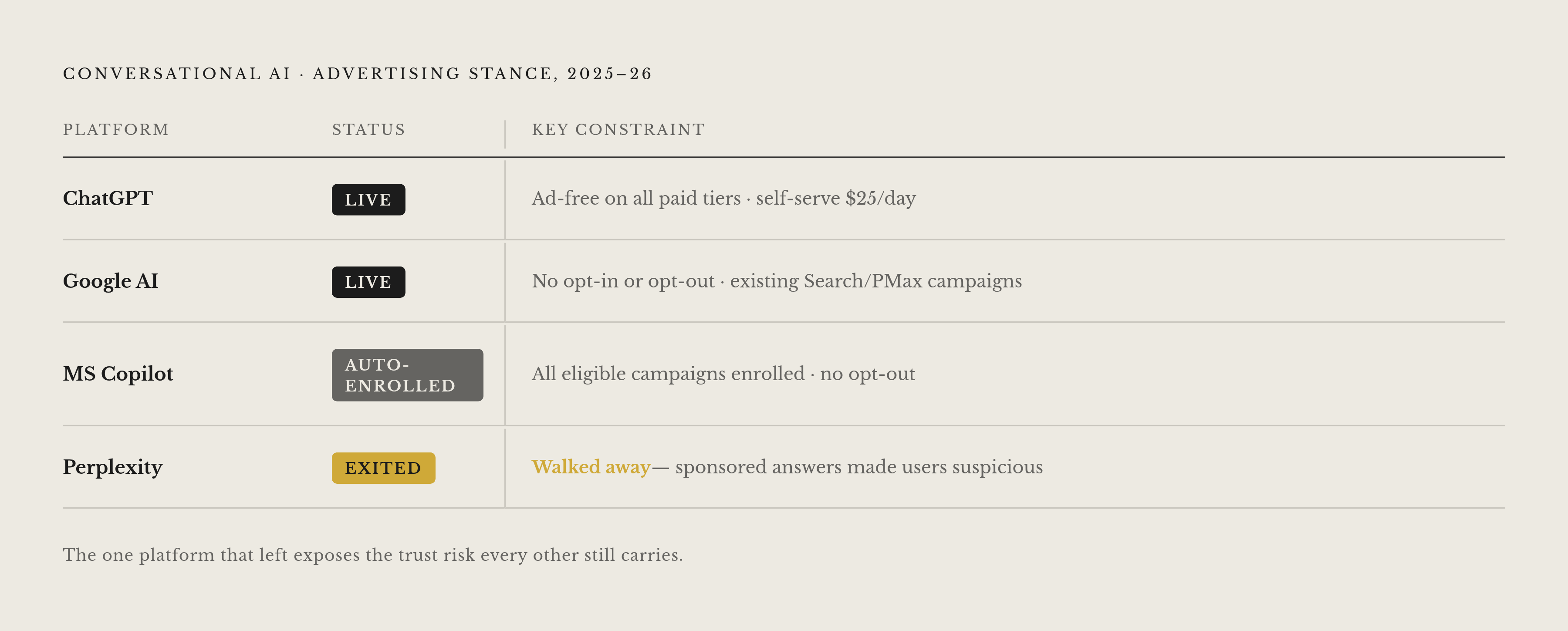
Four major platforms looked at the same opportunity and reached four different conclusions about whether and how to monetize it, and a planner needs to know which of those conclusions is live, which is constrained, and which is closed before committing any budget.
ChatGPT launched advertising on February 9, 2026. Ads appear as labeled sponsored cards below an answer, never woven into the answer itself, and they reach only logged-in adults on the Free and Go tiers. Every paid tier, Plus, Pro, Business, Enterprise, and Education, is ad-free, which is the single most consequential constraint for any B2B advertiser evaluating the platform: the professional users a B2B brand most wants to reach are disproportionately likely to sit on a paid tier where no ad will ever appear. A self-serve Ads Manager opened on May 5, 2026 at ads.openai.com, with campaigns starting at $25 a day and no minimum spend floor now that the earlier managed pilot has ended. Criteo became the first adtech partner integrated into the Free and Go tiers. OpenAI also built a custom audience feature that lets advertisers target using email addresses, phone numbers, hashed identifiers, and Google Advertising IDs, and the company has described sponsored agents, a format that would let a user chat directly with a brand-sponsored agent after clicking an ad, as part of its longer-term vision for the format. As of the third quarter of 2026, the ad product is live and expanding across more than 60 countries, including a large share on a second continent.
Google took a different approach: it monetizes AI Overviews and AI Mode through the campaign infrastructure advertisers already run. Search campaigns using broad match or AI Max, Performance Max campaigns, and Shopping campaigns are all eligible, but only if smart bidding is turned on. There is no opt-in and no opt-out. If a campaign qualifies, it is already serving inside AI-generated answers. The first task for any advertiser is an audit of existing campaigns rather than a decision about whether to participate. AI Overviews ads launched for mobile users in the U.S. in October 2024, then expanded to desktop in May 2025, then reached 11 additional countries in December 2025. Google has also announced newer, more explicitly conversational formats, Conversational Discovery ads and Highlighted Answers, for AI Mode. Reporting lags the product: Google Ads still doesn't break out segmented performance data for AI Overviews or AI Mode campaigns specifically, though Google Search Console added dedicated Generative AI performance reports in June 2026. Google wants to prevent LLM-based search from becoming a separate channel altogether, so it has folded the LLM experience into the standard results page and kept its ad auction as close as possible to the moment an answer gets synthesized.
Microsoft Copilot runs a stricter version of Google's model. Every eligible campaign and ad type is automatically opted in to serving inside Copilot, with no ability for an advertiser to opt out, and no placement is ever guaranteed. It reaches eligible Copilot users above the age of 13 in most regions, above 18 in some, and users under 18 see only non-personalized, contextual ads rather than targeted ones.
Perplexity is a cautionary case rather than a buying option. The platform built sponsored answers, then walked the category back entirely, because it concluded that sponsored placement risked making users suspicious of the answer itself. That's a real constraint other platforms haven't fully resolved: user trust in the response is part of what's being sold, and if the ad undermines that trust, the whole product suffers. Anthropic has never sold ad placement inside Claude, and it shows no sign of changing that position. Gemini carries no ads inside the chatbot itself, so Google's AI-related ad inventory lives entirely in AI Overviews and AI Mode, and the explicitly conversational ad formats stay tied to AI Mode specifically.
Where AI ads sit in the funnel relative to search and social
The cleanest way to place AI ads in a media plan is to ask which moment each channel already owns and let AI chat take the moment that's left over. Social interrupts people who weren't looking for anything in particular, planting category awareness or triggering a want that didn't exist a minute earlier. Search captures people who have already formed a specific query and are actively comparing named options. AI chat sits in the space between those two states, where someone knows they have a need, is actively narrowing it, but hasn't yet committed to a search term or a vendor.
That middle zone is where the six-prompt-deep research journey described in Verve's analysis of daily AI chat signals takes place. The user in that scenario isn't idly scrolling, and they aren't ready to type a final, high-intent search query either. They do the comparison work that used to happen across several search sessions and several site visits, except now it happens inside one sustained conversation.
There's downstream evidence that this middle-funnel activity doesn't just sit in isolation from the rest of a media plan. Adidas saw a measurable lift in branded search after the brand began showing up inside LLM conversations, showing a reinforcing relationship rather than a cannibalizing one.
The objection a planner will hear internally is that this all overlaps with what search and retargeting already do. The overlap is real for a single, isolated search query, but it isn't real for a multi-turn AI session, because a session carries information a single query never can: the sequence of what was asked, what was answered, and what the user asked next. The job of a planner is to map each surface to the specific moment it owns and resist the temptation to treat every AI placement as an interchangeable extension of an existing search or social line item.
As inventory keeps fragmenting across ChatGPT, Google's surfaces, and whatever Anthropic or others eventually ship, planners face a basic operational choice: manage each platform's native ad tools as separate line items, or run a single demand-side platform built to read conversational context and buy across more than one AI publisher at once. The latter is what programmatic infrastructure built specifically for conversational AI, the kind of buying layer one such vendor has built, is meant to provide: one place to centralize targeting logic and creative across surfaces, instead of rebuilding the same campaign four different ways in four different consoles.
Industry contexts where conversational intent is most commercially actionable right now
Four verticals have the clearest structural case for moving on this now, and each one has a different reason rooted in how its customers actually use conversational AI while they shop or research.
Travel is the most obvious. Travel already commands the largest share of digital spending directed at search among major verticals, and it accounts for roughly 60% of the category's total digital spending; per Verve's analysis, travel questions are also among the highest-frequency use cases inside AI chat. Visitors who land on a travel site after using an AI platform also show a meaningfully lower bounce rate than visitors from non-AI referral sources, which points to AI-referred traffic being further along in the decision process and more qualified by the time it arrives.
Healthcare carries real opportunity alongside real exposure. OpenAI reports that a majority of U.S. adults have used AI tools for health or healthcare questions in the past three months, and Google is already testing AI Mode monetization in healthcare through a limited U.S. pilot, so conversational search is being trusted with high-value, heavily regulated categories. The risk sits in inadvertent PHI disclosure: if ad targeting draws on health data signals that an AI platform has incorporated into its responses, that can trigger a HIPAA violation, and ads should never reference a personal health condition without proper consent. Tracking technology creates the same exposure if it captures protected health information and passes it to a non-compliant platform. Any brand in this category needs that compliance architecture built before it activates a single campaign, not after.
Finance has a parallel compliance dimension. Using generative AI in financial advertising brings a campaign under FINRA rules covering supervision, communications, recordkeeping, and fair dealing, and firms have to ensure that AI-generated ad copy complies with federal securities law, which in practice means documented review and approval before anything goes live. The burden is a known, surmountable cost, and the category's high commercial intent makes building that review infrastructure worth the effort for firms willing to do it properly.
E-commerce and retail are already moving. Amazon added Alexa for Shopping, an AI assistant that answers purchase-intent questions and runs alongside the standard search results page, and keyword search stays in place beside it. ChatGPT's pilot launch partners, Target, Williams-Sonoma, and Albertsons, alongside Adobe, were retail and consumer brands specifically, which suggests the surface had already shown enough commercial intent for major retailers to commit real, managed budgets to it early. Criteo's early integration data puts users referred from ChatGPT converting at a substantially higher rate than other referral channels, a gap large enough that it should factor directly into how a retail media planner prioritizes test budget for the next planning cycle.