Flight Scheduling and Pacing Logic in AI Ad Campaigns
Traditional ad pacing breaks down when inventory flows from conversation, not clock time.

Budget pacing in AI advertising has a problem no amount of tuning fixes: the heuristics running the show got built for a world of pages, keywords, and predictable clock-hour traffic. AI conversation streams don't work that way. They arrive in bursts tied to what a user happens to be asking about at a given moment, and no time-of-day curve can tell you when that burst hits. Most pacing teams are still fighting the wrong war: defending against a daypart problem that conversational AI doesn't have.
What makes AI conversation inventory structurally different from impression-based supply
A publisher selling a page slot is selling something that exists whether or not the visitor cares. The DSP gets a URL, a keyword, maybe a demographic guess, and it bids against that. The slot doesn't vanish if nobody's paying attention to it.
Conversational inventory doesn't work that way, and treating it like it does is the mistake most pacing setups still make. The ad opportunity gets created by what's happening inside an exchange that's already underway. A user typing about comparing project management tools, or asking follow-up questions about a vacation, throws off intent signal in real time, mid-conversation, not at a page load. That intent doesn't sit still either. A single session can swing from a sharp, high-intent moment to several flat turns and back again.
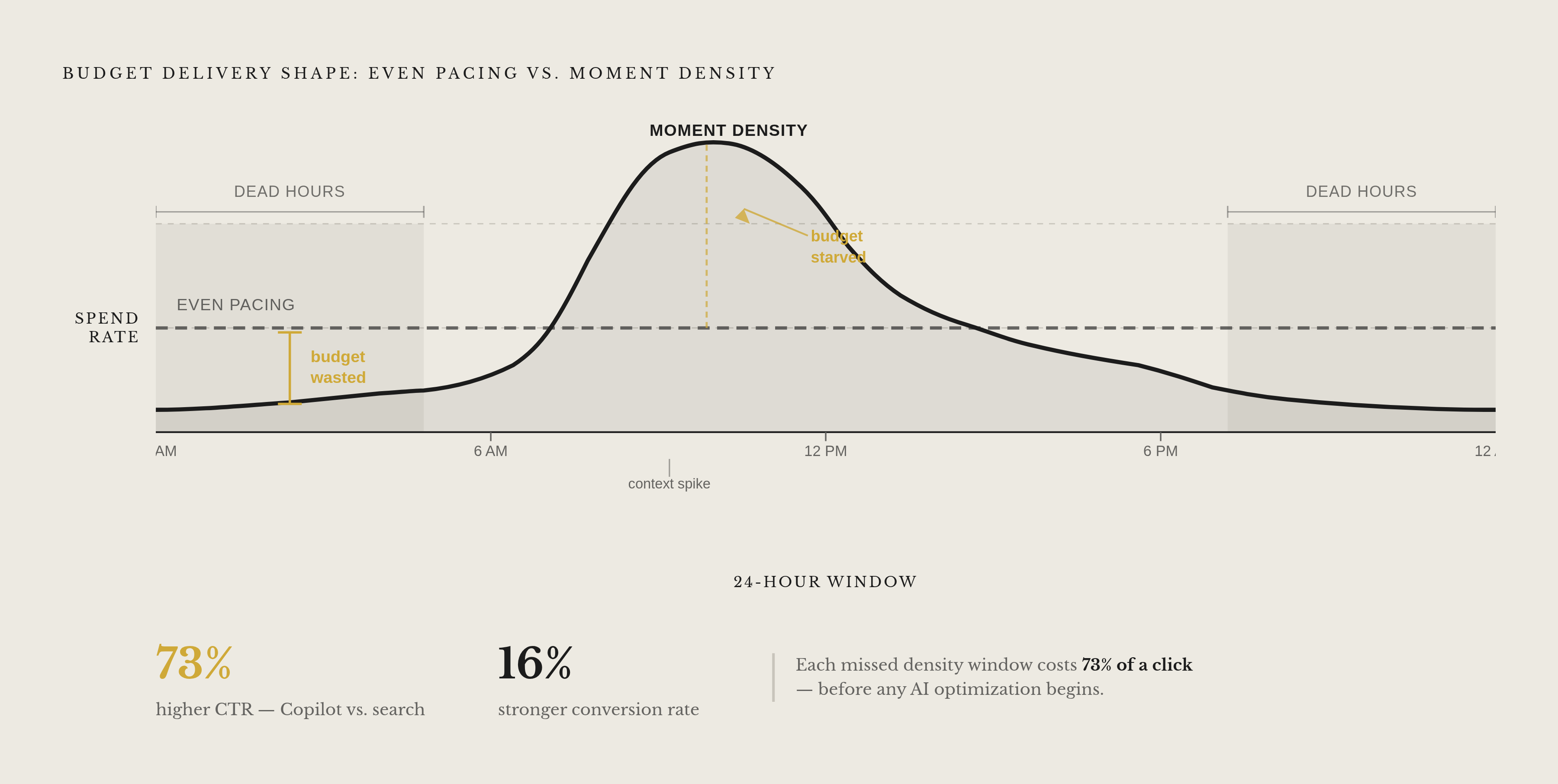
So supply density tracks topic mix, not the clock. A surge in travel-related conversations at 11pm on a Tuesday is invisible to a pacing system built around daypart curves. On ChatGPT, ad relevance gets matched to the immediate topic of conversation and to prior prompt context within that session, per OpenAI's own ad product documentation. The context hints advertisers use there aren't keyword bids in the search sense. They describe a conversational state ("users comparing project management tools") rather than an exact term, and that's a different inventory unit entirely. A campaign paced evenly across 24 hours burns through budget in the dead hours while starving the live ones.
Microsoft has put a number on why that gap matters. Copilot shows 73% higher click-through rates and 16% stronger conversion rates than traditional search, according to Microsoft Ads' own blog from August 2025. The number itself isn't the point. What it signals is that intent inside a conversational session runs hotter than intent inside a search query, so the cost of missing a high-density window is bigger too.
How the major AI ad surfaces structure their inventory, and what that means for flight timing
Each surface gates its inventory differently, and a flight built as one uniform block across all of them hits different supply conditions on each. Treating them as interchangeable is where most flight plans go wrong first.
ChatGPT announced ads on January 16, 2026, and launched them February 9, 2026, for Free and ChatGPT Go ($8/month) users in the US. The format is a "chat card" that shows up below the AI response. As of mid-2026, advertisers can bid CPM for brand discovery, CPC for direct response, or run Conversions/oCPC, which bills per click while optimizing delivery toward a tracked event like a purchase or sign-up. OpenAI factors predicted conversion likelihood into the per-click auction bid. Users can turn off ad personalization, and advertisers don't get access to chat histories or private details, though some limited identifiers may still pass to marketing partners depending on user settings. Put together, ChatGPT inventory is bounded on purpose: it only serves where topic relevance lines up and where the user hasn't opted out. Criteo is named as OpenAI's first technology partner for the test phase, with Scorpion handling local business campaigns inside the product.
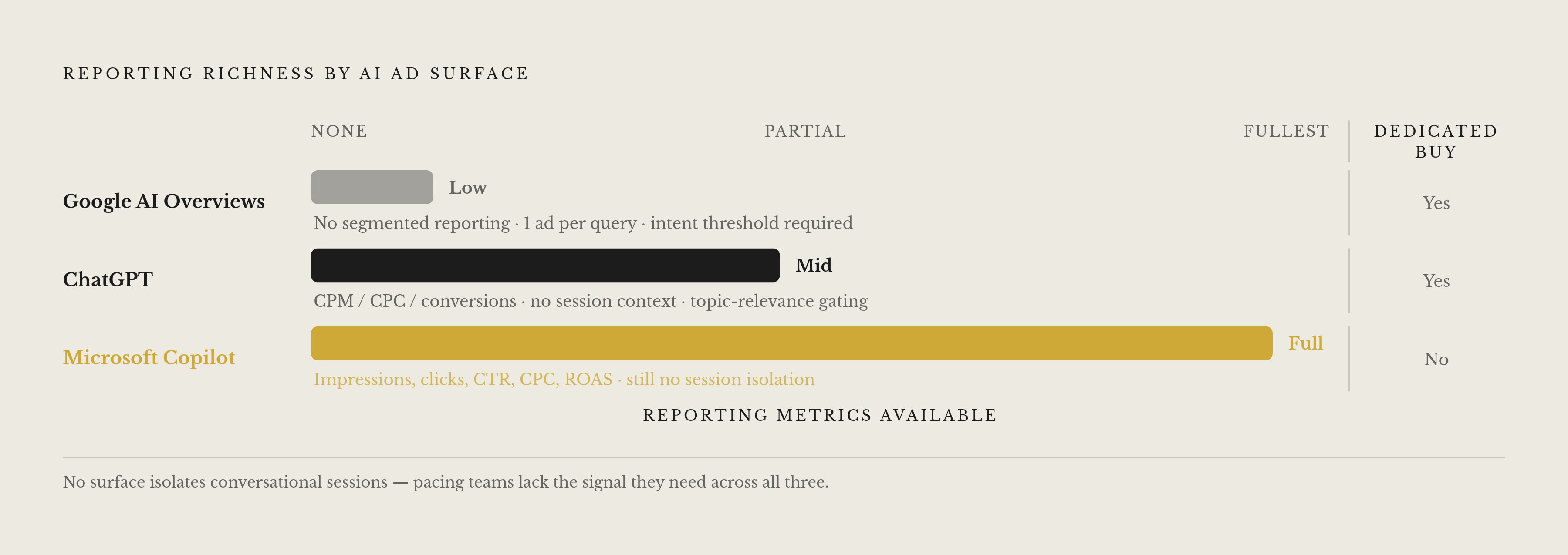
Google's AI Overviews launched ads in October 2024 on mobile in the US, expanded to desktop in May 2025, and reached 11 more countries by December 2025. There are three possible placements, above, embedded within, or below the summary, but only one shows per query, never all three at once, and each carries different visibility. Eligible formats are limited to Text or Shopping ads already running in Search, Shopping, or Performance Max. Adult content, alcohol, gambling, finance, healthcare, and politics are excluded categories entirely, so pacing strategy for advertisers in those verticals can't touch this surface at all. Not every AI Overview query triggers an ad either; the query needs to show buying intent, and the ad needs to fit both the query and the generated summary. There's no segmented reporting available as of mid-2026, so a flight running through AI Overviews can't be pulled apart from the broader Search or Performance Max campaign that fed it.
Microsoft Copilot ads are available to all eligible Copilot users, but can't be bought specifically for Copilot and can't be opted out of at the advertiser level. Inventory just flows through the standard Microsoft Ads buy. Copilot usage in PC search and Windows grew meaningfully between November 2024 and May 2025, and the mobile app also saw notable usage growth over the same window. Microsoft Ads also reports that customer journeys run 33% shorter on Copilot than on traditional search (August 2025 blog post), which compresses the gap between first exposure and decision. Pacing has to keep budget live through the whole session, not just at the top of the funnel. Reporting here beats AI Overviews by a wide margin: impressions, clicks, CTR, conversions, conversion rate, CPC, and ROAS are all available. None of it isolates specifically to Copilot conversational sessions within the wider buy, though.
A few other surfaces round out the picture, and matter mostly for what they rule out. Perplexity launched sponsored follow-up questions in November 2024 and pulled back from the program by early 2026; it's not accepting new advertisers, so it isn't a live scheduling surface right now. Google's Gemini app has no ads and, no plans to add them either. Google's AI Mode sits in test phase as of mid-2026 for US users, with new formats like Conversational Discovery ads and Highlighted Answers announced at Google Marketing Live, but broad availability isn't confirmed yet.
What moment density means as a pacing variable, and why it replaces time-of-day as the organizing signal
Call it conversational moment density: the concentration of high-intent, topic-relevant exchanges inside an inventory stream at a given point in time. It's a different measure than raw query volume or impression count, and it behaves differently too, which is exactly why porting over search-era pacing logic doesn't work.
Search traffic has real shape to it. Commute hours, lunch, the evening scroll, these produce bid-pressure curves stable enough to model, which is exactly what Waterlevel Pacing, examined in the International Journal of Research in Marketing alongside its refinement, Adaptive Waterlevel Pacing, for campaigns optimizing on profit rather than reach, was built to capture these curves. That research found that Even Pacing, still the default setting in most campaign systems, consistently underperforms the alternatives. So even the baseline most advertisers run today is already the weaker choice, before AI conversation inventory enters the picture at all.
AI conversation streams break the assumption those models depend on: a traffic curve stable enough to model in the first place. What matters isn't when users show up, it's when they show up talking about something that matches an advertiser's context. A spike in home-renovation conversations could hit at 2am and last six minutes or six hours, with no calendar logic behind it. Budget keyed to time misses these clusters by default, not by exception, and no amount of dayparting sophistication fixes a signal that was never time-shaped to begin with.
The alternative is pacing to moment availability: hold spend back when the topic mix running through the surface is low-relevance, and open the valve when context signals show a dense cluster of relevant conversation. That means reading context as it happens, not leaning on historical bid curves or clock hours.
Target's pilot inside ChatGPT is the clearest evidence available that this actually pays off. Ads served based on keywords appearing in a guest's actual prompt, matched to the live conversation, according to Target's own corporate blog post and fact sheet from February 2026. Traffic from ChatGPT to Target grew 40% on average each month during the pilot, which suggests moment-matched delivery compounds rather than producing a one-time bump. The takeaway for budget rhythm is plain: stop drawing a smooth delivery line and build a responsive valve instead. Spend low in quiet windows, spend high in dense ones, and hold reserves back specifically so a surge doesn't get missed for lack of dry powder.
How flight scheduling must account for episodic conversation structure rather than session count
Traditional flight scheduling picks from three modes: continuous, flighting (on/off cycles), or pulsing (a steady base plus timed bursts), chosen based on category seasonality and competitive pressure. All three assume an advertiser can name the high-demand weeks in advance. That works fine when demand tracks the calendar: holiday retail, sports seasons, product launch windows.
AI conversation demand doesn't track the calendar the same way, and scheduling it as though it does is where flights lose money. It tracks news events, product launches, and query cascades instead. A viral question or breaking story can spike a topic in AI assistants with zero calendar precedent behind it.
Multi-turn structure adds its own wrinkle. A user might start a research conversation, drop it, and pick it back up hours or days later, so the flight has to stay present across that full arc rather than just at the first touch. Copilot's compressed, 33%-shorter customer journey (Microsoft Ads, August 2025) suggests the decision window runs tighter in conversational AI, but tighter isn't instant. There's still a return session to catch, and a budget already exhausted by then costs real money, not a hypothetical.
Static daily caps set at flight launch handle this badly no matter which way you tune them. They over-pace on quiet days and run dry before a surge hits, or they under-pace on dense days and leave value on the table. Guideline's own framework flags the "set and forget" risk in traditional media, and it applies with more force here, because by the time a human reviews a pacing report, the conversational moment that mattered has already passed. The fix is structural: shorter flight sub-intervals with built-in review points instead of month-long locked plans, and reserves held at the campaign level rather than pre-loaded entirely into daily caps.
The role of autonomous pacing agents and where human governance must remain
Agentic buying is already running in production, not just sitting in pilot decks. MiQ's Sigma trading agent, NBCUniversal's tested agentic media buying, and Omnicom's confirmed live agentic buying using agent-to-agent infrastructure are all documented as of 2026. PubMatic launched AgenticOS on January 5, 2026, an agent-to-agent operating system where advertisers set goals, guardrails, brand-safety rules, and creative parameters through whatever LLM interface they prefer.
A protocol layer is forming underneath all this to standardize how it works: the Ad Context Protocol (built on MCP, mid-October 2025), plus IAB Tech Lab's Agentic RTB Framework, Agentic Audiences (formerly the User Context Protocol), and Agentic Advertising Management Protocols, all aimed at fitting agentic execution into existing OpenRTB and VAST rails. The reasoning layer running these agents shapes decision quality directly. GPT-4o, Claude, and Gemini are the named engines in active deployments, and a weaker model reads context worse, full stop. Memory architecture matters too. Short-term memory tracks what the agent's doing right now; long-term memory carries forward what worked in past flights. An agent that can't hold onto that history can't get better at calibrating moment density over time. It just resets each campaign from zero.
Some things still can't move to the agent side of the line, and this is where the industry needs to hold firm rather than defer to automation: hard budget limits, daily spend caps, approval gates on large changes, maximum thresholds for how much a daily spend can shift, and required human sign-off before a new campaign launches above a set budget. That governance gap is wider than the technology suggests it should be. Per the IAB State of Data report (as of March 2026), only 30% of agencies, brands, and publishers had fully integrated AI across the media campaign lifecycle, which means most of the organizations now running agentic pacing are doing it without mature governance behind it. The picture's real risk lies in that, not in the technology itself.
The specific danger in conversational AI pacing runs sharper than in display: an agent with write access to budget and live context signals can read a dense moment as a cue to surge spend, and without a hard cap, one viral topic could burn through a week's budget in hours. The agent should handle real-time bid adjustment and moment-density response inside guardrails a human already approved. Humans set those guardrails, review performance at the flight level, and sign off on any structural change to how budget gets allocated. Anyone letting the agent set its own ceiling is one viral topic away from a very bad week, a hypothetical not worth waiting around to test.
Measurement gaps that complicate pacing optimization in AI campaigns today
Every pacing model runs on a feedback loop: deliver, measure the outcome, adjust. The adjustment is only as good as the measurement feeding it, and right now that measurement runs thin across every major AI surface, thinner than most teams building pacing strategy around it seem to realize.
Google's AI Overviews offer no segmented reporting at all, so performance from that surface can't get pulled apart from the broader Search or Performance Max campaign it rode in on. ChatGPT gives advertisers CPM and CPC data, and conversion-level reporting when a Conversions objective runs, but the session-level conversation context that actually drove the click never passes to the advertiser. Copilot has the fullest reporting of the three, impressions, clicks, CTR, conversions, CPC, ROAS, but none of it isolates to Copilot-specific conversational sessions inside the wider Microsoft Ads buy.
That leaves pacing decisions built on partial signal almost everywhere. An advertiser can see that a flight performed well, but not always why, and not always which conversational moment drove it. Until reporting catches up to the granularity these surfaces actually operate at, pacing optimization in AI campaigns keeps running ahead of the data meant to justify it. Anyone claiming otherwise is selling confidence the measurement doesn't back up yet.