Deal ID Structures for Private AI Publisher Supply
Conversational AI inventory breaks the structural assumptions that make traditional deal IDs work.

Deal ID structures built for display and video inventory are migrating into AI publisher supply, and the migration is only partly successful.
What Deal IDs do in the OpenRTB stack
A Deal ID is a string inside the OpenRTB pmp object, and all it does is signal that a given impression is available under negotiated terms rather than open-market rules. The pmp object is the specification's container for direct deals: it holds an array of Deal objects, and only one field in them is mandatory, the identifier itself. Everything else in the object carries the commercial terms that the ID merely points to: bidfloor sets the minimum CPM, bidfloorcur defaults to USD, at determines the auction type (first-price, second-price-plus, or deal price treated as a floor), wseat lists which buyer seats are permitted to bid, and wadomain restricts eligibility by advertiser domain. A single flag can change the character of the entire impression: private_auction set to 1 means only deal bids are accepted, while at 0 open-market bids compete alongside them. The guar field marks a programmatic guaranteed deal, obligating the bidder to bid, and for audio and video inventory, mincpmpersec and durfloors let sellers price by creative length, with mincpmpersec introduced in the original OpenRTB 2.6 specification and durfloors added in the September 2023 revision, 2.6-202309. IAB Tech Lab guidance recommends using a deal ID whenever an impression might be awarded on grounds other than price alone, and it specifies that DSPs return at least one deal bid alongside one open-market bid, the so-called 1+1 minimum, with an M+N arrangement held up as the ideal, a rule practitioners frequently ignore in practice. Once a DSP decides to bid, the return path is mechanically simple: it copies the string into the dealid field of its Bid object, and the exchange matches it, applies the agreed terms, and decides a winner. Where header bidding sits in front of the ad server, Prebid.org documents a key-value convention, hb_deal for the overall winner and hb_deal_ followed by a bidder code for per-bidder deal bids, which the publisher's line items target to surface the deal, though prioritizing deal bids over open-market bids requires additional flags such as preferdeals or dealPrioritization.
The four deal types that travel on the same string
The same field, carrying nothing more than an identifier, stands in for commercial arrangements that differ from one another in almost every respect, and treating them as interchangeable is the most common reason AI publisher deals are configured incorrectly from day one. A preferred deal gives one buyer first look at a fixed price, but you get no guaranteed volume with it. A private auction invites multiple buyers to bid above a floor, with price settled by competition among that invited group and enforced through the private_auction flag. Programmatic guaranteed deals fix both price and volume, obligating the buyer to bid through the guar flag and requiring both sides to track forecasting and delivery. Marketplace packages bundle inventory across multiple properties or audience segments under one or more deal IDs, a format that curation has turned into the dominant growth vehicle in the space. The IAB Tech Lab's curation standards, announced in December 2024, made the deal ID the default delivery vehicle for data-inventory packages, so buyers increasingly encounter deal IDs that represent curated audience segments rather than a single publisher's inventory. The anti-patterns the IAB Tech Lab warns against, attaching an ID to a seat or an advertiser instead of a line item, or quietly shaving margin off deal bids as they pass through the chain, do particular damage in AI supply contexts, where audit trails are already thin.
Structural pressure on the standard Deal ID workflow
Before AI supply enters the picture, the Deal ID model is already showing strain, and Supply Path Optimization is the mechanism actively exposing it. Many deal IDs marketed as premium are, in practice, open-market inventory repackaged with higher floors and additional reseller fees layered on top, and DSP algorithms tuned for SPO are now catching and blocking exactly this pattern. By late 2025, the "Ad Tech Tax" had become a primary target for CFOs at major global brands, as advertisers recognized that a premium label on a deal ID offered no guarantee of premium inventory. When a DSP evaluates a deal ID today, it analyzes the full path that bid request traveled: a deal ID that passed through three resellers and a legacy SSP is likely to be blocked by the SPO algorithm before price even enters the calculation. The industry's response has been to move toward API-based integration, replacing static and opaque deal IDs with real-time, transparent connections; the IAB Tech Lab's Deals API was released for comment in December 2025 and marked final on February 6, 2026, encoding curation fee type as undisclosed, percentage, flat, CPM, or none. DV360 deprecated manual non-programmatic-guaranteed deal creation in April 2026, so the Deal Sync API is now the only route for configuring these deals, and that signals a broader shift: human-typed strings are giving way to machine-managed deal infrastructure. This pressure falls on a mechanism buyers cannot simply walk away from: the ANA's Q4 2025 benchmark found that private marketplaces accounted for the overwhelming majority of median programmatic spend across measured environments. So if you are a publisher with a supply path built for display inventory, with multiple SSP hops and legacy resellers in the chain, it gets penalized in SPO scoring before any AI context is even considered.
How conversational context breaks deal-definition assumptions
A standard deal definition assumes the unit of inventory is a page or a placement, and that you know its content when you configure the deal. A conversational AI session offers no such fixed content. Every structural assumption built into legacy deals, inventory bundling, brand suitability, audience targeting, volume forecasting, has to be rebuilt from the underlying signal up. A legacy PMP defines a deal against a placement: sports video, a homepage, an entertainment section, content stable enough to describe at negotiation time and to verify again once it has been delivered. An LLM interface offers no such placement. The "placement" is a conversation whose content emerges turn by turn, which the publisher cannot pre-describe and the buyer cannot pre-verify against a URL or a section taxonomy. The targeting mechanism stepping in to replace keyword or placement targeting is the context hint: a freeform, natural-language description, written at the ad group level and capped at a short character limit, of the conversations where a given ad belongs, matched against the live conversation in real time. That is a fundamentally different signal than a site list or a placement ID, and it changes the auction logic along with the targeting logic, since relevance becomes a component of the bid itself rather than a quality check applied after the fact. Volume forecasting, the precondition that programmatic guaranteed deals depend on, collapses under these conditions: session length, topic drift, and the number of monetizable moments in a conversation cannot be forecast from a URL or a section, so the guaranteed-volume commitments that structured PMPs around premium display inventory have no natural equivalent in conversational supply. That collapse is the hinge the rest of this analysis turns on, because it determines which deal types can be ported into AI publisher supply with minor adjustments and which require a different kind of commitment altogether.
Deal types: what carries over, what requires modification, what breaks entirely
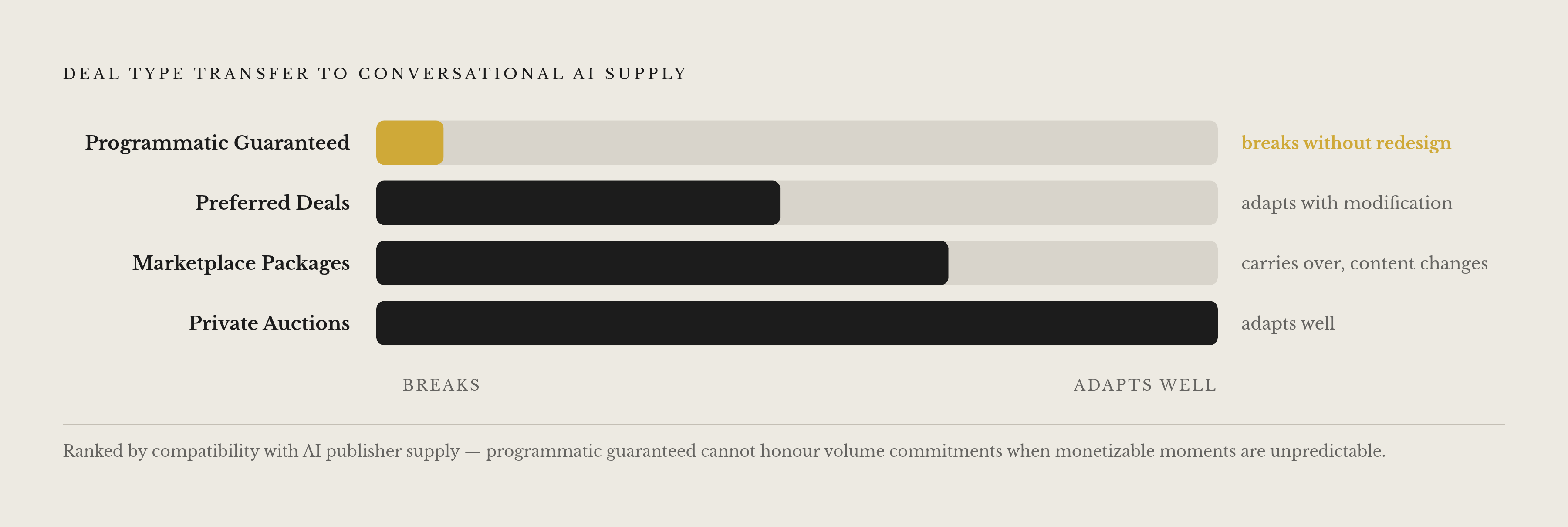
Preferred deals adapt to conversational supply with modification. The first-look, fixed-price logic survives intact: a buyer can still negotiate priority access at a floor CPM for conversations that match a defined context profile. What has to change is the inventory description itself. It can no longer reference a URL, a section, or a placement; it has to reference a context specification, written in natural language and matched at the moment of serving rather than fixed at deal configuration. The wseat and wadomain eligibility fields carry over without modification, and the bidfloor survives as well, but the placement description has to be replaced with a conversation-context descriptor that buyer and publisher agree on directly. Brand suitability verification shifts too, moving from pre-deal URL allowlisting to real-time context evaluation at serving time, and this workflow change demands publisher-side tooling, not just an updated deal ID.
Private auctions adapt well. The invite-list logic and the floor-bidding mechanics transfer directly, and the relevance-weighted auction structure used in at least one major conversational ad platform is structurally compatible with an at value of second-price-plus. What has to change is that invited buyers submit context hints instead of placement targets, so the auction awards on a combined relevance-and-price signal instead of price alone. Of the deal types examined here, this is the one most naturally suited to AI publisher supply, because it accommodates the uncertainty inherent in conversational content while still preserving price floors for publishers and priority access for buyers.
Programmatic guaranteed deals break without redesign. The guar flag obligates the buyer to bid and requires both sides to commit to a fixed price and a fixed volume, and neither commitment is realistic when the number of monetizable moments per session cannot be predicted and conversation topics cannot be verified in advance. The closest available adaptation is a context-conditional guarantee: it fixes price per qualifying conversational intent and expresses volume as a share of eligible moments rather than a raw impression count, but it needs platform-level support that does not yet exist in standardized form. Publishers who push programmatic guaranteed structures onto AI supply without that redesign should expect delivery shortfalls and reconciliation disputes.
Marketplace packages carry over at the infrastructure level, but what feeds them changes. The IAB Tech Lab's curation standards made the deal ID the default delivery vehicle for data-inventory packages, and that infrastructure continues to apply. What changes is the content of the package itself: it can no longer be built from page-level content categories or third-party audience segments, but must instead be built from conversation-derived context signals that the publisher exposes through the bid request in structured form. That shift matters because match rates already degrade at each platform hop, by a margin existing industry analyses place somewhere between a substantial fraction and a majority of the signal, and conversational context data degrades faster across those same intermediary hops than audience segment IDs do.
How to define inventory in a deal when there is no URL or section to point to
With no URL, section, or placement ID left to anchor a deal, the inventory specification has to be rebuilt around a structured conversation-context descriptor, and the terms of that descriptor need to be negotiated and fixed contractually with the same rigor that a floor price has always received. The natural-language context hint, freeform and capped at a short character limit in at least one live implementation, functions as both the buyer's targeting instrument and the inventory definition, specifying which conversations the deal actually covers. Context descriptors will never match the precision of a URL allowlist, but they can still be structured, by intent stage such as research, shortlisting, or decision, by topic cluster, and by exclusion category, giving both sides a verifiable record of what was bought and what was actually served. The same SPO skepticism that penalizes an opaque deal path in display supply applies here: a deal whose inventory definition amounts to "AI conversations generally" will draw the same distrust from DSP algorithms as a deal ID that has passed through three resellers, because neither one tells the buyer what they are actually getting. Publishers able to expose structured context signals directly in the bid request, intent stage, topic cluster, conversation depth, give buyers something concrete to match against at bid time, extending to conversational supply the same kind of transparency that direct API integration has already brought to display supply paths.