DSPs That Target Users Based on Live Prompt Content Not Audience Profiles
How conversational ad buying works and who can access it.
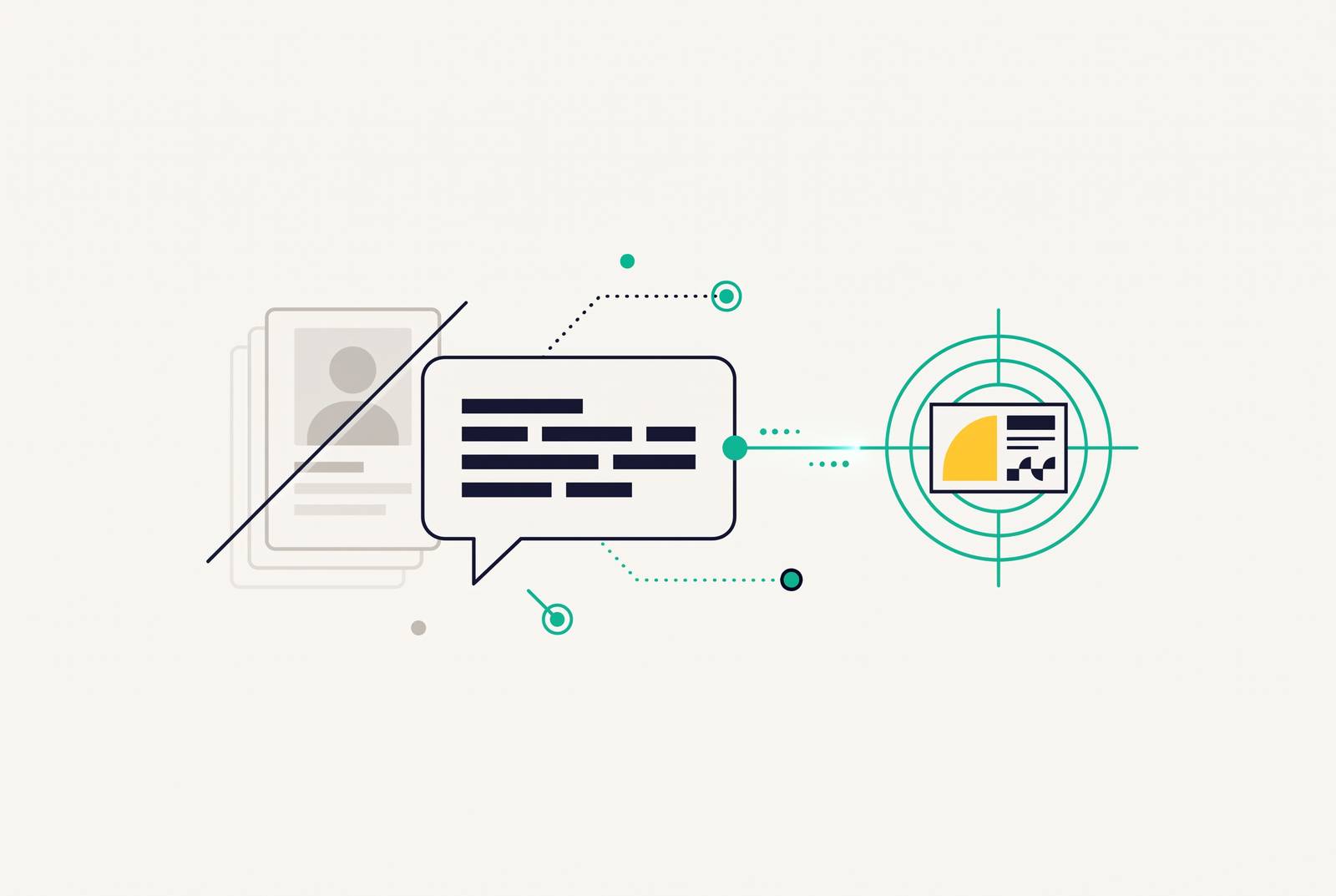
Prompt-content DSPs match ads to what a person is asking an AI now. ChatGPT offers direct buying through Ads Manager, while Google and Microsoft serve conversational placements through eligible existing campaigns. Perplexity has withdrawn from advertising. The operating advantage in this channel comes from understanding conversational relevance, auction mechanics, and measurement.
Why prompt-content targeting is a structurally different idea from audience-profile targeting
Audience-profile targeting begins with a person and their recorded history. What that person has done before, their demographics, and the interests they have shared help show which offer they might respond to. Prompt-content targeting starts from a different question, namely what the person is trying to accomplish at this moment. The conversation becomes the unit of selection. An offer qualifies because it fits the task underway, rather than because the user belongs to a promising segment.
A profile can suggest what someone has liked over time, while a live prompt says what they want to do now. The distinction changes the data required, the creative strategy, the auction, and the measurement model. It is not merely another audience attribute. OpenAI’s February 9, 2026 launch of ChatGPT ads took this approach with a context-hint system in place of the usual keyword or audience controls used outside chat.
The prompt as a targeting signal — what it contains and why it is richer than a keyword or a profile
A prompt can show intent, decision stage, category specificity, and emotional register all at once. A keyword gives the system a string to interpret, while a profile holds evidence of what someone has done before. A conversational request can instead describe the goal, the constraints, and the reason a person needs help. Much of the ambiguity has already been removed. The targeting system receives a description of a task rather than having to reconstruct that task from indirect signals.
Consider a user asking about integrating project management tools with an existing CRM. Follow-up questions might express frustration with the current solution and then request pricing comparisons. Each turn narrows the commercial opportunity. A system that reads conversational state can consider the earlier questions, the assistant’s responses, and the direction of the discussion rather than treating the request for pricing comparisons as an isolated event. The valuable signal is therefore not just the latest prompt but the trajectory of intent across the session.
That trajectory also distinguishes exploration from a more developed comparison. The same category can appear in an opening question and in a later request shaped by several constraints. Those are different moments for an advertiser. Topic matching alone cannot express the distinction, because it identifies the subject without necessarily identifying how far the user has progressed toward a decision.
How the targeting layer is actually built — context hints, semantic matching, and what replaces the keyword
A context hint describes, in natural language, the conversational situation in which an offer belongs. Its purpose is to explain what the person is trying to accomplish and why the offer would be useful then. A comma-separated topic list does not do that work. Writing hints is therefore a new craft.
The system uses semantic relevance to match that description to the live conversation. It also reads the ad title and copy and the landing page, making the destination part of targeting rather than merely the place where conversion happens. A specific hint paired with generic creative or an unrelated destination weakens the relevance that the hint was intended to establish.
Google’s AI Mode and AI Overviews draw from existing campaigns, including broad match, AI Max, Performance Max, and Shopping, with smart bidding recommended and no placement opt-in or opt-out control. Microsoft’s Copilot documentation states that all eligible campaign and ad types are automatically opted in, advertisers cannot opt out, and display is not guaranteed. Copilot assembles ads from assets already in the account. ChatGPT requires a new targeting layer, while these platforms inherit existing campaign inputs, with less visibility into where they serve.
How the auction resolves — relevance-weighting, second-price mechanics, and what that means for buyers with smaller budgets
In the relevance-weighted, second-price model described here, bid size does not determine the winner by itself. A more contextually relevant ad can defeat a higher bid because relevance is a direct input to selection. It is not simply a final tiebreaker. Second-price mechanics then mean that the winner pays just above the next competing bid.
This creates an opening for buyers with smaller budgets. A precise context hint, creative that matches it, and a relevant landing page can fit better than an offer with a vague description and more money behind it. Budget cannot substitute for that alignment. The auction evaluates the inputs together, so the buyer’s advantage comes from expressing one coherent response to the conversational moment.
That advantage matters more while advertisers are still learning to write context hints. As the field becomes more capable, precision becomes a shared competency. The opportunity for smaller advertisers is therefore time-limited. It also operates under a strict technical constraint, because the auction must resolve within milliseconds without interrupting the conversation.
The infrastructure behind real-time conversational targeting — what has to run in milliseconds and why that is hard
Before an ad appears, the system must interpret the incoming query, read conversational state, evaluate candidate ads, calculate relevance, resolve the auction, and serve the winner. These operations share the same tight latency budget. A noticeable delay is a conversational experience failure. Engineering must therefore achieve a good semantic match quickly enough across the candidate pool.
Conversational state makes this harder than handling an isolated search query. A chat session has a history that the targeting system must maintain and read in real time. Publisher integrations also need stable session identifiers to connect a later purchase to the right conversation and surface, because a stateless LLM does not provide that attribution infrastructure natively. Without per-user capping within a conversation, the same offer can appear repeatedly, weakening both the experience and advertiser efficiency.
Perplexity’s withdrawal from advertising illustrates the separate cost of user distrust. Sponsored placement made users suspicious of the whole answer. An integration can therefore function technically and still undermine the conversational product it is intended to fund.
Which platforms let buyers access ads inside AI assistant conversations at scale?
Purpose-built conversational DSPs are designed around live context, while generalist DSPs provide broad reach without the same ability to read conversational state. Buyers can also buy directly from a platform or through existing campaign integrations, but each route has to follow the rules of its surface. Neither broad distribution nor a chat placement alone establishes that a platform can target the evolving conversation.
ChatGPT is the largest conversational surface in the brief. OpenAI reported roughly 900 million weekly active users around the February 2026 launch and passed a billion monthly users in May 2026, as reported in June 2026. Its self-serve Ads Manager opened on May 5, 2026, and buyers no longer had to meet spend minimums. Reach is restricted, however, to logged-in adult users on Free and Go. Plus, Pro, Business, Enterprise, and Education are ad-free, creating a substantial planning constraint for B2B advertisers whose intended audiences skew toward paid tiers.
Google offers access through existing Search, Performance Max, and Shopping campaigns. Copilot similarly draws on eligible Microsoft campaigns, while Claude is an ad-free channel because Anthropic has not monetized it with ads. Targeting inputs, formats, auctions, tier restrictions, and attribution differ by surface. A cross-surface conversational DSP earns its function by bridging that fragmentation, rather than merely adding another single-surface connection.
How brand-safety and suitability work differently when the ad sits inside a conversation rather than next to a page
Page-level safety tools check a URL or its content against category rules. A conversational system must instead assess meaning as a discussion develops, because an initially suitable topic can move into sensitive territory over several turns. The latest prompt may not show that shift. Suitability therefore depends on the trajectory as well as the immediate trigger, making static page checks an incomplete safeguard.
OpenAI’s ad policies require clear labeling and independence between advertising and answer content. The sponsored card sits below the answer rather than inside it, separating commercial content from the model’s response. That boundary has a practical commercial purpose. Perplexity’s trust concerns show how suspicion about an ad can extend to the surrounding answer and weaken confidence in the entire surface.
Independent measurement is beginning to address this operational need. Integral Ad Science announced on October 5, 2026 that it was one of the first media quality partners supporting ChatGPT Ads, providing third-party brand safety and suitability measurement. That is an institutional response within a system whose full maturity remains unproven. Buyers and platforms still share responsibility for whether a placement fits the conversation in which it appears.
The measurement gap — what can be attributed, what cannot, and why honest accounting is a competitive advantage
Conversational advertising does not yet offer measurement parity with established search or social buying. Last-click and view-through models assume a traceable relationship between exposure and conversion, but a conversation can influence a user who never clicks an ad. The user may act through a separate channel. A user can therefore discover something in a conversation and buy it without leaving the direct trail that conventional attribution needs.
Stable session identifiers are necessary to connect an impression with a downstream conversion where that connection can be measured. They are not a complete solution to unclicked influence. Per-user attribution also depends on knowing which user saw which ad in which session, the same foundation needed for effective frequency controls. Missing that foundation compromises both optimization and credit assignment. Instrumentation must consequently be treated as part of the publisher integration.
Microsoft reports that Copilot placements outperform traditional search on click-through and conversion rate. Those results come from the vendor and do not independently show that attribution works across the whole channel. Early reporting suggests strong post-click engagement, while the broader discovery-to-conversion path remains incompletely measured. IAS’s entry is a step forward in third-party verification, but it leaves that gap open. Buyers who separate observed performance from unmeasured influence have a firmer basis for budget decisions than those who force conversational results into a legacy accounting model.
What buyers who can operate in this channel actually do differently — from context-hint craft to cross-surface coordination
Capable buyers write context hints around specific conversational situations. They treat the hint, creative, and landing page as one targeting system, because when those parts disagree, relevance suffers before conversion does. Timing becomes a campaign-design skill as well. A user beginning research occupies a different purchase moment from one several turns into a constrained comparison, even when both conversations concern the same product category.
ChatGPT, Google AI Mode, and Copilot require different inputs and expose different levels of control, so cross-surface buying is a coordination task rather than a straightforward campaign duplication exercise. B2B planning also needs to account for eligible tiers. Buyers targeting business decision-makers should compare ChatGPT’s Free and Go restriction with Copilot’s Microsoft 365 positioning when judging how many of each platform’s users they can reach with ads.
Measurement discipline completes the operating model. Buyers who instrument sessions with stable identifiers and frequency controls create the evidence needed to optimize, while honest reporting distinguishes measurable outcomes from influence that remains unattributed. Building these skills takes investment in how buyers work as well as access to media. The early advantage is real because the field is still learning how to express and evaluate conversational fit. It is not permanent, and the buyers developing that competence now establish the standard later entrants will need to match.