First-Party and Contextual Alternatives to Cookies Ranked by Programmatic Precision
Ranking five cookie alternatives by how well they reveal intent.

Real-time prompt intent analysis for programmatic advertising uses the meaning of an AI conversation to match an offer to a person’s current decision. Ranked by recency, declaration, and specificity, conversational AI prompt signals sit above first-party data, identity solutions, contextual targeting, and cohorts. A prompt states what someone wants now, while the other signals largely reconstruct intent from behavior.
Why ranking cookie alternatives by precision matters now
Advertisers need to rebuild several capabilities at once, which takes more than replacing a single targeting input. Third-party cookies supported cross-site audience building, retargeting, frequency capping, and multi-touch attribution. No single alternative recovers all of those functions. Instead, each restores a different part of the system, which makes an undifferentiated recommendation to “go cookieless” operationally weak. A tool that improves attribution may do no better at choosing the signal for the next impression.
Programmatic precision provides a useful axis for separating those capabilities. It measures how closely a signal identifies what a specific person is likely to do next, in a specific moment. That distinction is central to performance advertising. Reach, identity continuity, and measurement remain valuable, but none independently establishes that a person is considering a purchase now.
What precision means as a measurement standard across all alternatives
Precision here means how directly and reliably a signal shows current purchase intent, as opposed to historical behavior, demographic profile, or inferred interest. Three dimensions define the ranking. Signal recency measures proximity to the moment of decision, while signal declaration distinguishes inferred intent from intent expressed in the user’s own words. Signal specificity measures how narrowly the signal describes the need, from a broad product category to a purchase decision already in progress.
Consent-chain integrity is a prerequisite: even a detailed signal must be collected and processed lawfully. Its performance value depends on a defensible consent chain wherever personal data is involved. The tiers below apply the same three precision criteria, with privacy and addressability treated as conditions on their practical use.
Tier five: Google's Topics API and cohort-based signals
Google’s Topics API and cohort-based approaches are in the lowest precision tier because they group people by broad interests. The category describes an association. Topics assigns interests from browsing history over a rolling window, so someone who researched running shoes a week ago may retain that label while comparing kitchen appliances. The signal does not resolve the change in purpose.
Declaration and specificity are similarly limited by the mechanism. The user does not state a commercial need or choose the assigned topic. Before retirement, Privacy Sandbox also faced objections from privacy advocates over concentrated power within Google’s ecosystem and from advertisers over targeting granularity. Cohorts show broad interests from the past, while contextual targeting can at least make sense of what someone is reading now.
Tier four: AI-powered contextual targeting
Modern contextual targeting uses machine learning to understand what a page means, going beyond keyword matching alone. That is a genuine improvement in signal quality. It also brings the signal closer to the present because the page is the one the person is currently reading. Unlike identity-based approaches, contextual targeting does not need to recognize the reader across sites to match an advertisement to that content.
Contextual targeting that collects no personal data avoids the GDPR and CCPA risks associated with personal-data targeting. In cookieless environments, behavioral targeting loses 30–60% of addressable inventory compared with contextual approaches. Peer39 notes that contextual impressions typically cost less than behavioral impressions on eCPM, CPC, and vCPM. The precision-to-cost ratio can therefore be favorable even when absolute intent precision is lower.
A finance article could attract a student researching an assignment, a journalist checking facts, or a VP of procurement preparing to sign a contract. Contextual targeting shows what someone is reading now, but commercial intent still has to be inferred because the reader has not declared it.
Tier three: universal IDs and identity resolution
Universal IDs restore individual-level targeting across authenticated inventory by translating hashed or encrypted email addresses into pseudonymous cross-site identifiers. They reconnect activity to a known, consented identity. That enables frequency capping, retargeting, and audience suppression, which page-level contextual signals cannot reproduce. The precision gain comes from associating behavior with a particular person rather than treating everyone reading the same page as equivalent.
Identity, however, is not a statement of intent. The behavior attached to an identifier can still be historical, even when the identifier recognizes someone in the current session. Privacy rules still apply because a hashed email is still personal data under EU law, and publishers differ in how they ask for consent. Reach depends on publisher adoption and logged-in users. Outside authenticated inventory, which excludes most open-web browsing, the identifier is unavailable and its targeting advantage disappears.
Tier two: first-party data, retail media networks, and data clean rooms
First-party data has the highest precision among the pre-AI alternatives because it records the relationships a brand has with its own customers. Purchases, page visits, and email engagement are observed events. Predicting the next purchase still takes some interpretation of those events. This distinction makes first-party data a stronger foundation without turning a historical record into a current declaration.
Retail media networks build on that foundation with point-of-sale and loyalty data that reach beyond the customers a brand already has. A person who bought running shoes six months ago and is now browsing athletic apparel presents a more grounded in-market signal than a broad content association. The combination connects demonstrated category participation with more recent activity. With so much evidence of purchases, retail media is especially precise within the legacy stack.
Data clean rooms support a different extension of first-party value. Decentriq describes clean rooms as privacy-safe environments for advertiser and publisher collaboration, with some implementations allowing resulting insights to be activated directly with the chosen publisher. They are useful for lift studies, frequency audits, and reach analysis. Real-time cross-publisher activation at scale remains operationally complex, however. More importantly, collaboration does not change the evidence’s time orientation, because past transactions and engagement cannot establish what a person is trying to accomplish in the current session.
Why all five legacy tiers share the same fundamental limit
The central limitation is not simply that older data becomes stale. Reading a page now establishes attention to the page. Linking the event to an identity helps connect that person’s activity over time, but may still leave unclear what they are trying to decide.
This separates signal quality from signal type. Better matching, richer transaction histories, and more capable contextual models can improve a prediction. They do not convert an observation into a declaration. The advertiser still has to judge whether what someone did before or is reading now points to a chance of a purchase.
Third-party cookies operated within the same constraint. They assembled behavioral history from more sources, which could make predictions better calibrated. They did not expose the person’s unstated goal. Losing those histories reduced the evidence available for the prediction, but replacing them does not require treating historical inference as the best possible signal.
A commercial AI conversation changes the evidence available. When someone asks which product fits a stated need, the need is no longer hidden behind a browsing pattern. The person has expressed it directly. Interpretation is still necessary to match an offer to the request, but the advertiser no longer has to reconstruct the underlying goal solely from unrelated behavior.
Tier one: how can live AI prompts become programmatic ad signals?
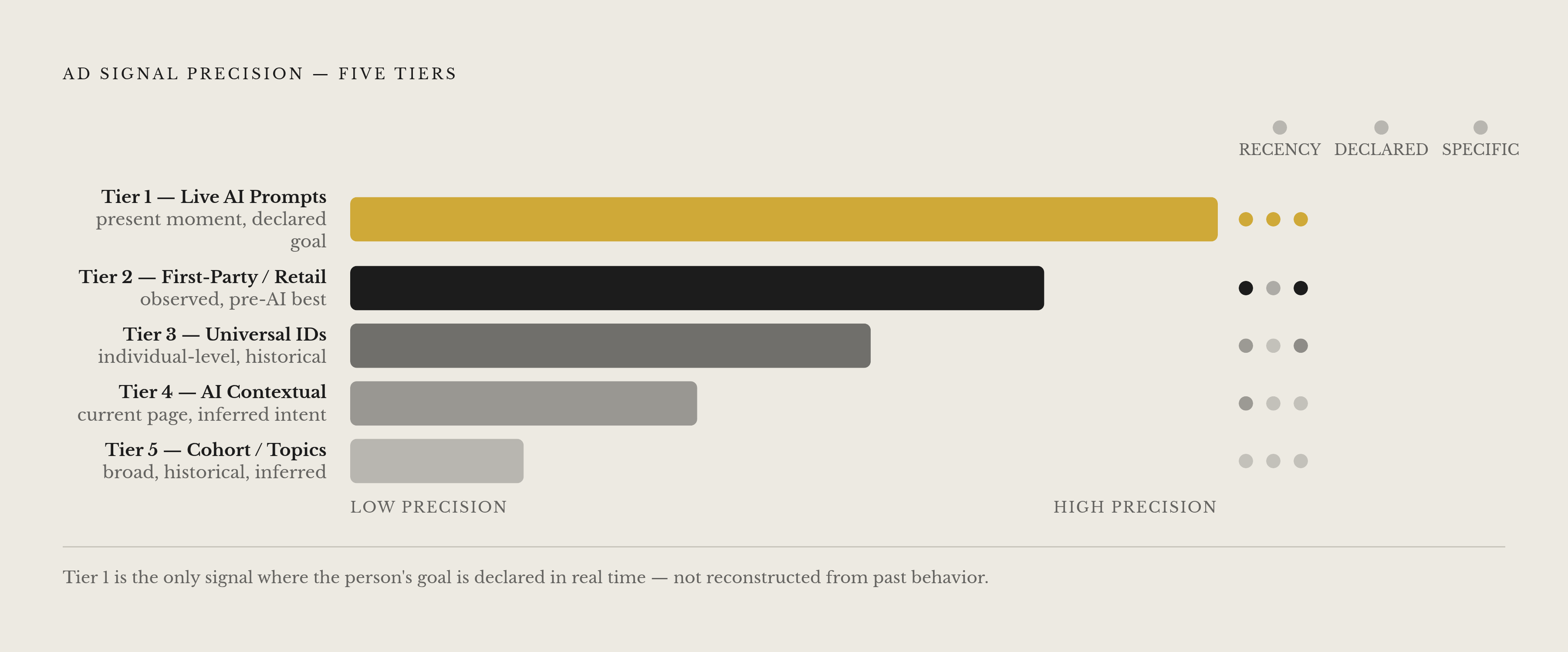
Conversational AI prompt signals rank first because they combine present-moment recency, explicit declaration, and detailed decision context. The prompt is generated while the person is seeking help. It can express a goal together with a budget, timeline, use case, and constraints. This places the signal inside a decision already in progress.
Mechanically, the targeting input is the semantic meaning of the conversation. The advertiser matches an offer to the expressed need rather than bidding only on a keyword, demographic, or historical audience label. Session-level context makes that match more specific. Follow-up questions add what the person has compared, rejected, or still needs to resolve, so a later turn can describe a narrower opportunity than the opening prompt.
This is why real-time prompt intent analysis requires infrastructure that can read conversational context. Generalist DSPs cannot do that, while single-surface AI networks can read the context only on their own platform. Cross-surface buying needs a platform built for conversational inventory that works across multiple AI surfaces through its own exchange and direct publisher supply. The infrastructure requirement is distinct from the ranking itself. Access to inventory gives advertisers reach, while understanding the conversation gives them contextual precision.
The strongest precision claim applies to prompts expressing a commercial decision. An explicit product comparison provides different evidence from a general informational question. Even a detailed request does not guarantee a purchase, and the privacy prerequisite still applies. Its advantage is that the person’s stated objective is available at the moment an offer could help address it.
What conversational intent data reveals that no cookie-era signal could
Conversational intent data can expose the structure of a decision. A search for “best project management software” establishes broad interest. A prompt comparing two platforms for a 12-person remote team, with a fixed monthly budget and a need for Slack integration and async workflows, supplies much more. It identifies vendor consideration, team size, budget constraints, integration requirements, and workflow preference within one request.
Those details show why one offer might fit better than another. A category label cannot express that distinction alone. A transaction history might establish previous software purchases, but it does not disclose the constraints governing the current comparison. The prompt can also reveal the gap between what the person already knows and what remains unresolved. That gap is part of the buying decision.
Multi-turn conversation also keeps track of what has already been said through retained conversational state. Each follow-up can narrow the comparison or clarify a requirement. By the third or fourth turn, the decision may be described more completely than weeks of browsing history could describe it. The resulting specificity comes from the person refining the question, rather than from the advertiser assembling more observations about that person.
How to operate across all five tiers in practice
The practical response is a portfolio organized by objective. Measurement, frequency capping, and attribution belong with first-party infrastructure and clean-room collaboration, where working across publishers is easier for measurement than for real-time activation. Even with a high-intent prompt, advertisers still need infrastructure to measure campaign results and manage the activity of known customers.
For prospecting and audience extension, contextual targeting and retail media networks provide reach at useful levels of precision. Known-customer retargeting calls for first-party data activated through clean rooms or publisher direct deals, supplemented by universal IDs in authenticated environments. Each allocation restores a distinct operational capability. Publisher audiences also have a place in this mix, though they cannot replace everything cookies did.
Conversational AI should be tested on its own for high-intent performance. The relevant opportunity is the session in which someone actively requests a recommendation, comparison, or decision. Brands and agencies that test now can build familiarity before the channel reaches the measurement maturity and standardization of search. As platforms like ChatGPT expand self-serve infrastructure and measurement tooling matures, that familiarity can support broader use of the signal.
A single-surface network gives access to one environment, while buying across surfaces needs conversational-context interpretation across multiple AI publishers. The test is whether the infrastructure can understand the decision as well as reach the inventory. Lower tiers recover valuable functions, but conversational signals add something different to the portfolio, which is access to a person’s expressed need while that need is being worked through.