Reframing the Attribution Conversation When AI Ad Clicks Never Existed
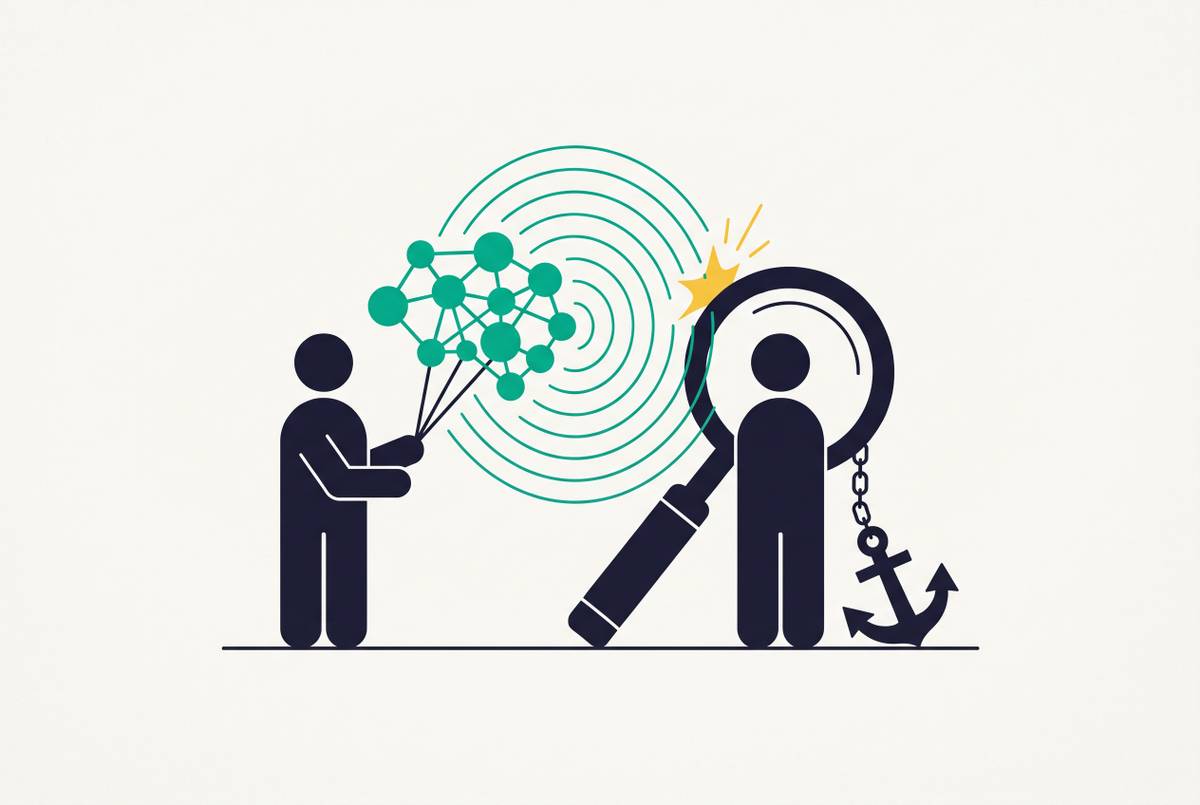
Click-based attribution can't see AI recommendations, so budgets drift.
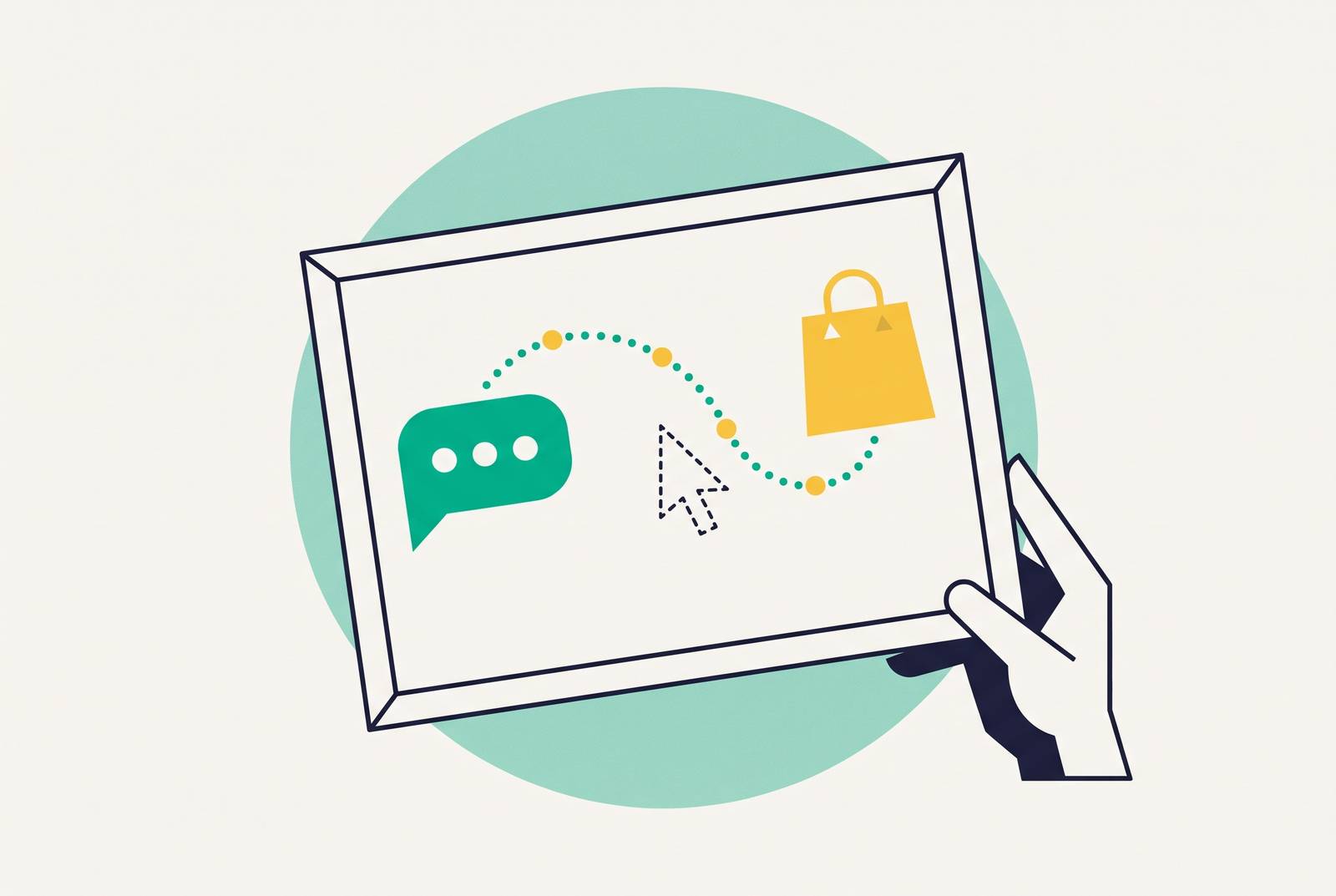
Conversational AI advertising platforms place paid messages around live AI exchanges, rather than simply adding a chatbot to a brand’s website. OpenAI offers ChatGPT Ads, while Google and Microsoft serve ads inside AI answers through existing campaigns. These placements expose a structural attribution problem. When an assistant shapes a purchase without a click, advertisers must measure conversational influence.
Why the click became the foundation of digital attribution — and what that assumption required
The click represented a legible handoff between an advertisement and its destination. It was more than an expression of interest. It connected an exposure to a visit, giving downstream attribution models an event they could associate with a later conversion. The system that developed from the mid-1990s depended on that connection being visible, recordable and available for assigning credit.
Its underlying sequence comprised a page, a feed, a keyword, a cookie and a click. Together, these supplied the surfaces, matching logic and records through which advertising influence could be reconstructed. A conversational recommendation removes those preconditions. The assistant can answer a question, name a brand and continue the exchange without a page visit, a feed exposure, a keyword match, a cookie set or a click. The resulting break is a category gap, because the event the model expects does not occur in the same form.
Which platforms offer conversational AI ads — and why has measurement lagged?
OpenAI began showing ads to Free and Go users on February 9, 2026. Within months, it reported that ChatGPT Ads had reached a billion-dollar annualized run rate in well under a year. Commercial scale preceded a matching measurement standard. Advertisers were therefore committing live budgets before they had a shared way to distinguish the influence of a conversation from the performance of an adjacent advertisement.
The self-serve Ads Manager opened on May 5, 2026, removing the high minimum commitment that characterized the launch period. That opened access to a broader advertiser base, much of it without conversational measurement infrastructure. As of October 21, 2026, ChatGPT Ads run across a large number of countries for a large and still-growing base of advertisers.
Google and Microsoft serve ads inside AI answers through campaigns advertisers already run, and there is no opt-out. Consequently, an existing media plan can include AI-influenced purchase pathways without a corresponding change in reporting.
How the AI assistant actually shapes a purchase decision — and where the measurement chain breaks
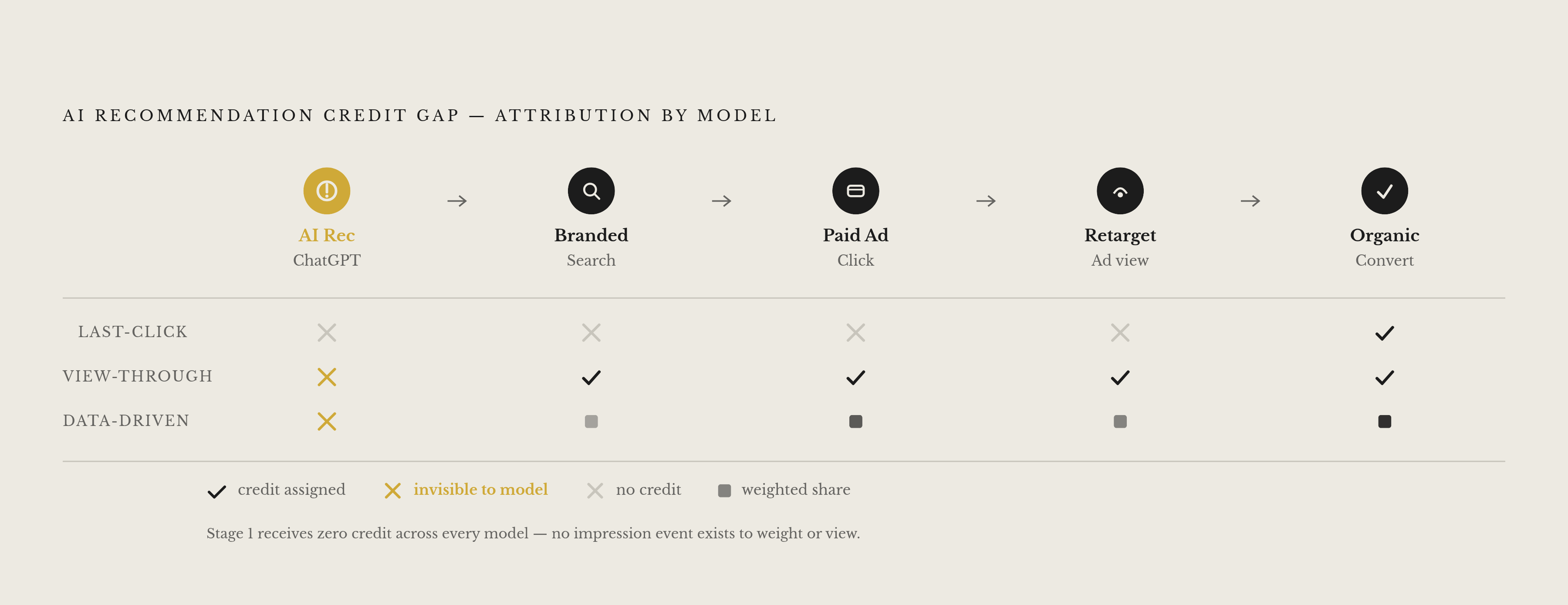
Consider a user who asks ChatGPT for a recommendation. The assistant names a brand, and the user searches for it by name, sees a paid search ad, browses and leaves. The user later sees a retargeting ad and makes a purchase through organic search. Last-click attribution assigns the conversion to organic search. The recommendation that initiated the journey has no event in that record.
View-through attribution has no impression event for the organic citation, while data-driven attribution has no event to weight. Even media mix modeling cannot include a channel for which it has no usable data. The failure occurs before the model decides how to distribute credit.
The distinction between a recommendation and an advertisement is essential here. ChatGPT’s labeled sponsored card sits below the answer and may generate a measurable click. OpenAI’s advertising principles state, “Ads do not influence the answers ChatGPT gives you. Answers are optimized based on what's most helpful to you. Ads are always separate and clearly labeled.” That protects the separation between advice and paid placement. It also means that measuring the sponsored card does not measure all the commercial influence of the response above it.
What conversational sessions actually contain — and why that changes what measurement must do
A keyword records a string, while a conversation records a goal in development. The exchange can reveal how specific the need is, which trade-offs the user is weighing and whether the user appears ready to decide. These are different kinds of evidence. Treating a session as merely another potential source of clicks discards information about the decision itself.
Users may be in research, comparison or decision modes. Conversational bidding mechanics can distinguish these intent stages in ways that keyword match types cannot. A measurement framework therefore needs to retain the stage associated with an exposure or citation, rather than flatten every interaction into an equivalent touchpoint. Otherwise, the buying logic can recognize intent that the reporting logic subsequently erases.
Branded search lift provides a downstream trace of this influence. When a brand is mentioned in AI chat, branded search activity rises as users take the demand that formed in the session elsewhere. A paid or organic click may then capture that demand. The click is measurable, but it is downstream. Recognizing that sequence shifts attention from which channel recorded the visit to which signals help explain why the user sought the brand.
Why retrofitting existing attribution models onto conversational AI produces systematically wrong answers
If a user clicks a paid search ad after receiving a ChatGPT recommendation, the ad platform records the click and credits paid search. The AI session remains invisible. An advertiser relying on that record can move budget toward the channel that captured demand and away from the channel that helped create it.
Paid search continues to produce visible events, while conversational influence remains outside the event record used to evaluate investment. As more decisions begin in AI sessions, more credit can migrate to later, trackable touchpoints.
Paid search reporting has no keyword match for the conversational recommendation, organic reporting has no page visit, and view-through reporting has no impression event. Google AI Overviews illustrates the distortion from another direction. Paid CTR on queries with AI Overviews dropped sharply from prior levels, yet paid CTR was dramatically higher when a brand was cited than when it was not. The citation changes the context in which the measured click occurs.
Media mix modeling presents the strongest objection to this diagnosis because it can address channels without user-level event chains. Media mix modeling requires volume and time-lag data that most AI surfaces cannot yet supply and treats the session as a black box, leaving its intent signals unread.
What a measurement framework built for conversational influence would actually track
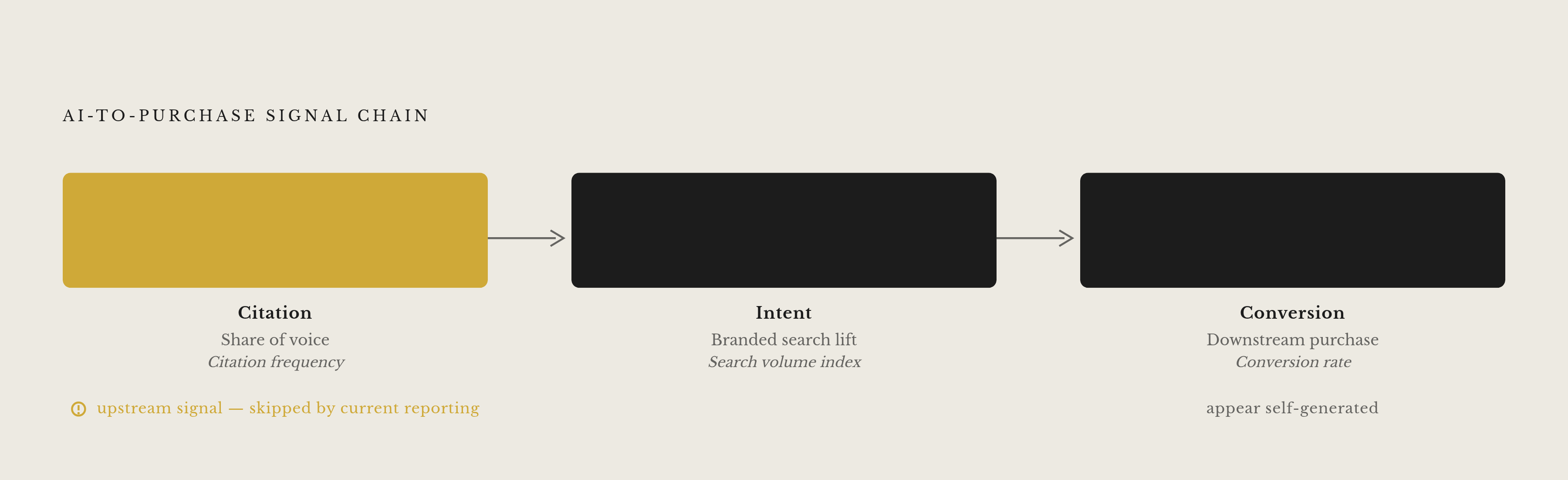
Tracking branded search lift, share of voice in AI responses, citation frequency and downstream conversion behavior provides a practical starting point. These signals describe influence before and after the visit. Share of voice records how often, and in what context, a brand appears across conversational responses. It serves as an upstream counterpart to impression share in paid search.
Citation frequency, branded search lift and downstream conversion rate form a three-stage measurement logic. A citation makes the user aware of a brand, a branded query shows intent, and a conversion records the demand that was captured. Advertisers can choose to track each stage with tools they already have. That provides a more appropriate basis for evaluating the pathway than assigning all credit to its last visible event, while leaving the complete user-level chain and the contribution of every citation unproven.
A citation in a decision-stage exchange should get more conversion credit than a mention that gives information during research. Applying that distinction requires context about the active topic, the user’s apparent goal and the stage of the conversation. Direct publisher relationships are valuable because access to this context can be as important as reach.
The shared infrastructure remains unfinished. IAB Tech Lab standardization of OpenRTB profiles for conversational ads and a common measurement layer is pending, with formal specification updates directed toward late 2026 and 2027. Frameworks built now around citation, intent and downstream behavior can be positioned to map onto those standards. They should not be presented as if interoperability or complete attribution already exists.
What the measurement rebuild requires from each party in the conversational ad ecosystem
Advertisers must add branded search volume and AI citation share as primary KPIs beside CPA and ROAS. Supplementary reporting would leave budget decisions anchored to the same incomplete record. The change is to evaluate conversion economics with evidence about where demand began, including influence that never appears as an ad click.
Agencies must make the same change in client reporting. A last-click report for a media plan containing conversational placements presents a partial picture as a complete one. Reports need to distinguish recorded conversions from upstream conversational signals and make their measurement limits explicit. Otherwise, the way reports are set up encourages clients to judge the channel by events it may not produce.
Publishers face a separate infrastructure requirement. Monetizing a conversational interface means tracking that a product exists, that a link is tracked, that the publisher receives credit and that the user does not repeatedly see the same offer. A base LLM cannot reliably guarantee these functions. Purpose-built infrastructure is therefore necessary, while retrofitted legacy ad technology risks importing its existing measurement gaps and revenue constraints.
Platforms operating both the conversation and the auction hold the richest context. Their willingness to expose intent-stage data, citation frequency and conversation-level information determines what advertisers can meaningfully assess. Industry bodies must standardize the layer through which that information becomes usable across participants. No party can supply the whole chain alone.
A DSP buying across conversational surfaces through direct publisher supply has a particular structural opportunity. It can aggregate cross-surface citation share, intent-stage distribution and branded lift associated with conversational contexts. That combination reaches beyond a single surface’s view or a generalist buyer’s access. That advantage depends on the signal layer it can access, beyond its ability to buy inventory.
The attribution conversation that needs to happen now — before standards arrive and while the channel is still being defined
Advertisers and agencies participating now can help determine which signals become standard and how those signals are reported. Waiting is also a consequential choice. Brands that defer involvement will inherit a framework shaped by earlier participants, including their decisions about intent-stage weighting and acceptable evidence.
The comparison with early paid search is imperfect but useful. Advertisers that treated the click as a proxy for intent built judgment and infrastructure while the channel was still developing. Conversational attribution offers a similar opportunity to learn, but the proxy must change. Reproducing the old event model would preserve the assumption that caused the present gap.
For now, advertisers should treat branded search lift, AI citation share and the intent-stage data they can get as primary signals, while building reporting infrastructure that can work with formal standards. Those signals remain imperfect and only partially instrumented. Their limits should be stated. The choice now is whether to help define how conversational influence is measured or let decisions continue to follow the channels that happen to leave a click.