Conversation Stage Targeting in AI Chat Campaigns
Reaching the right ads at the right moment of buying intent matters more than keywords or budgets.

Conversation stage targeting is the defining mechanic of AI chat campaigns. It makes real-time prompt intent analysis for programmatic advertising useful when buying ads by reading how a dialogue moves through awareness, consideration, and decision. The advantage comes from aligning the ad, format, and landing page with the decision the user is trying to make now.
Why keyword and page-level targeting cannot read a conversation in progress
Keyword targeting reads the string of words a user typed. That string can identify a subject, but it cannot establish whether the user is beginning research or asking a final question before purchase. The user can use the same words about buying at either point. A targeting system that sees only the query therefore lacks the sequence that gives the words their meaning.
Page-level contextual targeting has a different but related limitation. It analyzes fixed content at crawl time, while a ChatGPT conversation generates its content through successive exchanges. There is no stable page to classify. The subject can shift with every input, and the commercial opportunity can change even when the broader topic remains the same.
A restaurant recommendation can become a trip-planning discussion. That discussion can move into budget constraints and then transportation logistics, creating distinct commercial moments within one session. A restaurant keyword or travel-page classification cannot distinguish those transitions. The privacy architecture described for LLM advertising makes this limitation more consequential because relevance derives from the current conversation. Without a persistent user identifier to target against, the dialogue must give the system the context that older systems got elsewhere.
How a multi-turn dialogue accumulates intent signals that no single query carries
An opening prompt establishes a direction. It may be informational, exploratory, transactional, or already close to a decision, but later exchanges clarify which interpretation fits. A user narrows the subject, introduces a budget, specifies a location, or rejects an alternative. Each constraint changes the meaning of what came before.
“What is a good CRM?” leaves the purchase journey largely undefined, while “compare HubSpot and Salesforce pricing for a ten-person team” supplies alternatives, a commercial criterion, and an operating constraint. Both concern CRM software. Yet the second query expresses a much narrower task, and preceding exchanges can establish how the user arrived there. Quick follow-ups may show that the user is in a hurry, while slower exchanges may point to research, though timing alone cannot show how ready the user is to act.
Product names are not required for this process. A sustained discussion of team coordination failures can reveal a problem narrative even when the user never names the category that solves it. The assistant keeps the dialogue context in its context window, giving an ad system context it can use without a separate system to track browsing. Long histories can be truncated, and discourse coherence describes the connected meaning of the exchange.
What conversation stage targeting is and how it classifies where a user sits in a decision journey
Conversation stage targeting classifies a dialogue’s available arc into awareness, consideration, or decision and uses that classification as the primary targeting input. Topic identifies the field of interest. Stage identifies what the user is doing within it, distinguishing research from comparison and comparison from an operational question about purchase.
A family exploring a trip illustrates the distinction. Broad questions about what such a trip might involve indicate awareness because the user is still defining the problem. Comparing flights and hotels within a budget indicates consideration because alternatives and tradeoffs have become explicit. Questions about prices, availability, and booking terms indicate decision because the remaining uncertainty concerns taking action. These are working classifications of the conversation.
Advertisers use a natural-language context hint to say when an ad can be shown. This freeform description names the conversations where an ad belongs, and the platform’s model matches it against the live dialogue without an intervening keyword layer. An advertiser can therefore target comparison or near-decision conversations about travel. Microsoft Copilot uses a similar session-level approach that looks at the whole conversation. Copilot also displays “ad voice,” a summary before the ad block that explains how the ads connect to the discussion.
How the auction architecture makes conversation stage targeting the primary lever, not price
ChatGPT’s relevance-weighted, second-price auction means that more precise targeting helps advertisers buy ads as well as classify conversations. Advertisers usually pay just above the next competing bid. Relevance also influences the outcome. A larger budget does not compensate automatically for an imprecise description of the conversational moment an advertiser wants to reach.
The auction looks at the context hint, ad title, copy, and landing page together. A software advertiser focused on active comparison can therefore outperform a broader advertiser when its relevance score is higher. This is the practical substitution for keyword-era ad quality score optimization. Price still plays a part, but it cannot make up for a weak match.
OpenAI’s ad system crawls the landing page during review, making the destination part of that match. A page that continues a specific comparison gives the system a more coherent relevance signal than a generic homepage. For buyers, the implication is to treat stage selection, context hints, and destination content as one decision. Lower bids on decision-stage hints that name the conversation precisely can bring better clicks than larger budgets spread across broad awareness conversations.
How ad formats map to conversation stages, and why placement position is a design commitment, not a layout choice
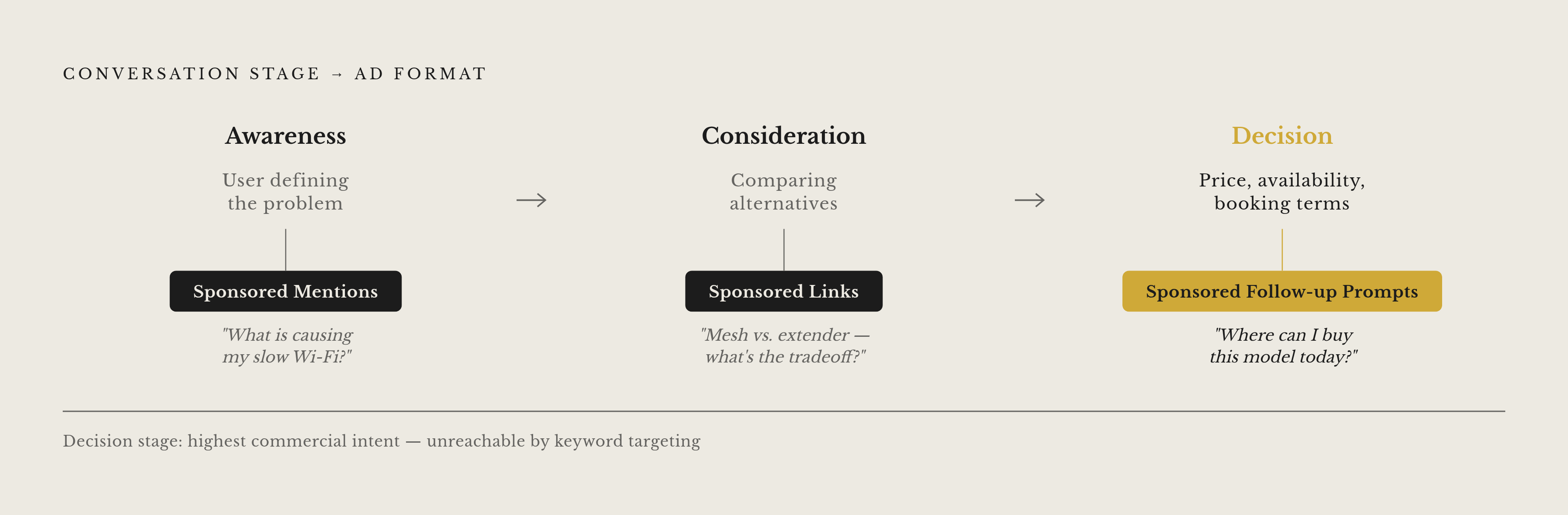
Sponsored mentions, sponsored links, and sponsored follow-up prompts serve different conversational needs. Mentions suit awareness because they introduce a brand or product while the user is defining a problem. Links suit consideration because they take the user to a resource or product worth looking into. Follow-up prompts suit decision because they continue an existing line of inquiry inside the interface.
That taxonomy does not make every format appropriate for every platform. OpenAI’s Answer Independence principle says that ads do not affect ChatGPT’s answers and stay separate and clearly labeled. A sponsored mention woven into an answer is not equivalent to a separate commercial unit placed near it, even if both introduce the same product. Placement commits the platform to a particular boundary between assistance and advertising.
Copilot places commercial units below the organic response and uses session-level context to connect them to the conversation. This preserves a distinct role for the ad while allowing its relevance to reflect the discussion’s direction. The user has just asked a question and is actively reading an answer, unlike the passive attention common to banners or feeds. That attention increases the cost of a mismatch. An awareness-level mention in a decision-stage exchange offers an introduction when the user needs help acting, dissipating the value of an otherwise precise signal.
Why conversation stage signals reveal purchase intent more precisely than any keyword or demographic proxy
A conversation stage shows where the user stands in making a decision, while a keyword gives a piece of what they said. Knowing that someone typed “project management software” is less precise than knowing they have spent twelve conversational turns discussing coordination failures, evaluating two tools, and asking about pricing tiers. An age bracket or income quartile is further removed because neither establishes readiness for a particular purchase at a particular moment.
This changes what relevance means for media buying. The useful distinction is not simply whether someone resembles a likely customer, but whether the current exchange reveals a problem the advertiser can resolve. Because the signal comes from the conversation, it reflects present intent. That is a structural advantage as privacy regulations tighten. It does not require treating every detailed conversation as a guaranteed conversion.
A user can ask follow-up questions, leave the chat, and convert hours or days later, creating a conversation gap that last-click models can undercount. A delay alone does not prove that the ad led to the purchase. Effective measurement nevertheless needs the preceding context, including conversation depth, primary intent signals, and timing, as well as clicks and conversions. Otherwise, the measurement system discards the very evidence that made the placement distinctive.
How campaign structure must change when conversation stage replaces the keyword as the primary organizing unit
For brands and programmatic leads, the operational shift is to organize campaigns around problem domains and decision stages. Campaign planning starts by identifying what a user is actively trying to resolve. That produces a map of relevant problem narratives. Awareness, consideration, and decision then warrant separate ad groups because each requires its own context hint, creative, and landing page.
The context hint has the most weight in targeting. Comma-separated topic lists describe subject matter but leave the system to infer the commercial moment. Descriptions of who is participating, what they want to accomplish, and where they stand in the decision provide a more precise match. The destination must preserve that specificity. A decision-stage comparison ad should lead to a page addressing the comparison.
Teams with programmatic or content-targeted advertising experience have a head start, but the unit of audience changes from a demographic segment to a problem state. For platform selection, the relevant criterion is whether the system can read conversational context on the surfaces being bought. Cross-surface campaigns spanning ChatGPT, Google AI Mode and AI Overviews, and Copilot require that capability across those environments. A generalist DSP without conversational context-reading cannot carry out the same stage-level strategy, while a single-surface network cannot reach users beyond its own interface. Coverage and context-reading are separate capabilities, and buyers need both for that campaign structure.
Which verticals gain the most from decision-stage targeting, and why the gap between early movers and late adopters compounds over time
Travel is a clear fit because conversations about it naturally move through destination research, itinerary building, budget comparison, and booking. Each phase presents a different commercial task. Date specificity and pricing questions make booking intent recognizable without relying on a travel keyword alone. A brand able to distinguish those phases can align its offer with the point at which a traveler is ready to evaluate or act.
Healthcare and pharma involve longer, high-consideration decisions, with rich signals in symptom specificity, treatment comparisons, and provider availability. Those signals show both an interest in a health topic and the context in which the user is making a decision. Their richness should not be confused with permission to target sensitive information. In e-commerce, Amazon’s Rufus demonstrates that the transactional layer of AI commerce is already active. Rufus logged rapid user growth, and users who engage with it are substantially more likely to complete a purchase, connecting conversational assistance with shopping behavior.
The available platform landscape gives this learning a practical timetable. ChatGPT’s self-serve Ads Manager opened in May 2026 and expanded to a range of countries, creating an early buying period with less competition than a more crowded field would bring. Perplexity’s withdrawal from advertising and Anthropic’s commitment to keep Claude ad-free, while reserving the right to revisit that approach, also narrow the available surfaces. That concentrates the strategic significance of ChatGPT, Google AI Mode, and Copilot. The opportunity is not only access to placements but experience in distinguishing valuable conversational moments.
Early participants accumulate knowledge about which context hints, creative angles, and landing page continuations perform at each stage. That knowledge compounds as more campaigns expose useful distinctions between superficially similar conversations. A late entrant can increase its bid immediately, but it cannot purchase the accumulated understanding of which problem states deserve that bid.