Ranking the Ad Tech Platforms by Depth of Real-Time Prompt Intent Analysis
ChatGPT reads more of a conversation than Google's AI placements do.

Real-time prompt intent analysis for programmatic advertising reads the topic, decision stage, need-state, and sequence in a live conversation to turn it into ad signals. ChatGPT is the clearest live example of multi-dimensional matching, while Google can reach more people through the campaign tools it already has. To rank platforms by depth, the comparison must cover which signals they can read as well as whether they place ads inside AI answers.
Why prompt intent analysis is not keyword matching with extra steps
A user typing “I need to plan a two-week trip to Japan with my family” is not simply searching for Japan. They are opening a conversation about a plan. The message says where the user wants to go, how long they want to stay, and who they will travel with, while leaving room for follow-up questions about limits and choices.
The distinction becomes sharper in a commercial evaluation. “Project management software” identifies a category, but a prompt describing team size, budget constraints, integration requirements, and an evaluation deadline describes a buying problem. Timing changes the value of that signal. Keyword matching alone cannot distinguish someone who just heard of the category from someone two days from purchase when both use the same category term.
Meta-style audience sculpting describes who someone is, while a prompt describes what they are trying to accomplish now. The intent is expressed rather than inferred from browsing behavior, although interpreting it still requires analysis. Advertisers who transpose keyword lists or audience segments onto conversational platforms risk discarding the very information that makes the channel distinct.
The four dimensions that actually separate shallow from deep intent reading
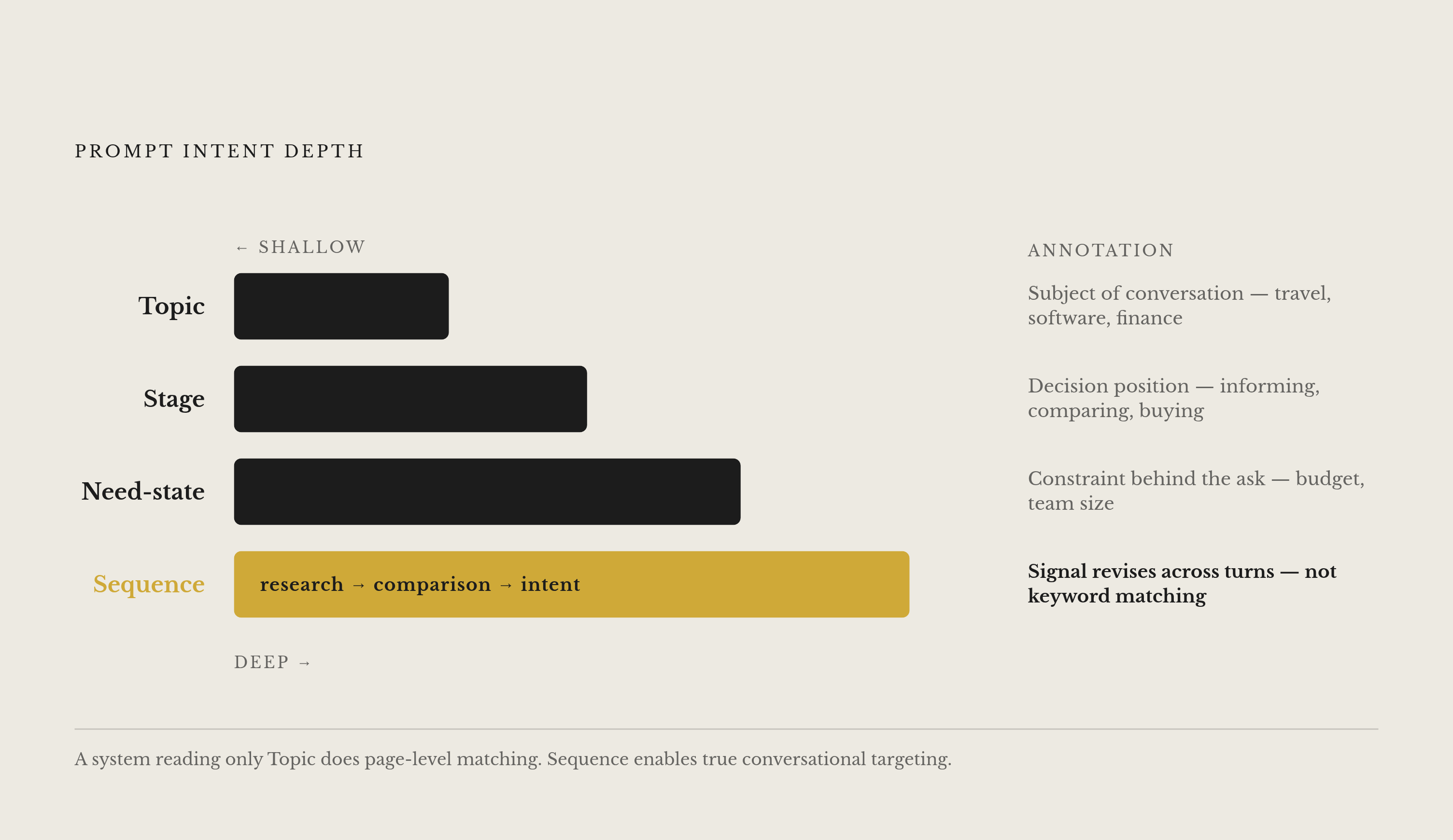
A useful order for reading these signals is topic, stage, need-state, and sequence. Topic is the subject of the conversation, such as travel, home improvement, or software evaluation. It is the shallowest layer of intent reading. Every contextual matching system works at this level, and a system that goes no further is doing much the same as page-level content matching inside a chat window.
Stage identifies where the user sits in a decision. Within the same topic, a user can be looking for information, comparing choices, or ready to buy. The category alone cannot separate those moments. A system that reads topic and stage can prioritize commercially relevant exchanges without treating every mention of a product as evidence of purchase intent.
Need-state is the problem or constraint behind what the user asks. A limit on the budget, the size of a team, a focus on sustainability, or a need for accessibility can decide which offer fits even when the user never names a product category. This is where relevance becomes more specific. Matching an offer to someone comparing project management tools for a remote team with a hard budget limit is a different task from matching one to someone comparing the same tools without those constraints.
Sequence adds the order and development of the conversation. It allows a system to detect when research becomes comparison or when comparison becomes a decision, without waiting for another session or keyword. Repetition also changes how a signal should be weighted. Models trained on conversational patterns can use question specificity, follow-up depth, and return frequency to distinguish a cost concern revisited repeatedly from a price question mentioned once and dropped. Depth therefore depends on reading these dimensions together and revising that reading as the conversation goes on.
How the ChatGPT ad system uses live prompts to target ads in real time
The ChatGPT ad system is the only live, self-serve AI-native ad platform described as of mid-2026. OpenAI Ads Manager launched on May 5, 2026, initially for advertisers in the US. The language model generates its response from training, reasoning, and conversation context before the ad matching algorithm analyzes the conversation for a relevant placement. This matching process therefore gives ads no way to change the organic answer.
OpenAI’s help page identifies the current chat thread, including personalized model responses, ad interactions, past chats, and memory as signals available when Personalized Ads is enabled. That personalization is opt-in. The broader matching loop uses both the live conversation and feedback on how people engaged with similar ad units.
The auction then weighs relevance against price. A score measuring how well an advertiser’s context hint matches the live conversation ranks alongside the CPM or CPC bid. A more relevant ad with a lower bid frequently wins over a less relevant ad with a higher bid.
Criteo was the first adtech partner integrated into the system and subsequently introduced Prompt Smart Ads. The product combines commerce data, shopping signals, and prompt-level insights to generate product creatives and descriptions dynamically. Context can therefore shape the creative as well as the placement. This is a distinct capability from simply selecting an existing ad for a broad topic.
Analysis happens in-memory during active sessions, and full conversation transcripts are not persisted by that analysis process. Afterward, all that remains is aggregate statistics and signals used to train the model. Reading sequence therefore works without building a persistent user profile, while the choice to use past-chat and memory inputs for personalization is separate.
What Google's approach to the same problem reveals about depth versus reach
Google routes existing campaign types into AI-generated surfaces rather than making conversational context a separate targeting layer. Search campaigns that use broad match or AI Max, along with Performance Max and Shopping campaigns, can appear inside AI Mode and AI Overviews. Exact and phrase match Search campaigns can appear above or below AI Overviews, but not inside them. Eligible campaigns enter these placements without a separate opt-in or opt-out.
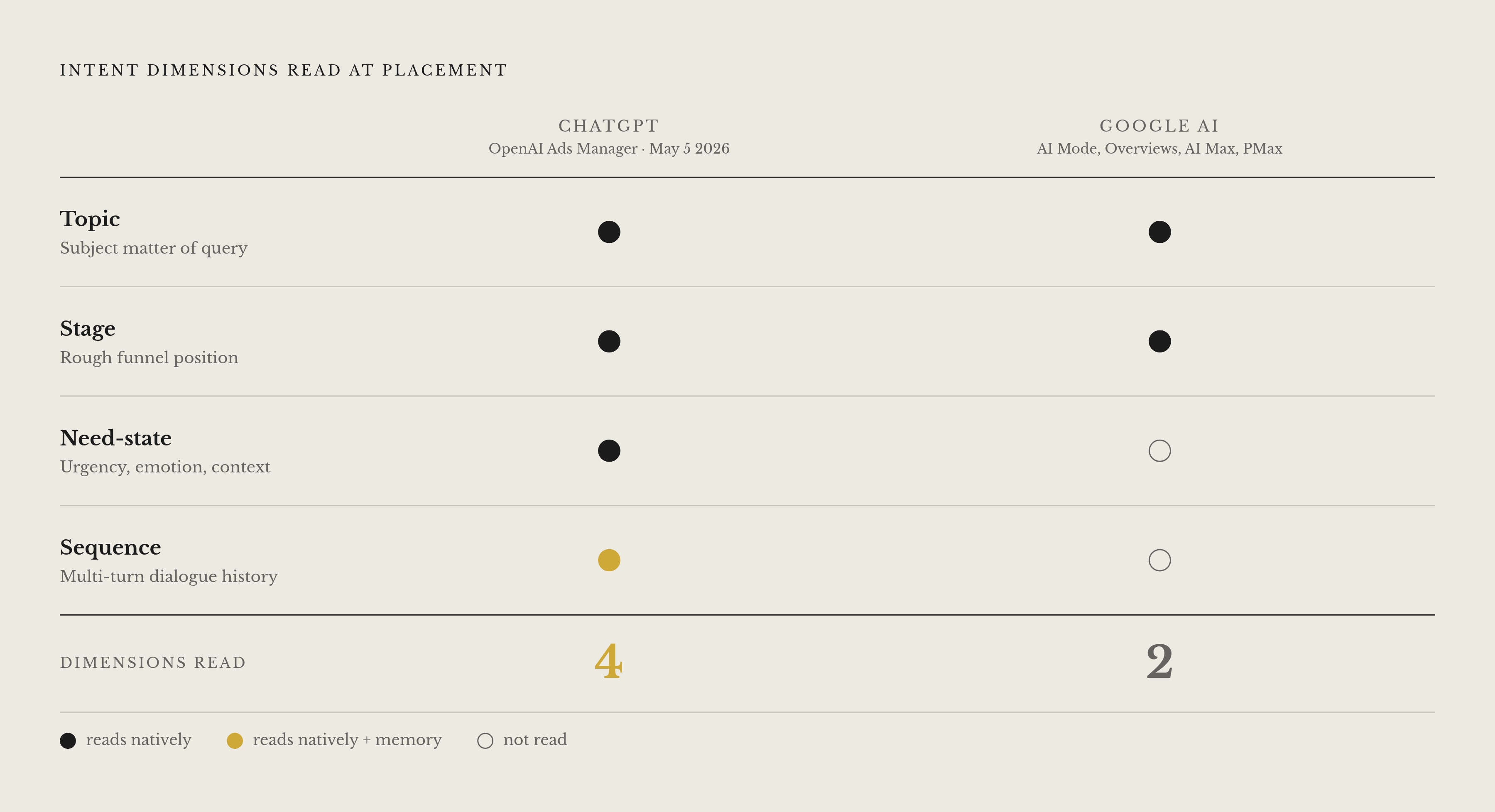
The targeting signal remains the query and the campaign’s existing keyword and audience parameters. Placement changes, but the underlying matching architecture does not. Google consequently reads topic and a rough indication of stage through query intent, rather than natively reading need-state and sequence across a multi-turn dialogue. Access to an AI answer is not equivalent to access to the conversational signals behind it.
Google’s generalist infrastructure provides breadth of reach through familiar campaign machinery. ChatGPT’s conversational architecture provides deeper access to the state of a dialogue. A buyer who wants ads to reach people across AI-generated search surfaces has a different need from one who wants to match an offer to a constraint that emerges over several turns.
On the specific criterion of conversational signal depth, ChatGPT therefore ranks ahead of Google’s AI placements. That conclusion identifies which dimensions the architecture can use, while leaving the commercial outcome to measurement. Reach and depth remain separate capabilities rather than interchangeable measures of sophistication.
The platforms that have opted out and what their absence signals
Perplexity has withdrawn from advertising, while Claude has refused it. Their absence narrows the inventory available to conversational advertisers. Both decisions reflect the tension between monetizing a dialogue and preserving confidence that the answer is unsponsored. A platform can possess a rich conversational surface without making that surface available for ad targeting.
Microsoft Copilot runs Showroom ads and dynamic filters designed for conversational shopping. Its format focus is narrower than ChatGPT’s general conversational targeting. Elon Musk has announced plans to place ads within Grok’s suggested solutions, but no launch date has been provided and the feature has not been confirmed at scale.
These differences limit what a vendor ranking can honestly claim. A live shopping format, an announced ad product, and an advertising refusal are not comparable levels of intent-reading capability. For buyers, the practical landscape is concentrated in relatively few surfaces. The deepest conversational signals also arise where trust in an unsponsored answer is especially valuable, which helps explain ChatGPT’s separation of the response from the ad below it.
The unsolved measurement problem that the depth debate sidesteps
Being able to read more intent dimensions does not prove that using them led to a better result. This is the central unresolved measurement problem. Conversational targeting can reach someone several turns into research before they would have typed a traditional search query. That earlier access creates an opportunity for top-of-funnel capture, but it also lengthens the path to conversion and makes attribution harder.
Privacy protections make the gap more difficult to close. Because the ad analysis does not persist full conversation transcripts or build persistent user profiles, advertisers cannot reconstruct every signal behind a placement. They know that a context hint matched. They do not know which turn, constraint, or change in decision stage was decisive, so an apparently successful match cannot be cleanly assigned to one intent dimension.
ChatGPT referrals convert at a meaningfully higher rate than other referral channels, but that aggregate result does not isolate the contribution of paid placements or individual targeting dimensions. The distinction limits what advertisers can optimize confidently. A conversion signal cannot, by itself, show whether topic, stage, need-state, or sequence caused the improvement.
Research proposals illustrate the tradeoffs without resolving them in a live product. A 2026 arXiv paper proposes a “genres” framework in which advertisers bid offline on stable semantic clusters, including hotels, airlines, and food. The platform estimates coherence probability between a genre and a conversation slot at inference time. This makes privacy and latency more tractable, but sacrifices some need-state and sequence depth.
Google researchers have proposed a different boundary case through a “token auction” model. Advertisers would bid to shape the actual words generated by the language model, making intent reading and ad influence simultaneous. The model remains theoretical. It also shows why depth cannot be judged independently of the rules separating advertising from the answer itself.
Last-click attribution will undercount the value of earlier conversational exposure, while treating the channel as brand advertising without a conversion signal will overstate it. The platforms reading the richest intent also have some of the least resolved attribution. That uncertainty belongs in the comparison.
How advertisers and platforms should work inside the measurement gap today
The practical response is to design campaigns around readable intent dimensions and use explicit proxies where attribution remains incomplete. Context hints should describe stage and need-state. “Users describing a home renovation with a fixed budget who are asking about contractor selection” identifies a topic, a constraint, and a decision activity. “Home improvement” identifies only the topic. The longer description gives a relevance-weighted system a clearer target to match.
Measurement should stay tied to business results without claiming to be more precise than the data allows. Useful proxies include how AI-surface referral conversion rates compare with those from other channels, engagement depth, and return-session rates for users who interacted with a placement. Engagement depth concerns how far into a conversation the ad appeared and what action followed. Where those signals are available, they can support evaluation without pretending to reveal the decisive conversational turn.
A generalist DSP can reach AI surfaces while still applying search or display logic that does not read conversational context. A single-surface AI ad network can read that context but cannot provide reach beyond its own platform. A purpose-built cross-surface approach is designed to close that gap through direct supply relationships with AI publishers and a bidding layer that reads intent dimensions.
Display networks and keyword-matched search ads do not interpret the full conversational signal publishers’ interfaces produce. The inventory unit must reflect the interaction. First-class monetization for an AI publisher therefore requires infrastructure that treats a conversation turn, rather than a page or session, as the unit available for matching.
eMarketer’s June 2026 forecast says total US AI advertising will roughly double between 2026 and 2030, while standalone chatbot advertising will still be a small share but will grow quickly. The channel is still new enough to give campaign design and measurement practices time to develop before its auctions become as competitive as those in search. The opportunity is to match an offer to the user’s developing decision while remaining precise about what the platform can read and what the advertiser can prove.