Declared Intent at Keystroke Versus Inferred Intent From Content Consumption for In-Market Accuracy
Prompts state what buyers want, but advertisers still can't see them.

Real-time prompt intent analysis for programmatic advertising matches ads to the problem a person states in an AI conversation, rather than reconstructing demand from content consumption. Its in-market accuracy advantage is structural, because a detailed prompt declares needs, constraints and decision stage together. Advertisers use that signal through conversational targeting controls, but cannot yet see the prompt behind each placement.
Why behavioral inference became the dominant targeting method and what it actually measures
Behavioral targeting solved a genuine engineering problem. Advertisers needed to reach likely buyers at scale without asking each person what they wanted, so programmatic systems assembled observable proxies into probabilistic models. Page visits, dwell time, repeat visits, IP-matching and content category co-occurrence each supplied a reasonable clue. The weakness emerged when that assembled estimate was treated as a reading of the buyer’s actual purpose.
Content consumption does not establish commercial intent. A procurement lead evaluating enterprise CRM software, an analyst writing a report and a competitor researching the category can generate the same behavioral signals. More observations can strengthen a pattern without resolving that ambiguity, because the missing information is why the person is reading. Even a search term, although more direct than a page visit, can compress the decision into a fragment.
Independent benchmarking of B2B intent surge signals has found that roughly one in five flagged accounts is not actually in market. False positives are substantial enough to affect routine campaign economics. An upstream misclassification can waste bids, suppress conversion rates and distort attribution.
What a consumer prompt actually contains that a behavioral profile never could
A consumer prompt supplies a different information structure. It can state intent, constraints, preferences and decision stage within a single semantic utterance, without requiring an advertiser to reconstruct those details from browsing residue. The distinction is visible between “what's a good CRM?” and “compare HubSpot and Salesforce pricing for a 10-person team”. The second request asks for a comparison and names the competing products, the size of the team and a concern with price. Page visits alone cannot show that the person has asked for that exact combination.
The conversation also makes the signal dynamic. In ChatGPT’s advertising model, the unit of value is the conversation state, including what the user has said, what the assistant has responded, the active topic and the user’s apparent goal. An early question can show awareness-level interest, while a longer thread adds specific comparisons and constraints on the decision. Declared intent therefore describes more than the latest string of words entered into a box.
Consumer surveys show that a large share of active LLM users mention price or budget directly, while most write their prompts as questions. These are requests to resolve something. Navigational intent nearly disappears because users can get things done inside the conversation. That shifts the chance to win business toward ads with semantic proximity to the problem the user is discussing. A prompt still requires interpretation for ad matching, but the buyer’s stated constraints do not need to be guessed from unrelated observations.
How can advertisers turn live AI prompts into programmatic ad signals?
Conversational advertising translates that information into targeting through descriptions of where an offer belongs. ChatGPT’s context hint is a freeform, natural-language description written at the ad group level and matched against the live conversation arc. Precision becomes a direct targeting input. There is no officially documented character limit, although 280 characters is a widely cited practitioner convention. Treating that convention as a confirmed cap would confuse working practice with a platform rule.
Relevance also enters the auction and review process. ChatGPT’s relevance-weighted second-price auction can allow a precise context hint from a smaller budget to outcompete a vague hint from a larger one. Budget alone does not settle the match. OpenAI’s ad system also reads and crawls the landing page as a relevance signal during review, bringing the destination into the targeting loop. The resulting alignment depends on the conversation description, the offer and the page.
Google and Microsoft provide further evidence that existing advertising infrastructure is moving into conversational surfaces. Qualifying campaigns can already serve in their AI placements without a separate opt-in or opt-out control. Microsoft Copilot assembles ads from existing account assets. These are routes into AI advertising, but they do not establish that advertisers receive a live prompt feed or interchangeable controls across platforms.
Perplexity illustrates the importance of separating commercial placement from the answer. It launched sponsored answers in late 2024, stopped accepting new advertisers in October 2025 and wound the program down by early 2026, with leadership citing the risk that sponsorship would make users suspicious of the entire response. The design issue extends beyond targeting accuracy. OpenAI’s answer-independence principle keeps response generation independent of advertising, with labeled sponsored units appended below the answer. Contextual relevance must coexist with a clear boundary around the organic response.
Where declared intent is sharpest: the prompt patterns that signal in-market readiness most reliably
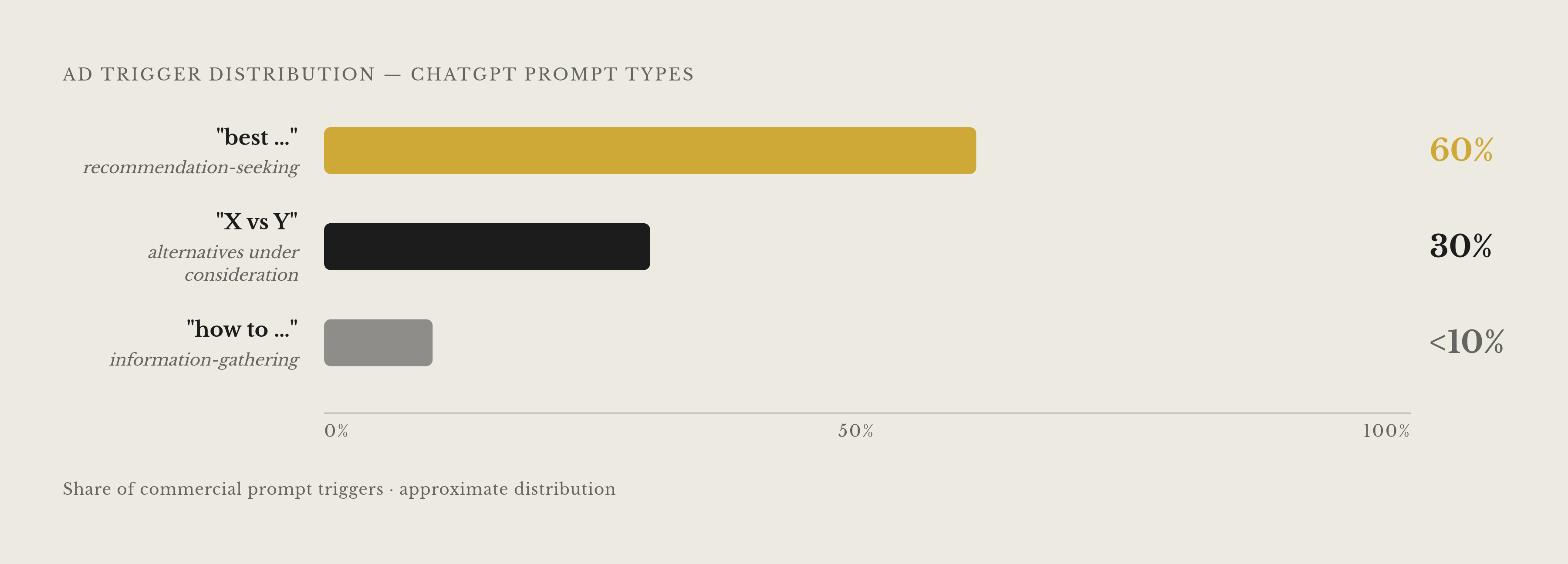
Monitoring data indicates that roughly three in five ChatGPT ads trigger on “best” queries, about three in ten on “X vs Y” comparisons and fewer than one in ten on how-to questions. Those patterns make the decision task explicit. A recommendation asks the assistant to identify a suitable option, while a comparison narrows attention to alternatives already under consideration. Neither ensures that someone will buy, but both tell more about the decision than content category membership alone.
Specific constraints sharpen the distinction further. A broad question that asks for information and a detailed product comparison are both prompts, but they differ in how much purchase intent they show. Reported prompt distributions place transactional intent in AI chat at roughly nine times its rate in traditional search, while ads appear across roughly a quarter of commercial prompts. These figures describe concentration. The strongest signal lies where a conversation combines an active choice with requirements that determine which offer could satisfy it.
Zéa Hirsh, performance media supervisor at Collective Measures, has identified the absence of prompt-level reporting as a practical limitation. There is no search- or prompt-level report showing exactly what users asked when an ad appeared. A conversation can contain rich declared intent while the advertiser remains unable to audit the precise match that the platform made.
What the in-market accuracy advantage looks like in practice across industries where intent is most explicit
Macy’s deployed Ask Macy’s, built on Google Gemini, as a beta with a small percentage of site users, expanded it to about half of site visitors within a day and went fully live across the site and app in March 2026. Macy’s reported that shoppers who used the assistant spent about 4.75 times more than those who did not. Frasers Group launched Ask Frasers, powered by Algolia’s Agentic Experience, and reported sales conversion rates rose by up to 25% compared with traditional search experiences. These outcomes show commercial value in shopping assistants where shoppers can articulate what suits them, while incremental advertising effects remain unproven.
Travel offers a related downstream pattern. Travel puts a higher share of its total digital spending toward search than any other industry, so being found when people are deciding what to buy is especially important. Among US adults who use AI during the purchase journey, a majority research or plan travel purchases with AI assistance. Consumers arriving at travel sites from AI sources are further along in their decisions and show materially lower bounce rates than those arriving from non-AI sources. That behavior is consistent with conversational research resolving requirements before the site visit, although it does not isolate an advertising effect.
In financial services, too, direct questions can fit closely with decisions about what to buy. A large share of the industry’s budgets already goes toward search, and product comparisons and eligibility questions can state what people need where content visits only offer clues. Healthcare exposes a different boundary on activation. OpenAI excludes ads near personal health and mental health conversations by default, even though some health advertisers may qualify under strict criteria. The signal can show a specific buying need even when platform policy keeps ads out of the conversation.
Why the measurement and attribution problem does not cancel the accuracy advantage but does change how it should be evaluated
Signal quality and measurement maturity are separate questions. A prompt can state a requirement more directly than browsing behavior even when the advertising system cannot expose that prompt in reporting. That does not establish that every resulting placement is accurate or that every campaign will convert. The platform must still match the conversation to the right offer. Structural information richness is therefore a reason to expect better qualification, while evidence of delivery and outcomes remains necessary.
ChatGPT advertisers cannot set traditional keyword exclusions or site placement lists, but they can use topic exclusion lists, and qualifying advertisers can use negative phrases. Without prompt-level reporting, advertisers have a less developed optimization feedback loop than they have in search. Advertisers can see the results without seeing all of the conversation that led to the ad being chosen. That limits diagnosis when a campaign attracts clicks but fails to produce qualified demand.
Early performance evidence also requires careful interpretation. Microsoft’s reported Copilot click-through and conversion improvements versus traditional search remain vendor claims. Independent estimates of ChatGPT CTR show a gap versus Google Search because users tend to stay inside the assistant. A lower click-through rate need not indicate weaker intent. It can reflect an interface in which the user continues the task without leaving.
Conversion evidence is more relevant, but still incomplete. First Page Sage’s March 2026 directional analysis found that LLM-referred conversion rates were higher by meaningful multiples than those from Google Ads in higher education, B2B tech, financial services and e-commerce. Those referral results are consistent with better-qualified traffic, but they do not directly validate every paid conversational placement. Mixed campaign evidence reinforces that distinction, with at least one B2B test producing impressions and clicks but zero conversions, while hotel-sector practitioners report positive click-through rates at competitive CPCs. The variance prevents a universal performance claim without erasing the underlying information advantage.
What advertisers and agencies need to build differently to capture the declared-intent advantage today
Context hints are the highest-leverage targeting input in ChatGPT campaigns, and a comma-separated topic list does not describe when an offer becomes useful. A precise hint describes the problem someone is actively solving and the conditions under which the product fits. Intent category maps should be built around those problems. That gives the targeting framework a basis that can extend across AI surfaces.
The landing page must continue the same decision. Because OpenAI reads it as a relevance input, the page is both a conversion destination and part of the targeting signal. A disconnect between the described conversation and the destination weakens that alignment. Before setting budgets for new AI-specific campaigns, advertisers should check whether their existing Google and Microsoft campaigns qualify, since those that do may already be serving in AI placements.
Measurement should distinguish traffic quality from attribution completeness. Conversion quality, bounce rate, session depth and return visits can help advertisers judge the visitors a campaign brings even before they have prompt-level reporting. These indicators can provide a more useful assessment of in-market readiness than click-through rate alone. Infrastructure evaluation should likewise focus on conversational context across AI surfaces, rather than assuming that generalist DSP keyword logic provides equivalent intent analysis.
The opportunity is also extending beyond ad slots. OpenAI’s Agentic Commerce Protocol, Google’s AI Mode shopping and Universal Commerce Protocol, Microsoft’s Copilot Checkout and Brand Agents, Perplexity’s Instant Buy and Meta’s shopping mode bring discovery and transactions closer within AI interfaces. As more of the decision and action occur together, conversational targeting practice becomes relevant beyond the click. Brands and agencies building that practice now can accumulate operational learning while competition is thin.