Switching to a DSP With Native AI Chat Inventory When Your Current Platform Has None
A DSP needs both ChatGPT inventory and conversation-level targeting.
A DSP for buying ads inside AI chat interfaces needs both inventory access and conversational targeting. StackAdapt lists ChatGPT ads among its channels, while Amazon DSP offers access through a U.S. pilot with OpenAI. Switching platforms is justified when the new DSP can match bids to live conversational intent that the current platform cannot read.
Why the absence of AI chat inventory is a structural problem, not a channel gap
Traditional DSPs are built around fixed surfaces and familiar targeting inputs, including results pages, feeds, keywords, cookies, and trackable clicks. An LLM conversation has a different organizing unit. Its targeting primitive is the conversation state, which includes what the user has asked, how the assistant has responded, and where the dialogue is heading. A platform built only to interpret keywords or audience segments cannot treat that state as a bidding signal simply because an inventory integration becomes available.
The distinction is between access and interpretation. A DSP might be allowed to serve an impression without being able to judge how well it fits the conversation. Without that context, it cannot price the opportunity against the intent that makes it valuable. The buyer therefore needs to evaluate the targeting layer separately from the supply connection. Otherwise, a new placement can conceal the same old blind spot.
What conversational intent signals are and why prompt-level context is different from keyword intent
Search captures expressed intent in a string typed at a particular moment. A conversational thread can reveal motivation, uncertainty, follow-up questions, and the progression from curiosity to comparison to readiness to act. Those signals build on each other as the conversation unfolds. That progression changes what an advertiser can infer. The useful signal is not just the subject under discussion, but the user's position within a decision.
For example, a user might spend six conversational turns discussing team coordination, deadline tracking, and remote collaboration difficulties without typing “project management software.” The product category is absent, but the problem is explicit. A system that can only match that category keyword misses the connection, but a conversational system can spot what the user needs. It can also distinguish an exploratory discussion from a request for help choosing a solution.
Intent mapping turns that distinction into a classification framework. It categorizes conversations by decision-making stage and connects each stage to a message with a higher probability of prompting action. Demographic proxies give way to live conversational signals. This changes the evidence available for judging relevance. The prospect can become recognizable before a category search or an outbound click.
How the auction and targeting mechanics inside AI chat actually work
ChatGPT Ads uses a natural-language context hint at the ad group level. OpenAI documents no official character limit for that hint. The hint describes what the person is trying to accomplish and when the offer would be useful. Comma-separated topic lists are a poor substitute.
A relevance-weighted second-price auction resolves the opportunity using the hint, ad title, copy, and landing page together. A more precisely matched ad can beat a higher bid, so contextual alignment affects competitiveness as well as creative choices. The landing page participates in that assessment. This makes a retrofit more demanding than adding a new inventory label to an existing buying interface.
OpenAI separates ad selection from ChatGPT's answer generation in its own service. Ads render as labeled sponsored cards below the answer. Relevance can come from the current conversation without the need for persistent user identifiers or cross-site tracking. The targeting mechanism alone leaves advertiser access to the underlying conversation unestablished.
Google Search campaigns using broad match or AI Max, Performance Max, and Shopping can serve automatically in AI Overviews and AI Mode if they are eligible, while Microsoft campaigns that are eligible can reach Copilot. These folded-in placements offer neither a separate opt-in nor an opt-out. Existing campaign exposure therefore does not establish that a buyer has a DSP capable of operating ChatGPT's context-hint controls.
Which DSPs support AI chat ads, and through which buying paths?
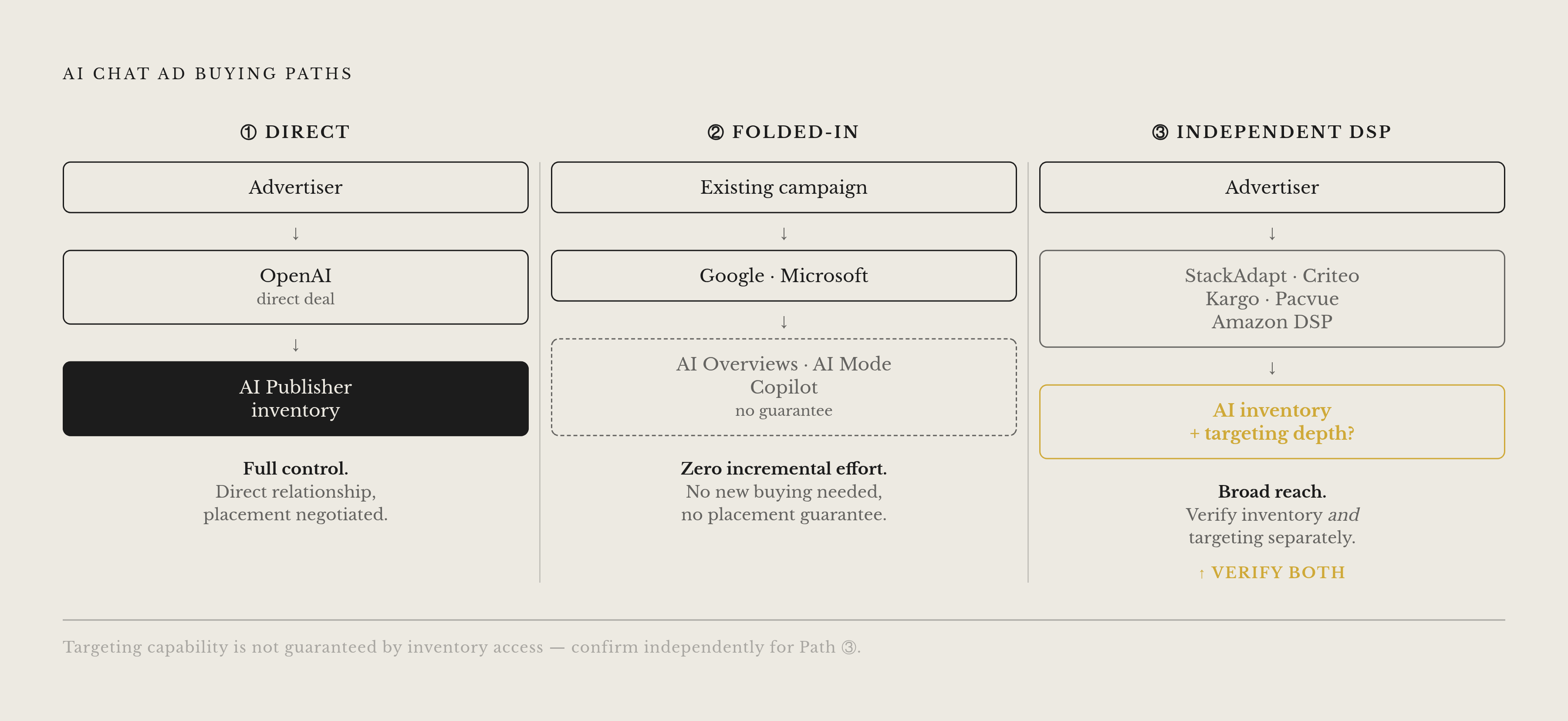
The market has three distinct access paths, which are direct buying, inventory folded into existing campaigns, and independent DSP or network access. Direct buying establishes a relationship with the AI publisher. Folded-in access uses existing Google or Microsoft accounts without requiring a new buying relationship, but offers no placement guarantee. Independent access adds an intermediary, so buyers need to check both its inventory relationships and what its targeting can do.
OpenAI names Adobe, Criteo, Kargo, Pacvue, and StackAdapt as technology partners. StackAdapt explicitly lists ChatGPT ads among its channels. OpenAI also has agreements with Omnicom, WPP, Dentsu, and Publicis. These relationships establish routes into the ecosystem, while each partner's buying controls and cross-surface reach require verification.
Amazon DSP's U.S. pilot offers another route for existing programmatic buyers. Amazon Ads representatives help build campaigns, and advertisers supply context hints through their representative to inform OpenAI's matching. OpenAI retains authority over delivery and placement within ChatGPT. The pilot changes the access threshold for buyers who previously needed a direct OpenAI relationship or a holding-agency budget, but it does not transfer control of the placement to Amazon.
Perplexity launched sponsored answers in 2024, stopped accepting new advertisers in October 2025, and wound down the program. Anthropic sells no ad placement in Claude as a stated position. Neither surface belongs in an available-inventory promise merely because it hosts AI conversations.
ChatGPT's tier restrictions also narrow the addressable audience. Ads reach only logged-in adults on Free and Go, while Plus, Pro, Business, Enterprise, and Education are ad-free. B2B buyers need to account for that boundary. Access to ChatGPT advertising is not access to every professional using ChatGPT, and the distinction changes the potential return for campaigns aimed at business users.
What to audit in your current DSP before deciding to switch
The practical audit begins with existing exposure. Review eligible Google and Microsoft campaigns before assigning a new budget to AI placements, because some activity may already reach AI Overviews, AI Mode, or Copilot. Separate that exposure from inventory bought directly inside chat interfaces. This establishes what the account already reaches before a migration is credited with adding something new.
Does the current DSP have a native connection to ChatGPT inventory, and can the buyer supply natural-language context hints at the ad group level? Keyword match types and audience segments do not answer that question. If neither access nor the required targeting control exists, additional spend cannot solve the lockout. If access exists through an intermediary, establish how the hints reach the matching system.
Reporting needs its own audit, because native access does not mean the buyer has prompt-level visibility. Determine what the current account exposes, what a prospective platform would add, and what remains unavailable across the category. Negative targeting and prompt-matching visibility are capabilities buyers are requesting. Assess the prospective DSP's roadmap and its dependence on OpenAI's reporting layer. A platform switch should not be justified by reporting improvements that the underlying channel cannot yet provide.
What a DSP built for AI chat inventory actually offers that a legacy platform cannot replicate
A conversational DSP built for the job brings together two things that are often separate, cross-surface buying and the ability to read conversational context. Generalist DSPs provide broad reach, but a generalist platform without a conversational targeting layer cannot evaluate prompt-level intent merely by gaining placement access. A single-surface AI ad network has the opposite limitation. It can run a contextual auction inside one app without offering reach beyond that app.
The distinct architecture combines conversational matching, an exchange, and direct publisher supply relationships. Smaller LLM apps often need an ad network to aggregate demand at workable economics, rather than separate arrangements with individual advertisers. A DSP operating its own exchange can bring that supply together across publishers instead of depending on one publisher's inventory or one API integration.
On the publisher side, a chatbot ad network uses an SDK or API to render ads, run the prompt-level auction, handle disclosure, and pay publishers through revenue share or a flat fee. A DSP with its own exchange can coordinate that function across multiple publishers. The buyer gets a targeting framework that works across AI apps and assistants. That reduces the fragmentation of separate direct relationships, while leaving each platform's actual inventory access as a capability to establish.
What to migrate, in what order, when switching DSPs for AI chat inventory
The migration should start with intent mapping, before the campaign structure changes. Identify the problems the product solves from the user's perspective. Trouble with team coordination, for example, describes a buying situation even when the user has not named project management software. Even an experienced DSP migration team needs to rebuild the targeting idiom.
Next, translate existing keyword clusters into conversational problem narratives. Each narrative should describe the topic, apparent decision stage, and kind of question that makes the offer relevant. Write context hints around the user's situation and goal in natural language. A topic list discards the relationships between those elements. The resulting hint needs to explain why the offer belongs at that point in the conversation.
Start with decision-stage conversations where the offer is most directly relevant, before expanding into research or awareness. This limits waste while the team learns the platform. Before those campaigns launch, audit their landing pages against the conversational situations described in the hints. Because the auction evaluates the hint, copy, and destination together, a page built for keyword relevance may need a different fit.
Initial budgets should allow learning without committing heavily before the context-hint framework is validated. More spend cannot compensate reliably for vague targeting in a relevance-weighted auction. Set up reporting before the first campaign goes live, including OpenAI's conversion pixel and Conversions API to measure ChatGPT conversions. OpenAI launched both on May 5, 2026. Teams should be clear about which outcomes they can measure and which prompt-level details the platform keeps out of view.
What to expect from performance measurement while the channel's attribution infrastructure matures
Conversion instrumentation is available, but downstream attribution data is still developing. That is a category-wide limitation. Even with native access, there are still limits on exact prompt-level visibility. Buyers therefore cannot assume that a context hint provides an observable record of the conversation that triggered an impression. Targeting instructions and delivery evidence are different things.
Criteo's early data indicates that LLM-referred traffic converts at roughly one and a half times other referral channels. That is vendor-sourced evidence. It does not establish the return a particular advertiser will earn from paid chat placements, nor remove the need to assess conversion quality within the buyer's own category.
Attribution can also lose the beginning of the journey. A user may start in AI chat and move to the open web to convert shortly afterward, particularly in categories such as flights and electronics. Existing models may classify that conversion as direct or organic. Plan for that gap explicitly. Otherwise, the reporting framework may understate the channel's contribution while still failing to reveal which conversations produced useful demand.
During the transition, use the on-platform engagement signals that are available, including conversation depth and ad interaction, along with post-click landing-page behavior and incremental lift measured against control audiences. Treat missing negative targeting and prompt-matching visibility as known constraints to plan around. Buyers are exchanging measurement clarity for earlier access to a high-intent environment, and the decision depends on whether that intent quality justifies the uncertainty for their category and budget.