AI Assistant User Intent Mapping by Industry Vertical
Matching AI prompts to buyer intent requires vertical-specific constraint mapping.

Real-time prompt intent analysis for programmatic advertising means matching an offer to what a user is trying to accomplish, the constraints they reveal, and their decision stage. The practical approach is to translate live conversational signals into vertical-specific problem narratives, then use the targeting and measurement controls available on each advertising surface.
Why intent in AI conversations cannot be treated as a single signal
Search inferred intent from compressed queries, while conversational AI reads needs, feelings, and constraints stated directly across multiple turns. A category keyword might identify travel interest without revealing who is travelling or what would make an offer unsuitable. A conversation can supply both. Its commercial meaning changes as the user adds information, so the initial prompt cannot stand for the whole session.
“Constraint emergence” describes the moment a new limitation reshapes the context. A user saying “it needs to be dog-friendly” creates a more specific matching opportunity than the preceding discussion alone. Users usually go roughly six prompts deep before moving to the open internet to act, so there is only so much time to match an offer to their needs. But how much of the decision journey fits in that window varies by industry. Vertical-specific intent mapping is therefore a prerequisite for effective targeting, rather than a refinement applied after campaign design.
How do major AI advertising surfaces use live prompts for vertical targeting?
Google AI Mode and AI Overviews extend existing campaign eligibility into conversational discovery. Search campaigns using broad match or AI Max, Performance Max, and Shopping campaigns are automatically eligible, with no opt-in or opt-out. Smart bidding is strongly recommended and required for AI Max, but it is not a universal requirement across eligible campaign types. Eligibility comes before a new campaign build. For advertisers on Google, the first action is to audit existing campaigns for AI eligibility.
ChatGPT gives advertisers a different control through the context hint, a natural-language description of the situation in which an offer belongs. Amazon Sponsored Prompts, currently in beta, put brands in AI shopping conversations when shoppers ask questions that show they are ready to buy. On ChatGPT, the critical craft is writing a context hint that describes the user’s problem.
Travel: high-volume, fast-converting intent with rich constraint signals
Travel provides the clearest benchmark for AI-originated purchase intent. More than a third of travel queries begin in an AI chat, and some users convert quickly after the initial query, particularly for flights. The conversation can therefore contain both the start of discovery and the conditions that make booking possible. The action window can be short. Advertisers need to distinguish a broad destination discussion from a comparison that has acquired enough constraints to support a relevant offer.
Those constraints arrive densely in travel conversations, including dates, party composition, accessibility needs, pet requirements, and a budget ceiling. Each addition narrows the acceptable options without necessarily introducing a conventional purchase keyword. A family planning a trip abroad for several weeks with specific dietary needs gives advertisers a different chance to match an offer than someone talking about travel in general. For travel advertisers, context hints should describe such constraint clusters rather than category terms such as “travel” or “flights.”
E-commerce and retail: transactional intent at scale, mediated by an AI shopping layer
Retail shifts the focus from weighing a trip purchase to coming back to explore products within a category. Users ask purchase-intent questions before they reach a search results page or product listing, so brands compete to be seen in the AI shopping layer. Initial prompts are often unbranded. An advertiser that bids only in branded keyword auctions therefore misses the stage when shoppers are choosing which products to look into. Amazon’s Sponsored Prompts address that purchase-ready conversation directly, though the format is currently in beta.
For Google advertisers, Shopping and Performance Max eligibility means that the inputs in their existing campaigns also matter for AI discovery. The quality of the product feed and rich text assets helps show how well an ad fits, while more detailed product content, including A+ content, helps products be seen in the shopping layer. Users can convert quickly after an AI-originated query for electronics and fast-moving consumer goods, while they take longer to weigh purchases such as furniture or appliances. A retail context hint should consequently capture the evaluative task, such as comparing mid-range wireless headphones for commuting with noise cancellation as the priority.
Finance: high-value intent constrained by regulation and platform tier demographics
Conversations about finance can show valuable intent because users explain their situation, limits, and long-term goals in detail. ChatGPT’s Plus, Pro, and Business tiers are entirely ad-free, while research-intensive, high-income users are more likely to use those tiers. That creates a structural access problem. Some of the users financial advertisers most want to reach may generate useful conversational signals without being available for paid placement on ChatGPT.
The reachable audience also requires a slower-stage approach. Someone looking into retirement planning or mortgage options may spend many sessions learning and comparing choices before showing that they are ready to decide. Awareness and comparison-stage placements fit that pace better than campaigns that aim to get users to convert right away. A statement such as “I'm 42, self-employed, with irregular income and no employer pension” describes a financial problem without naming a product. Context hints should match that situation and follow the platform’s restrictions on sensitive topics including personalized financial advice. As of April 2026, financial advice contexts are no longer categorically blocked from ad placement by default, but that does not remove the need to account for those restrictions.
Healthcare: intent arrives as a problem narrative, not a product query
Healthcare exposes the largest gap between conversational expression and product-category targeting. Users describe symptoms, conditions, care concerns, and personal situations rather than beginning with the name of a service or product. The narrative is the starting signal. As the conversation develops, insurance coverage, proximity to care, caregiver relationships, and cost sensitivity narrow the context.
Healthcare intent also progresses through understanding a concern, comparing options or providers, and potentially booking an appointment or purchasing a product. Many sessions never reach that final stage. Advertisers must audit category eligibility before campaign development because platforms including ChatGPT restrict health-related advertising categories and contexts. It can also be harder to reach higher-income users who are engaged with their health and researching complex conditions, since they are more likely to use premium tiers. On ChatGPT, Free and Go users constitute the addressable population, making available inventory narrower than the full set of health conversations.
How intent stage and conversion speed differ across verticals — and what that means for bidding
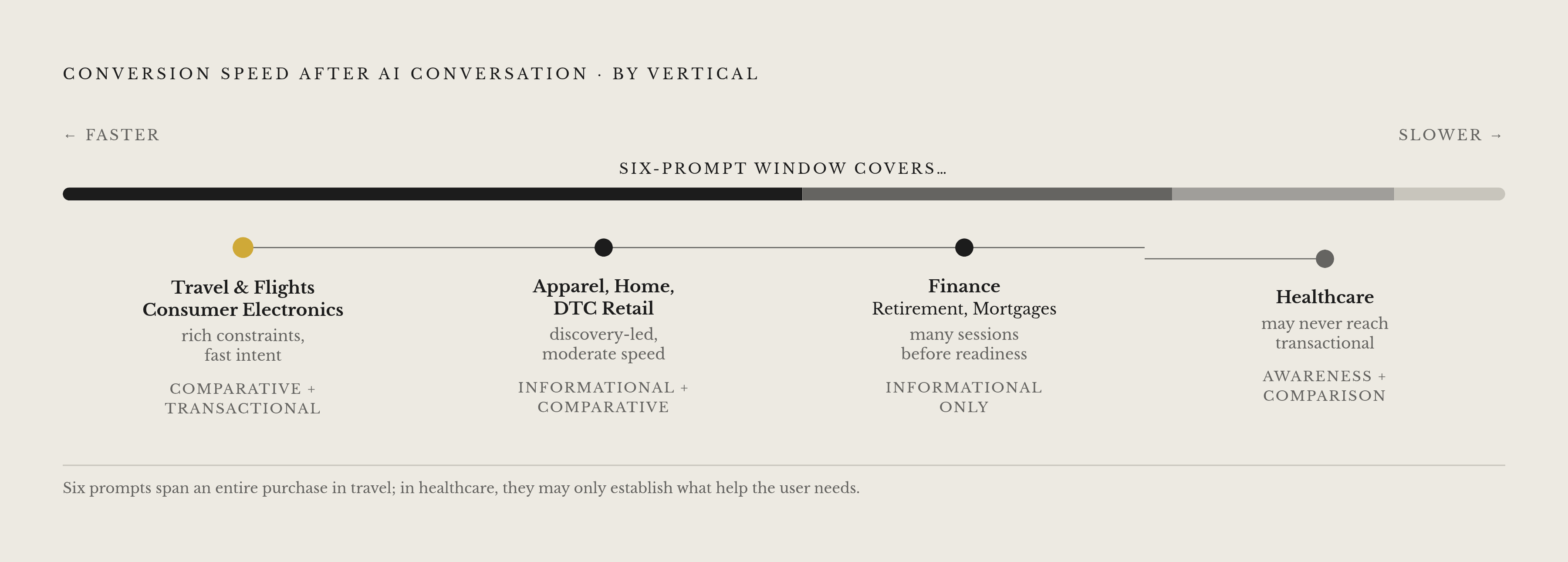
Conversion speed provides a flexible planning framework. In travel, especially flights, and consumer electronics, users can give rich constraint signals and then act quickly. Campaigns in those categories should put more weight on the comparative and transactional stages, including placements that aim for conversion deeper in the conversation. Discovery-led retail, including apparel, home goods, and direct-to-consumer products, calls for earlier presence in informational and comparative exchanges. The distinction is the task being performed.
Finance and healthcare are toward the end of this spectrum where users do more research. Their informational and comparative stages may last many sessions, so awareness and comparison-stage placements fit better than bids for an immediate direct response. Six prompts mean different things here. In travel, they may cover much of the decision journey, while in healthcare they may only establish what help the user needs to find care. Bid strategy should account for that difference while allowing for conversion rates to vary within each vertical and for users to go deep into a conversation before they are ready to buy.
Why brand visibility inside AI answers affects paid performance in commercial verticals
Brands cited in generated answers appear to see stronger paid performance when they also advertise, but that relationship does not prove citation caused higher click-through rates. The distinction prevents a correlation from becoming a promised result. It still supports working on organic AI visibility and paid conversational advertising together so that each can help the other.
The recommended sequence is to establish credibility as a cited source before using paid placement to reinforce that presence. Brands mentioned consistently across high-authority publications, expert commentary, and reputable data sources are more likely to appear in AI-generated responses. The evidence base differs by vertical. Healthcare and finance rely on high-authority sources in their fields, while travel and retail benefit from the number of reviews and signals about the context of a transaction.
Matching context hints to vertical-specific problem narratives: the craft that determines whether targeting works
The practical test for a context hint is whether it explains both the user’s goal and the constraints that shape a useful answer. “Travel planning” names only the subject. “Family planning first international trip on a fixed budget with mixed travel experience levels” describes a problem the system can match against the live conversation. Travel hints should also distinguish research, comparison, and readiness to book through the decision stage they describe.
Retail hints need the same specificity, but their anchor is how the shopper evaluates the options. “Wireless headphones” labels inventory, while comparing mid-range wireless headphones for commuting with noise cancellation as the priority identifies the shopper’s basis for choosing. The product name alone misses that distinction. Because initial shopping prompts are often unbranded, the hint should match category exploration and the need being resolved. This places the targeting description at the discovery stage rather than assuming the shopper already knows the eventual purchase.
Finance and healthcare require a stronger departure from category labels. “Personal finance” says little about the self-employed user with irregular income and no employer pension, whereas that financial situation explains why a particular decision requires help. Likewise, “health insurance” names only a topic. Healthcare hints should describe the health situation or navigation challenge and include relevant insurance, location, or caregiver constraints as they emerge. Across both verticals, the hint must reflect what the user is trying to resolve without treating a detailed problem description as evidence of immediate purchase intent.
Measurement and attribution across verticals: what is solvable now and what is not
Conversational attribution is partially functional for fast-converting journeys and remains unsolved at the channel level for slow-converting ones. OpenAI’s October 2026 measurement infrastructure includes Pixel and Conversions API, an Event Quality Score, and a fixed one-day view-through attribution window that cannot be configured. It also includes incrementality experiment partnerships with Haus, Measured, and WorkMagic. These tools provide a measurement foundation. They do not make every vertical’s decision journey observable within the same attribution window.
A one-day view-through window can fit travel and electronics journeys where users convert soon after seeing an ad. However, it systematically undercounts contribution when finance or healthcare users convert weeks or months later after further research sessions. Criteo reports notably higher conversion rates for ChatGPT referrals than for other referral channels, but that vendor-reported aggregate should not be applied uniformly across verticals. Referral conversion and delayed advertising contribution are different questions.
For slow-converting verticals, incrementality testing is the more honest benchmark because it asks whether placement produced additional conversions above a baseline. Measurement plans should therefore fit each vertical instead of using one attribution model for all of them. The remaining uncertainty should stay explicit. Fast transactional categories have a clearer path to attributed outcomes, while research-intensive categories require experiments that address contribution beyond immediate response. The verticals that build this measurement infrastructure now will compound their learning advantage as the channel matures.