Platforms Purpose-Built for AI Conversation Placement Versus Search Ad Retrofits
Purpose-built conversational ads outperform retrofitted search machinery.

The unit of commercial attention has changed. For two decades, advertisers bought access to a keyword someone typed or a page someone opened. Paid inventory inside AI assistants now attaches to something different: a live, multi-turn conversation with its own memory, direction, and evolving intent.
Search advertising reads a string of words. Conversational advertising reads a dialogue, what the user asked three exchanges ago, how the assistant responded, and where the exchange is heading. That difference in input is not a refinement of the user experience. It changes what targeting can see, what relevance means, and which infrastructure can deliver either. If you look at research on generative AI advertising, the main deployed platforms keep a visible boundary between the model's response and the commercial unit. That boundary is a structural decision, not a stylistic one.
The market has already made the stakes concrete. OpenAI built purpose-built paid inventory. Google and Microsoft folded AI surfaces into existing search ad machinery. Perplexity concluded that sponsored placement undermined user trust in the answer itself and wound its program down in February 2026. Anthropic declined to participate at all. Four platforms, four different conclusions about the same opportunity. That divergence is the clearest evidence that the underlying design problem remains unresolved, and consequential.
What each major platform has actually decided to build — and what that reveals about their architecture
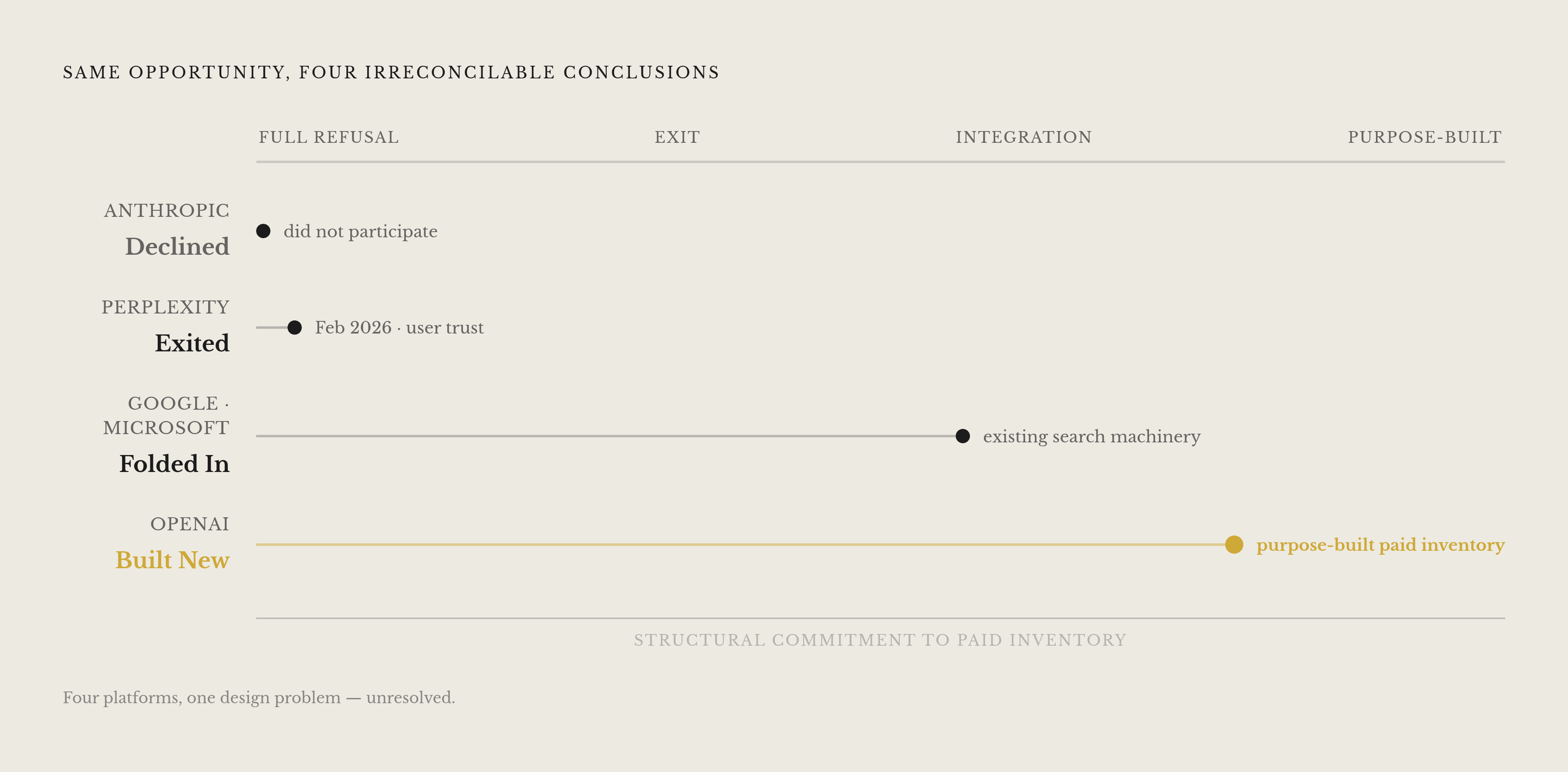
The platforms now running paid inventory inside AI surfaces do not just differ in reach or pricing. They differ in whether their ad infrastructure was designed for conversational context from the start, or grafted onto machinery built for keyword strings and page-level signals. Each decision encodes a theory about what an AI ad surface is.
Google AI Mode and AI Overviews are monetized entirely through campaigns you already run. Search campaigns using broad match or AI Max, Performance Max, and Shopping campaigns are all eligible. Smart bidding is recommended. There is no opt-in and no opt-out. Qualifying campaigns are already serving inside AI answers. Conversational Discovery ads and Highlighted Answers are in U.S. testing, and Business Agent for Leads is in open beta for U.S. advertisers. The architecture is explicit: Google treats the AI answer as another placement inside the existing search auction, not as a new surface requiring new machinery.
Microsoft has taken a similar path with Copilot, though with one distinctive element. Copilot's "ad voice," a session-level awareness of the conversation's direction, departs from single-query keyword matching and delivers measurably stronger performance than traditional search placements. But it runs on top of the Microsoft Advertising infrastructure you already run. It is a meaningful adaptation, not a purpose-built conversational targeting layer.
Perplexity reached the opposite conclusion. The company exited advertising entirely in February 2026 after executives determined that sponsored placement risked reducing user trust in AI-generated answers. It shifted to subscription and enterprise revenue. Anthropic has declined to participate at all. Neither decision is a failure of execution. Each reflects a judgment about whether commercial adjacency can coexist with the credibility of an AI-generated response, and the two companies landed on opposite sides of that question.
How targeting works inside a purpose-built conversational system — the context hint and what it can see
The context hint is a natural-language description of the conversations where an ad belongs, matched against a live multi-turn dialogue. It is a fundamentally different targeting instrument than a keyword or a page-level content category. A keyword asks what string someone typed. A context hint asks what the person is trying to accomplish, and whether an offer is useful at this moment in the dialogue. Those are different questions, and they require different kinds of inference.
Generative AI advertising research describes the targeting environment as one where the conversation itself is the signal. The system interprets the entire conversational trajectory: prior turns, AI responses, follow-up questions, and inferred direction. It does not evaluate the most recent query in isolation. A user four turns into describing a logistics problem may never type a product category name. A sophisticated contextual system recognizes the conversational pattern as a high-intent signal without requiring an explicit keyword match. That capacity is the architectural distinction, not a feature layered on top.
The auction itself is relevance-weighted and second-price, which means a more relevant ad can beat a higher bid. The auction reads the context hint, the ad title and copy, and the landing page. Notably, OpenAI crawls the landing page as a relevance signal during review. The page is part of targeting, not an afterthought. That detail matters because it inverts a long-standing assumption: in a purpose-built conversational system, the destination is read before the ad serves, not merely measured after the click.
Privacy architecture follows from the same design. Relevance derives from what is being discussed in the current conversation rather than from historical browsing behavior or persistent user identifiers. That is a structural consequence of reading context rather than profiles. The strongest objection is that this sounds like sophisticated contextual targeting that any system could approximate with enough NLP. The answer is that approximating conversational context from a page or a query string is categorically different from maintaining discourse coherence across multiple turns of a live dialogue. The transformer models behind the assistant already keep that conversational state so they can generate coherent responses. The ad system reads the same representations. A keyword system never built them.
How the retrofit model works — and what it cannot read
When a search ad system is extended into an AI answer surface, it carries with it the assumptions of its original design. The bid is triggered by a query string. The relevance signal is a keyword match or page content. There is no mechanism to read the arc of a multi-turn conversation. Those are not limitations that better features will eventually remove. They are the architecture.
On Google AI Overviews and AI Mode, and inside Microsoft Copilot, eligible campaigns serve automatically through the existing ad machinery. Advertisers cannot opt in or out, and no ad is purpose-built for the conversational surface. What appears is assembled from assets already sitting in the account. Smart bidding and broad match extend the reach of existing campaigns into AI answers, but the targeting logic remains anchored to keyword and audience signals. The system cannot read where the conversation has been or where it is heading.
The practical consequences are measurable. When an AI Overview appears, the organic click-through rate on standard search listings falls sharply. Brands that earn citation inside the AI Overview see paid CTR lift substantially. The implication is uncomfortable: on retrofit surfaces, brand authority and AI-referral presence affect paid performance in ways the ad system itself cannot directly control or optimize for. The advertiser's organic standing, not the ad's relevance, can determine whether the paid placement performs.
Measurement compounds the problem. Google AI Overviews do not offer segmented reporting, and no segmented reporting has been announced for AI Mode. Advertisers cannot isolate what served inside the AI answer from what served elsewhere in the SERP. That makes it structurally impossible to evaluate the conversational placement on its own merits. The absence of segmented reporting is the sharpest evidence of the gap. A surface that cannot be measured separately is, for practical purposes, a surface the advertiser is buying blind. And the direction of travel is clear: Google AI Max, starting September 2026, auto-upgrades Automatically Created Assets and campaign-level broad match settings, with Dynamic Search Ads following in February 2027, and no option to opt out. The retrofitting of existing campaigns into AI surfaces is no longer optional.
What the architectural gap means for B2B advertisers specifically
For B2B advertisers, the choice of platform is partly a reachability question, and the answer can override every targeting consideration. ChatGPT ads reach only logged-in adult users on the Free and Go tiers. Plus, Pro, Business, Enterprise, and Education are ad-free. A buyer whose employer has purchased a business or enterprise plan is structurally unreachable through ChatGPT paid inventory, regardless of how well the targeting is written.
Self-serve products, developer tools, and small and mid-market targets align more naturally with the Free and Go audience that ChatGPT ads can reach. Enterprise and mid-market B2B buyers with employer-paid plans sit largely outside that window. The architectural implication is blunt: a purpose-built conversational targeting system that cannot reach a defined audience segment is the wrong platform for that segment, no matter how sophisticated its context-reading is. Audience reachability is a structural fact, not a campaign-optimization variable.
The measurement gap compounds the problem. B2B advertisers cannot tell whether the intent signal they are paying for is the one their audience is actually generating without segmented reporting on retrofit surfaces such as Google AI Mode and AI Overviews, or the ability to isolate conversational placements. That uncertainty carries a real cost in B2B, where the gap between a promising signal and a qualified buyer is already wide.
What brand safety and measurement infrastructure looks like when the surface is a conversation
Advertising inside a conversation requires a different kind of brand safety and measurement infrastructure than advertising against a page, because there is no static content to audit and no standard impression to count. The central design decision, identified in generative AI advertising research, is the visible boundary between the model's response and the commercial unit. The model's response is not for sale. The commercial unit sits adjacent to it. Independent measurement must verify that the boundary is being maintained, and that verification is a new discipline, not an extension of existing brand safety tools.
On retrofit surfaces, the problem is acute. Google AI Overviews and AI Mode offer no segmented reporting, so you cannot isolate what served inside the AI answer from what served elsewhere. Brand safety monitoring is therefore undifferentiated as well. An advertiser cannot confirm whether an unsafe adjacency occurred inside the conversational placement or somewhere else on the page.
Attribution in assistant-mediated discovery is genuinely unsolved. A user who sees a sponsored card inside a ChatGPT answer and then converts through another channel may not be trackable through standard last-click or even multi-touch models. The OpenAI measurement expansion announced October 5, 2026, which includes Pixel and Conversions API, Event Quality Score, a one-day view-through window, and incrementality experiment partners, represents the current state of what is available. It is not a solved problem. It is a first attempt at instrumentation for a surface whose conversion paths do not yet fit established models.
Perplexity's exit is instructive. Its research found that sponsored placement reduced user trust in AI-generated answers. Trust in the answer and trust in the ad are not independent variables. The adjacency of a commercial unit to an AI response is itself a trust variable, not just a brand safety variable. Measurement infrastructure must eventually address that relationship, and nothing currently deployed does so adequately.
How to read the architectural difference as a practical budget and platform decision
The choice between purpose-built conversational ad infrastructure and search ad retrofits is not primarily a question of which platform has more reach or better creative tools. It is a question of what kind of signal the advertiser needs to match, and whether the infrastructure can read it. If the need is to reach buyers at a precise moment of conversational intent, a multi-turn dialogue where a problem is being articulated rather than a keyword that names it, only infrastructure designed to read that context can deliver the match. A keyword system cannot see the arc of the conversation.
Retrofit surfaces carry a practical advantage: they operate on campaigns the advertiser already runs. But the absence of segmented reporting means the conversational placement cannot be evaluated on its own terms. Budget decisions made without that visibility are structurally uninformed about the channel they are actually buying. That is not a counsel of avoidance. It is a demand for clarity about what is being purchased.
Between the generalist search retrofit, which has reach but cannot read conversational context, and the single-surface AI ad system, which can read context but is limited to one environment, sits a third structural position. A platform that works across multiple AI surfaces, buying through a single demand layer while reading conversational context across publisher environments, fixes the limitation each model has alone. Real-time prompt analysis and contextual deployment infrastructure represent that approach: infrastructure engineered to read the full conversational arc and match intent in the moment, rather than mapping a new surface onto search ad machinery. That architectural difference determines what a relevance signal actually is and which platforms can act on it. For advertisers who need both reach and contextual precision, the emergence of independent platforms built exclusively for conversational AI advertising reflects a recognition that the shift from keyword strings to multi-turn dialogue requires infrastructure designed from the ground up for that input. The distinction between purpose-built and retrofitted systems is the first meaningful test of whether a platform understands the structural change.
The practical sequence follows from that analysis. Audit what existing campaigns are already serving into on Google and Microsoft before allocating new budget. Determine whether the target audience is reachable on the tiers where ChatGPT ads run. Write context hints as problem narratives, not keyword lists. If you write hints as comma-separated topic lists, you get poor matching. And treat measurement as a design constraint, not an afterthought. The landing page, the pixel, and the attribution model are part of the targeting system in purpose-built conversational ad infrastructure. That is the conclusion the architecture has been pointing toward from the start: the surface is new, but the discipline it demands is older than the technology. Read the input, match the intent, and measure what was actually delivered.