How to Brief and Buy Paid Placements Inside Live AI Conversations
Relevance, not bids, wins placements inside AI conversations.

Placing ads inside a live AI conversation means buying against a fundamentally different mechanism than search or social: a relevance-weighted auction that reads natural-language context inside a single evolving exchange. This guide walks through what that shift means in practice, from the mechanics of the auction to the brief that feeds it, the copy it rewards, and the gaps in what can currently be measured.
Why Buying Inside AI Conversations Is Structurally Different
Search and social advertising rest on three load-bearing primitives: a surface to place the ad on (a results page or a feed), a targeting input to decide who sees it (a keyword or an audience profile), and a trackable click to measure whether it worked. Buying inside a live AI conversation removes all three at once. There is no SERP and no feed inside an LLM; there is a single conversation, rendered one turn at a time, and an ad has to fit the flow of that specific exchange or it reads as an interruption rather than a continuation of what the user is already doing. Because the assistant itself can research, compare, and recommend without the user ever clicking through, a meaningful share of commercial influence happens inside the conversation itself, invisible to a pixel that only fires on a landing page, and the entire last-click attribution model that search and social depend on starts to break down.
This isn't a hypothetical future problem. OpenAI opened self-serve buying at ads.openai.com in May 2026, on a platform where the weekly user base is large and growing fast, and now Microsoft Copilot decides which ads are relevant by reading the entire session context, not just the most recent query. Writing a brief and running a buy for conversational placements is the baseline requirement for entering the channel.
How the LLM ad auction actually selects and serves an ad
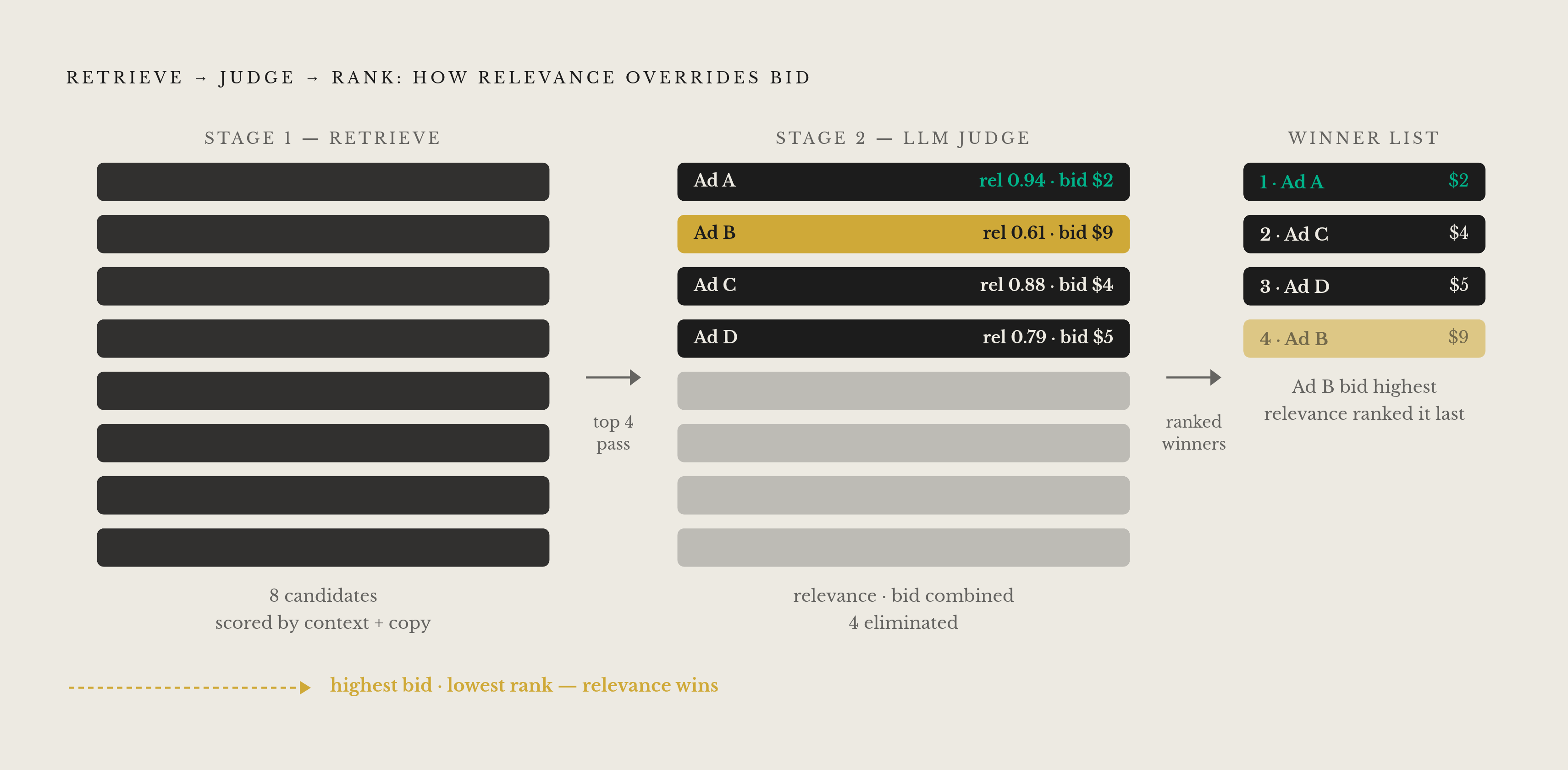
These platforms run on a relevance-weighted second-price auction, and the winner pays just above the next-highest competing bid: that is simply how a second-price auction works. What changes is the first half of the mechanism: it decides who wins before price even enters the picture. A higher bid can lose to a more relevant ad, so the words in a campaign's targeting hint and the words in its ad copy work as direct commercial levers in a way a keyword bid never did.
The clearest illustration of how far this can go is the LERA framework, developed by researchers at Peking University and Alibaba Group, which proposes a two-stage retrieve-then-generate auction. The second stage does something a keyword auction has no equivalent for: it queries the LLM itself with a designed prompt and asks it to judge relevance directly, producing scores over the shortlisted candidates that then combine with bids under a payment rule designed to keep the mechanism truthful for advertisers trying to maximize their own return. So the auction does not just match text strings: it asks a language model to reason about whether a given ad actually fits the conversation at hand. LERA's design also lets more than one ad appear within a single dynamic dialogue, so across a long response you can place different ads at different moments instead of treating the whole thing as one static slot.
Microsoft Copilot's implementation carries the same logic in a different form. The takeaway for anyone buying into this environment is straightforward: the auction reads meaning, not syntax. A precisely written context hint paired with tightly relevant copy works like Quality Score in search, except here it can outweigh bid size entirely, where in search it only discounts the cost of a click.
What prompt-level intent signals mean for how you target
Once relevance is understood as the dominant force in the auction, the next question is what, specifically, the auction is reading relevance against. It is intent expressed in natural language across a sequence of turns, not a keyword you type once into a search box. A single search query gives you a snapshot of intent, but a multi-turn conversation gives you a trajectory. Users reveal constraints, priorities, timing, and where they are in a decision process, and that depth of signal has no equivalent in a single query.
That trajectory tends to move through recognizable phases. For targeting purposes, this trajectory breaks down into four practical tiers. When a user faces a specific challenge, you need messaging that speaks to the problem itself, not the product category.
So a single context hint per campaign is not enough. A reasonable objection follows: no advertiser can know in advance which tier an individual user is in. That's true, and it's also not the job being asked of them. The auction matches the context hint to the live conversation; the advertiser's job is to write that hint precisely enough that it only wins placement in the tier it was built for.
Writing the brief: what to capture that a search or social brief never asks for
A brief written for conversational AI placements has to specify the conversational moment itself, not an audience segment or a keyword list, because everything that follows, the context hint, the copy, the landing page, flows from getting that description right. The first thing it needs is a plain-language sentence describing the exchange the brand wants to appear inside: what the user is trying to accomplish, what stage of the conversation this is, and what a genuinely helpful response would look like at that moment. Alongside that, the brief needs an explicit intent tier assignment, naming which of the four tiers (informational, comparative, transactional, problem-solving) the placement is built for, since that assignment determines both ad format and the logic behind the call to action.
From there you need the natural-language context hint itself, the short targeting signal the auction actually reads, so draft two or three variants in the brief and note which one is tightest, since broader hints will win more impressions at the cost of relevance-weighting advantage. A topic-exclusion list belongs in the brief as a safety input from the start, not a fix applied after an incident, and it should name the categorical topics the brand must not appear adjacent to. Finally, the brief needs a measurement plan written before launch, specifying what signals (view-through windows, downstream conversion events, assisted-conversion logic) will actually be used to judge performance, so that expectations are set before any results come in.
What a search or social brief would normally carry over doesn't belong here at all: keyword lists, demographic audience definitions, bid-per-keyword logic, and placement-level creative sized for a feed have no equivalent in this environment and shouldn't be ported into the document out of habit. You revise the brief as campaign data comes in; you don't file it once and forget it.
Translating the brief into ad copy that works inside a conversation
Copy that performs well in this environment reads as a helpful continuation of the exchange already in progress. The copy that wins on relevance-weighting is copy the assistant itself could plausibly have written. There is no evergreen banner that works across every conversation here; the creative has to be produced for the specific context the brief describes, not just for a generic placement.
That constraint translates into a few concrete rules. Copy should lead with the user's problem or question, not the brand name or a product feature, so the opening line feels responsive to what you're already discussing. For transactional intent tiers, a product-card format, a title, a one-sentence value statement, and a clear call to action, tends to fit; for informational or comparative tiers, a softer educational frame performs better. Headline, body, and call to action all need to read as one coherent package aligned with the context hint, because the auction scores all three together, and internal inconsistency carries a relevance penalty. In OpenAI's reference implementation, more than one ad unit can appear per response, so you get a position-one versus position-two dynamic even without multiple SERP slots to compete across, and relevance alone decides which position an ad earns.
The volume of distinct copy units a conversational campaign needs is higher than in search, since relevance rewards specificity: a campaign running across three intent tiers and two or three industry contexts can require a large number of distinct units, making generative production tools an operational necessity at any real scale. Research on trustworthy commercial intervention in generative AI advertising makes clear that copy labelled transparently as sponsored, and copy that doesn't misrepresent the assistant's own recommendation, preserves user trust, while copy that blurs that line creates both reputational and regulatory exposure, an obligation that sits beneath everything else here.
Setting up the buy: campaign structure, bidding, and budget decisions
Campaign structure should mirror the intent-tier framework directly, organized around conversational intent rather than audience segments or keyword themes, because the auction resolves targeting through conversational context and intent tiers are the structural unit that gives the relevance-weighting mechanism a clean signal to work with. So in practice you run one campaign per intent tier rather than one per product line, which keeps context hints tight and stops a broad hint from diluting relevance across intents it wasn't written for. Context hints themselves belong at the ad-group level, not the campaign level, since multiple hints per tier let the auction match more precisely across the different ways the same intent gets phrased in an actual conversation. You should likewise assign landing pages per ad group rather than share them across a campaign, because a single landing page serving multiple intent tiers will underperform on relevance for all but the one it was built for.
Bidding strategy follows directly from the auction's mechanics: because a more relevant ad can beat a higher bid, the right move is to maximize the relevance gap, putting spend into copy and hint quality first and setting bids at a level that covers the realistic clearing price for that tier. On surface selection, you have two live self-serve options with documented performance characteristics: OpenAI's platform and Microsoft Copilot, and each assistant renders ads in its own native format, so you need to adapt creative per surface rather than repurpose it wholesale from one to the other.
If you're sequencing a first buy, start with transactional intent tiers, where downstream conversion events are actually measurable, and build baseline relevance scores and landing-page quality signals before you expand into comparative and informational tiers once a measurement framework is in place to judge them. Minimum entry points vary by surface, so when you plan budget, account for each platform's own thresholds rather than assuming the minimums that apply in search carry over here.
What to Measure and What You Cannot Yet Measure
A structural gap runs through measurement in this environment: a meaningful share of an ad's influence on a purchase decision happens inside the conversation itself, invisible to a pixel that only fires on a landing page, and standard last-click attribution simply does not capture it. Campaigns planned without accounting for that gap will read as underperforming when the real story is that the measurement tools can't see where the influence actually occurred.
What can be measured today includes impressions and sponsored-card views as reported by the platform, click-through to the landing page where a click occurs, downstream conversion events, purchases, sign-ups, form completions, attributable to sessions that included an LLM ad impression within a defined view-through window, and assisted conversions where that impression precedes a later direct or search visit that converts. What current tooling misses is the influence an impression has on a decision made inside the conversation and only expressed later through action on a different surface; any brand consideration shift that builds across a multi-turn session without producing a click in that same session; and full cross-surface attribution when a user moves from an AI assistant to a search engine to a direct visit before finally converting.
The practical response is to build a measurement plan around that honesty rather than around it: define primary KPIs using only what is actually measurable, conversion events inside a defined view-through window, treat branded search lift and direct traffic lift during the campaign period as secondary, corroborating signals rather than primary ones, and put the entire measurement plan into the brief before launch so stakeholders see the limits of what will be reported before results start coming in. Early campaigns in this channel are best run as learning exercises: the goal is building baseline data on which intent tiers, which context hints, and which copy approaches produce measurable downstream signals, not proving that AI advertising can match search CPAs in a first flight. To the objection that a budget is hard to justify without full attribution, the fair answer is that the measurement gap is temporary and narrowing as platform infrastructure matures, and brands building campaign experience now will hold proprietary baseline data by the time that infrastructure catches up, while brands that wait will be starting from zero against competitors who didn't.