Ad Networks That Monetize AI Apps and Chatbots With Sponsored Placements
How conversational ad inventory is defined, matched, and bought.

Ad networks that monetize AI apps and chatbots with sponsored placements sell access to a conversational moment. A productive integration therefore depends on understanding how that moment becomes eligible inventory, a matched placement, a billable event, and revenue. Importing search or display assumptions without examining those steps creates the risk of a costly mismatch.
Why AI app ad networks are a structurally different category from search or display
Search inventory is a slot next to results, while display inventory is a region on a webpage. Conversational inventory begins with the task unfolding in an exchange. The placement opportunity depends on what the user is trying to accomplish, which constraints have emerged, and whether a commercial offer belongs at that point. A place where an ad could appear is not, by itself, an eligible advertising moment.
That distinction changes both selection and measurement. The targeting signal is the inferred meaning of the exchange rather than simply a keyword bid or a behavioral profile. The impression follows a rendered placement selected against that context, although the interface may still measure a conventional view or click. Conversational advertising does not make every measurement convention obsolete. Conversational advertising changes when the event can happen, so teams must check how inventory is defined, what buyers assume, and which reporting denominators are used before they integrate it.
What forced this category into existence — the economics of serving free users at scale
Serving free users costs money even if they never subscribe. ChatGPT had more than 50 million consumer subscribers in February 2026, yet its free-user base was far larger. Independent apps should plan for a less favorable conversion ratio rather than treating that benchmark as readily attainable. The economic gap is built into the service. Usage creates serving costs, while subscription revenue comes from only the paying share of the audience.
For apps with a large free audience and commercial-intent conversations, advertising provides a way to connect some of that usage to revenue. The same exchange that incurs a serving cost may reveal a product need or purchase decision. That does not make every message monetizable. It makes the selection of appropriate commercial moments central to the business model, rather than a cosmetic decision about where to insert an ad.
The product constraint follows directly from that arithmetic. A placement must help fund the free experience without undermining the answer that brought the user there. An irrelevant offer can satisfy a rendering requirement while failing that purpose.
How the inventory unit is actually defined in a conversational interface
The inventory unit is an eligible opportunity to place commercial content within a conversation. It is not synonymous with a message, a response, or an entire session. Eligibility comes first, before any ad request is sent. The app must establish whether the topic and the user’s task permit advertising at that moment, rather than assuming that every response supplies saleable inventory.
A provider can return an eligible creative, but that return alone does not establish that the user encountered an ad. The integration must define the rendered impression and the agreed view or click event used for measurement. These are distinct stages of the same transaction. Treating them as interchangeable obscures whether an opportunity failed during matching, presentation, or measurement.
The final boundary is the absence of a placement. A provider may return no match, and a request may time out. Neither state is an exceptional inventory definition. Both belong in the integration design because a conversation must remain useful when advertising produces nothing. Taken together, eligibility, rendering, and no-match behavior define what the publisher can offer before any discussion of campaign performance begins.
How targeting and bidding work without a keyword layer
ChatGPT’s model uses advertiser-specified context at the ad group level, expressed as a natural-language description of the conversational situation the advertiser wants to reach. That description takes the place of a keyword list. The platform matches it against signals including the problem under discussion, the user’s use case, prior interactions, and enabled memory or personalization features. A campaign therefore groups related conversational needs rather than merely collecting terms that might appear in a query.
This distinction gives creative a different job. Conversational queries can articulate a problem, constraints, tradeoffs, and a desired outcome before an ad appears. The offer must address that decision rather than interrupt it with a loosely related message. Richer intent demands a closer fit between the situation described in targeting and the problem the creative promises to solve.
OpenAI’s documented auction model is relevance-weighted and second-price, with buying options including CPM for Views, CPC for Clicks, and conversion optimization through oCPC or oCPM. oCPC is billed per click, while oCPM is billed per impression. An optimization objective is therefore not the same as the event charged to the advertiser, and campaign comparisons must preserve that distinction.
OpenAI gives advertisers aggregate reporting and keeps personal chat transcripts and conversation histories from them. That limits what advertisers can see, but the targeting inputs still matter for privacy. Memory and preferences can deepen the signal from the current exchange toward a person’s ongoing projects. Buyers therefore need to know which signals are used for matching, because aggregate reporting does not mean the system uses only the latest message.
Where you can actually buy conversational AI inventory in 2026, and what each surface sells
The 2026 market separates into first-party platforms, inventory folded into existing campaigns, and independent networks serving AI app publishers. ChatGPT provides the first-party example of conversational context targeting and auction buying described above. Claude, Perplexity, and the Gemini app sell no ads as of October 2026.
Microsoft Copilot and Amazon Rufus draw from existing advertiser relationships through a folded-in model. Much of what is called AI ad spend goes through these formats, where an AI layer builds on existing ads instead of using mechanics built for native conversational placements. The distinction changes what a buyer is purchasing. Access through an existing campaign does not imply that an independent chatbot publisher can integrate the same supply or use the same commercial terms.
ChatAds offers an affiliate-first infrastructure model for independent developers. Developers connect their approved affiliate accounts, including Amazon Associates and Commission Junction, through a dashboard and keep all the commissions they earn. ChatAds charges for each API request and takes no revenue share. Its commercial model separates infrastructure fees from affiliate earnings. That makes it best suited to developers who already have approved accounts and enough conversations about products.
ChatAds supports eight ad formats and five integration paths, including a REST API, TypeScript SDK, Python SDK, MCP Server, and n8n nodes. Dappier puts publishers first in a different way, offering both on-site agentic ads, which are sponsored prompts placed in AI conversations, and off-site content licensing through a data marketplace. It runs on nearly 100 publisher sites, including HomeLife Brands with millions of monthly users. Those two revenue streams serve distinct commercial functions. Sponsored prompts monetize an interaction, while licensing monetizes access to content.
ZeroClick Agent Storefront addresses a different recipient altogether. Its machine-readable catalog is intended for autonomous agents that read and transact through x402 or MPP protocols, rather than for human users viewing sponsored responses. The intended buyer interaction differs, so it belongs in an evaluation only when agent transactions match the product’s purpose.
How revenue actually flows from an eligible request to a publisher payout
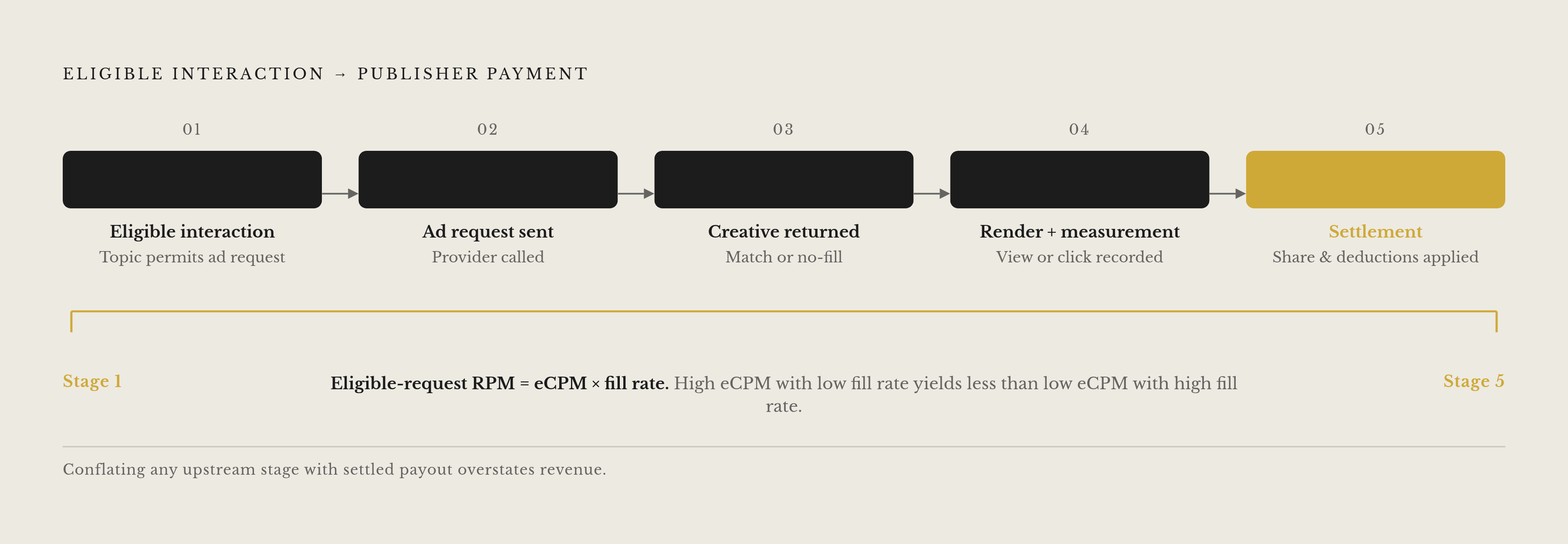
Publisher revenue begins with an eligible interaction that permits a request, after which the provider returns a creative or no match, and a returned placement must then render and generate the agreed measurement event. The contract sets the share paid, what is deducted, and the settlement rules. A count of requests cannot substitute for impressions, and measured impressions cannot substitute for settled publisher earnings.
Eligible-request RPM exposes the weakness of an eCPM-first comparison. Where fill rate represents the share of eligible requests yielding a counted impression, eligible-request RPM is eCPM multiplied by that fill rate. A higher eCPM can therefore bring in less revenue across eligible requests if fewer requests fill. This relationship follows from arithmetic alone. Where reporting defines fill at the selection stage instead, rendering and measurement must still be reconciled before that calculation describes realized yield.
The commercial model then determines which costs and deductions remain. A revenue-share arrangement applies its agreed share and settlement terms, while ChatAds separates per-request API charges from commissions retained by the developer. Serving and operating costs must be subtracted before advertising is compared with subscriptions or another monetization line. Otherwise, the comparison favors numbers that look good in a report over an integration that pays off.
What the integration contract determines — and what the network's default policy does not
Define eligible topics and tasks, the context permitted in a request, and any identifiers permitted by policy and agreement. Then establish which party handles selection, rendering, and tracking. SDK defaults do not transfer the publisher’s responsibility. Brand safety and data handling remain obligations to define and enforce, even where the network supplies much of the implementation.
Specify no-fill and timeout behavior before launch, so the product does not depend on receiving an ad. Keep the commercial placement visibly separate from the answer’s editorial claims, and assign responsibility for preserving that distinction in the interface. Disclosure belongs at the moment of encounter. A terms-of-service footnote does not perform the same function as a visible commercial label when the user sees the sponsored content.
Define the agreed view or click event, record it once, and reconcile it with provider reporting. The contract should also make the share, deductions, and settlement rules clear enough to trace measured activity to payment. These operational requirements belong before integration. Without them, a discrepancy can remain ambiguous between a selection failure, a rendering difference, a measurement mismatch, and a commercial deduction. The publisher needs that separation to understand both product behavior and revenue.
How to run a pilot that produces a usable answer, not just a first impression
A useful pilot starts with agreed definitions, a randomized comparison group, and a stop rule established before launch. A two-week SDK test judged against total impressions does not answer whether the integration earns useful revenue without degrading the experience. The comparison must reflect the actual decision. For a publisher, that means evaluating the eligible conversational opportunities and their economic outcome, rather than treating all app activity as equally monetizable.
Use the inventory definition to establish what enters the test, then follow eligible requests through matching, rendering, measurement, and payment. Evaluate conversational context clusters rather than importing keyword groupings without adjustment. The creative should address the problem those clusters describe. At the same time, compare the advertising experience with the randomized comparison group so that revenue is not considered in isolation from the usefulness of the product. The stop rule makes that tradeoff explicit before results create pressure to reinterpret it.
Expansion should follow evidence from the pilot: add a second network or increase budget only when the results justify doing so. An empty placement is preferable to an irrelevant ad. That discipline turns the channel’s structural differences into advantages, because conversational context can support a closer match between a user’s decision and a commercial offer. Practitioners who test that mechanism directly are better positioned than those who merely transplant a search playbook.