Agency Margin Models for Emerging AI Ad Channels
Expert work on intent-driven channels demands payment for precision, not hours or spend.

AI ad channels price intent, not impressions. Every legacy agency margin model, from hourly billing to percentage-of-spend to media arbitrage, was built on assumptions that these channels violate. The structure of that repricing is already visible, and the window for claiming it is finite.
Why legacy agency pricing models cannot survive the move to AI ad channels
Hourly billing assumes that time spent is a fair proxy for value delivered. AI compresses delivery without reducing strategic value, so when a 20-hour deliverable becomes a five-hour one, the model punishes the agency's best work. Media arbitrage, buying inventory at one rate and reselling at another, assumes opaque and commoditized inventory, yet AI ad placements on a surface like ChatGPT launched with quoted CPMs far above standard display.
The deeper problem cuts across all three models. Each one prices the input, whether hours, dollars, or inventory units, rather than the outcome. That mismatch becomes visible and costly when the channel itself is intent-driven, because the outcome is the only thing the channel actually transacts on. The models did not fail because agencies were short-sighted. They failed because the assumptions underneath them stopped matching the mechanics of the environment.
What makes AI ad channels structurally different from search and social
The unit of value in conversational AI advertising is the conversation state, not the keyword. In traditional paid search, targeting is a keyword match. In LLM advertising, targeting is a freeform natural-language description of the conversations where an ad belongs, matched in real time against the live dialogue. It is a context hint, not a query string, and that distinction changes what agency expertise is actually worth.
Placement is decided by a relevance-weighted second-price auction, a mechanic where a more relevant advertiser can beat a higher bidder. That property rewards contextual craft over raw budget, and it means the agency's descriptive precision now functions as a direct bidding input rather than an operational wrapper around one. Microsoft Copilot's targeting processes the entire session, not just the most recent query, so the ad system is already operating at a semantic depth that keyword-trained analysts are not equipped to replicate.
The infrastructure behind every contextually served ad must analyze queries, interpret semantic meaning, maintain conversational state, evaluate ad candidates, run auction mechanics, and serve, all within milliseconds. The agency's job is to feed that system accurate intent descriptions, not to manage bids manually. Learning to write those descriptions well is a learnable and billable skill, and it is the point where a new margin model becomes necessary.
Where margin actually lives in AI ad channel work
The work that generates real value on AI ad channels is expert work that compresses time without compressing worth. Context hint writing is the highest-leverage single task in the channel. The craft is describing what a person is trying to accomplish and whether the offer is useful in that moment, a distinct skill from keyword selection that most practitioners have not yet developed.
Channel-specific setup work carries the same premium. Audit work is similarly underpriced, because Google AI Mode and Microsoft Copilot automatically serve eligible campaigns inside AI answers with no opt-in. Many advertisers are already appearing in these placements without knowing it, and the agency that finds and structures this exposure is providing a service, not just managing a line item.
The structural analogy is programmatic's early years, when agencies that understood auction mechanics, floor prices, and audience segmentation earned outsized margin before the market commoditized. AI ad channels are at the same early stage. A more precisely described advertiser can outcompete a vague one with a larger budget, and that precision is the agency's product.
How the percentage-of-spend model fails on a low-volume, high-intent channel
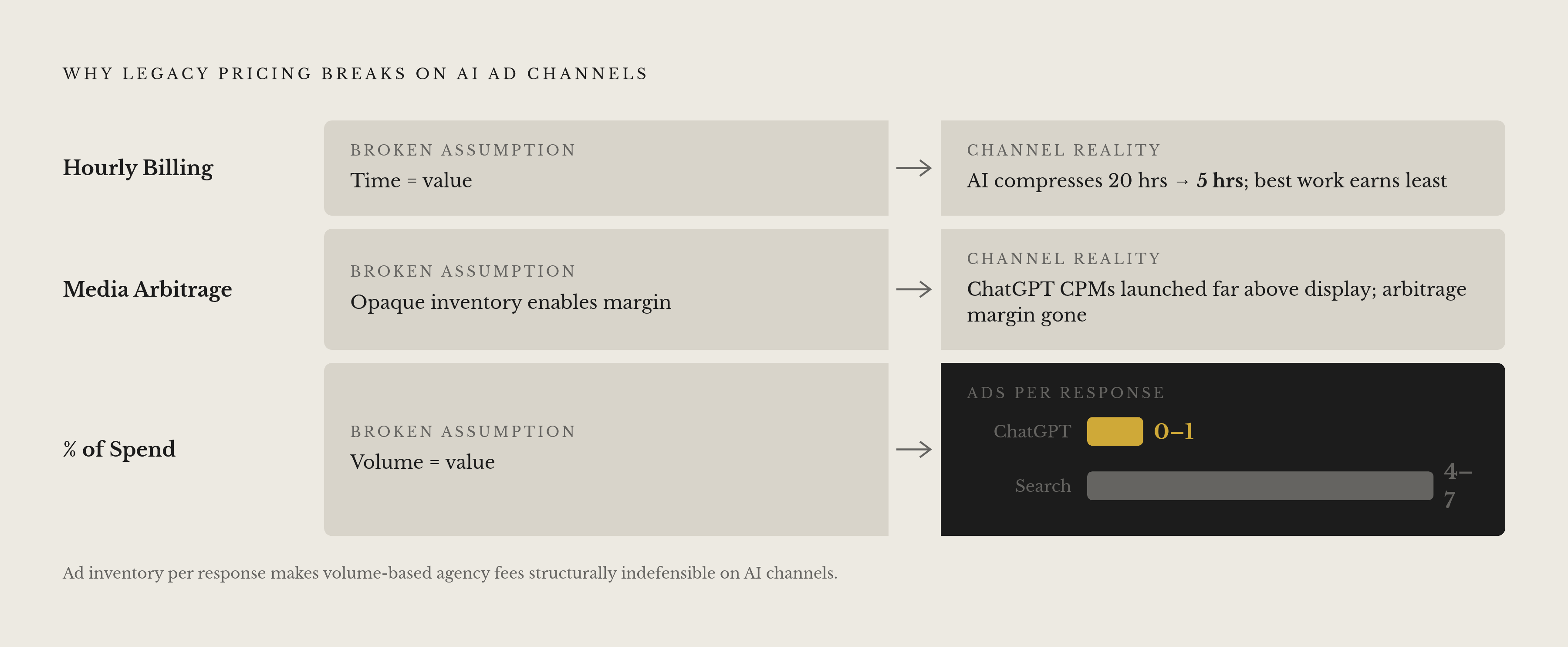
Percentage-of-spend pricing systematically undercharges for AI ad work because the channel's value is concentrated in low-spend, high-intent placements that the model treats as low-revenue accounts. On a surface like ChatGPT, ad load is deliberately constrained to zero or one placement per response, compared to four to seven on a standard search results page. A fee tied to spend cannot tell the difference between a channel that is cheap to run and a channel that is strategically essential but thin on volume. ChatGPT's self-serve Ads Manager opened on May 5, 2026, and removed spend minimums, so smaller budgets could access the channel, but percentage fees were too small to fund real expertise. The CPM on AI placements launched at a significant premium over standard display, so an agency taking a percentage of a modest spend on a high-CPM channel collects more fee than on legacy display.
The deeper misalignment is structural. The agency's incentive points away from precision and toward volume, the opposite of what the channel rewards. A better model would price the accuracy of that description, not the volume of the spend it directs.
Why hourly billing punishes the agency that invests in AI channel expertise
Hourly billing creates a structural disincentive for agencies to build the AI channel expertise that protects their clients' margin. Context hint writing, properly done, is dense intellectual work that a skilled practitioner can complete quickly. Hourly billing makes that practitioner's speed a liability rather than an asset, because the invoice shrinks at exactly the moment the work improves.
The holding-company pattern shows what happens when agencies respond to this compression by protecting their own books instead of repricing the value. The 4As and Forrester findings show agencies harvesting AI productivity for internal margin, billing fewer hours at the same rate rather than reinvesting in channel expertise. Specialized agencies that operate on retainer or value-based models report margin profiles far above project-based peers, which suggests that expertise depth, not hours logged, is what commands premium pricing.
Channel setup compounds the mismatch. Auditing existing campaigns for AI surface eligibility, structuring context hints, and configuring measurement for a channel where attribution is still unsolved is front-loaded work that does not repeat at the same rate. The model assumes recurring labor, but the highest-value labor on an AI channel arrives once and then becomes an appreciating asset.
What a margin-protective pricing structure for AI ad channels looks like
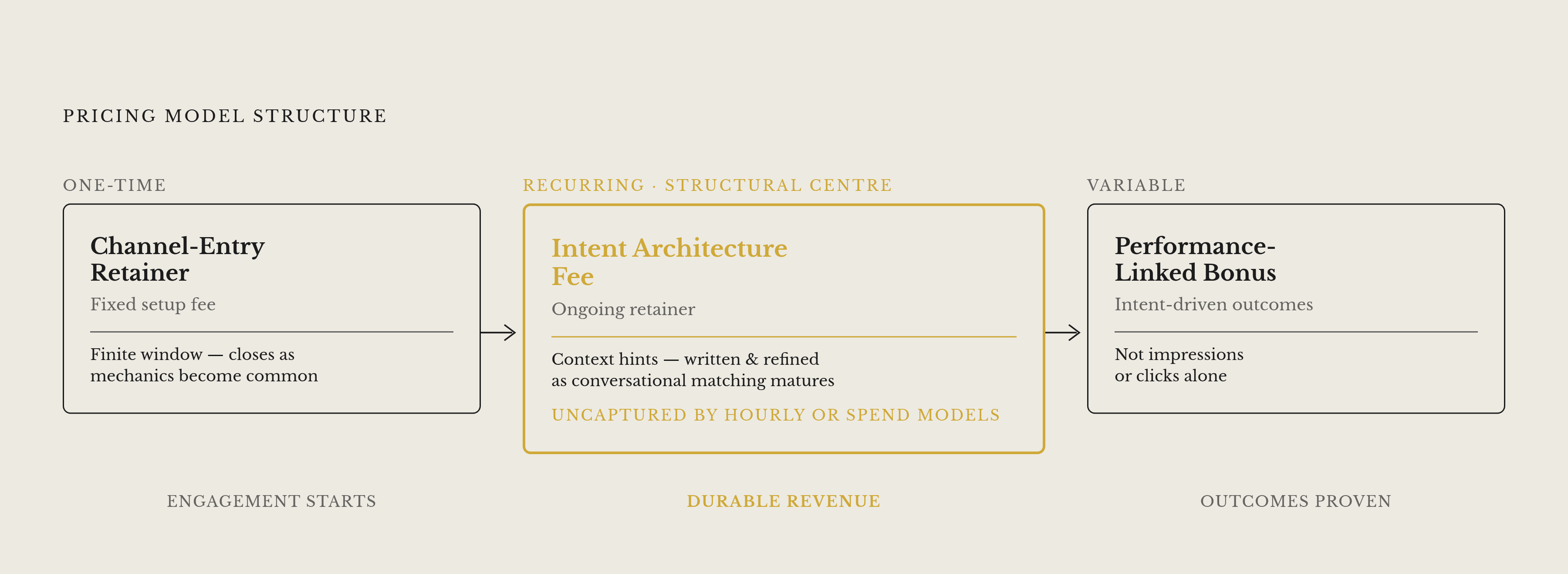
Agencies that reprice AI channel work around three components will capture margin that spend-based and hourly models will surrender. The first is a channel-entry retainer, a fixed fee for the setup work that only happens once. This is the work generalist buyers cannot replicate quickly, and the window of pricing power is finite, because the more agencies learn the channel's mechanics, the harder it becomes to charge a premium for knowing them.
The second component is an intent architecture fee, an ongoing retainer for the craft of maintaining and refining context hints as the channel matures. Real-time matching of conversational context to ad relevance is a completely new infrastructure challenge, and ad infrastructure purpose-built for LLM environments reads the full conversation state and runs relevance-weighted auctions on intent descriptions rather than bid strings. The third component is performance-linked, a bonus tied to outcomes that the channel actually measures, not impressions or clicks alone but signals closer to the conversational intent that drove the placement. This aligns agency incentive with channel logic rather than with spend volume.
The AI-native margin structure, replacing labor-intensive workflows with automated execution and pricing for expertise rather than time, demonstrates that the model is viable. One caution applies: do not promise specific margin percentages or uplift figures without a signed case study. Frame this as a structural argument, not a financial projection, because the channel has not existed long enough to support credible projections yet.
How measurement gaps on AI channels affect pricing conversations with clients
The attribution gap on AI ad channels is real and should be disclosed, but it is also an argument for expertise-based pricing rather than an argument against it. Traditional paid media pricing is partly justified by measurable, attributable outcomes. A client paying percentage-of-spend expects to see ROAS, and a client paying hourly expects to see deliverables. AI channels are early enough that neither standard applies cleanly, so the pricing conversation is temporarily unanchored and open to being defined by whichever party moves first.
The intent signal is richer than any keyword, but the measurement infrastructure has not caught up. IAB Tech Lab shipped AAMP 2.3 on July 30, 2026, adding pricing provenance to trace the source of CPM data and enhanced pricing guardrails to improve the accuracy and integrity of transaction data, alongside a vendor approval gate and audience embeddings. The infrastructure is maturing, but measurement is still a work in progress, and no honest vendor should claim otherwise.
The pricing implication runs the other way from what agencies might fear. When measurement is uncertain, the agency's expertise in reading and structuring conversational intent is the client's best hedge, which is an argument for paying for the expertise retainer, not for withholding it pending proof. Agencies that name the measurement gap, explain what is currently measurable, and price around expertise rather than attributed outcomes will build more durable client relationships.
The vertical mix that is already adopting AI ad channels and what it means for agency specialization
The verticals moving fastest into AI ad channels are those where conversational intent is richest and purchase decisions are complex. Shopping's share of ChatGPT ad impressions fell sharply during the same period that higher-consideration categories grew, which suggests the channel is self-selecting toward purchases where intent richness justifies the premium CPM and away from transactional retail where search still dominates. Travel is structurally aligned because a majority of the category's total digital spending goes toward search and a significant share of US adults who use AI in the purchase journey research or plan travel purchases with AI assistance. The intent is already there, and the agency that can describe it precisely in a context hint is worth more than one managing keywords.
Financial services and health advertising inside AI interfaces carry additional brand suitability considerations. Context-hint accuracy matters not just for performance but for appearing in appropriate conversations, which makes it a compliance-adjacent service that justifies a premium. Vertical specialization is becoming a pricing moat, not just a pitch differentiator, because the context-hint craft for one category does not transfer to another without deliberate study.
A campaign with a small total spend but razor-sharp context hints can outperform a high-budget campaign with generic targeting. That dynamic is structurally visible in conversational AI ad infrastructure, and it blows apart the assumption that percentage-of-spend correlates with agency value delivered. The retainer argument gets stronger when the agency can name the conversational patterns specific to a client's category, because the client is no longer buying media management in the abstract but a documented understanding of how their prospects describe a problem to an AI assistant.
What agencies that reprice early will have that late movers will not
The programmatic parallel is the clearest guide. Agencies that built trading desk expertise in programmatic's early years, before auction mechanics were widely understood and before the tooling commoditized, held pricing power for years. The same window is open now on AI channels, and it is finite. Repricing around conversational intent expertise now means accumulating proprietary knowledge about what context descriptions work, in which verticals, at what auction dynamics. That knowledge base is the moat that late movers cannot buy.
The assets compound. Vertical intent maps, documented understanding of how a financial services prospect, a travel planner, or a health consumer describes their problem to an AI assistant, are the AI-channel equivalent of keyword libraries, and they are worth considerably more because no competitor can extract them from a public auction tool. Platforms that reach across many surfaces cannot read conversational context at the granularity that a channel-specialist agency can describe, so the agency's context-hint craft is what bridges the gap between broad reach and precise placement.
Safe and transparent advertising in AI interfaces is both an ethical obligation and a client-retention argument. Agencies that develop brand suitability practices specific to conversational surfaces are providing a service that becomes a pricing line as regulatory attention on AI advertising increases. The agencies that will define what AI channel expertise is worth are the ones pricing it deliberately today, not waiting for the market to set the rate, because by the time the market sets the rate, the expertise will have been commoditized along with the price.