Telling the Origin Story of Conversational AI Ad Formats to a Client Audience That Defaults to Google
Google's search playbook doesn't map onto conversational AI ads.
Conversational AI advertising matches paid placements to the live intent of a dialogue. ChatGPT has its own ad buy, while Google and Microsoft let campaigns already running reach their AI surfaces. The agency’s job is to explain that structural difference so a Google-fluent client can plan around a buyer’s situation.
Why clients keep reaching for Google when AI conversations need a different map
A client who reaches for Google as the reference point is applying a model that has worked for two decades. Keyword intent is a genuine signal, the auction is legible, and measurement is relatively clean. That confidence has a sound commercial basis. The difficulty begins when a model built for queries and ranked results becomes the default explanation for every new place where people discover products and make decisions.
The change is visible in what people ask. Instead of typing “best CRM startup,” a user can ask “what's the best CRM for a team of five with a limited budget” and receive a synthesized answer. The second request contains a situation. It also gives the assistant constraints to work through before the user has settled on what to buy. An agency has to explain how ads fit into that exchange without suggesting that the client’s search skills are out of date.
How keyword-based advertising came to feel like the natural order of things
The keyword auction established a clear sequence. A user shows intent through a search string, the platform returns ranked results, and advertisers compete for spots around those results. Broad match, exact match, Quality Score and landing page relevance build on that basic way of matching ads. Search therefore trained advertisers to treat intent as a discrete expression that could be isolated, valued and matched. A slot won through bid and relevance became the familiar unit of paid discovery.
Google’s move into AI preserves much of that infrastructure. Shopping and Performance Max campaigns already running, along with Search campaigns that use broad match or AI Max, can qualify for AI Overviews and AI Mode. Advertisers do not need a separate AI buy. The campaign structure remains recognizable, but the user may now be reading an answer.
What changed when the interface stopped returning a list
A conversational answer removes the ranked list as the organizing structure of the exchange. The assistant synthesizes a response instead of presenting results for the user to scan and resolve. That changes the place of the commercial unit. There is no equivalent list position to purchase, so the advertiser’s relevance must be understood in relation to the answer and the task behind it.
OpenAI makes that separation explicit in ChatGPT. The model’s response is not for sale, and the sponsored placement appears as a clearly labeled card below the answer. Google’s AI Mode tests use a different arrangement, with clearly labeled Sponsored units inside AI answers beside an independent AI explainer. These designs should not be collapsed into a claim that brands can pay an assistant to recommend them.
The distinction also separates conversational AI advertising from adding a chatbot to a brand’s website. The former places paid units in an AI environment where a person is already working through a question. The latter adds a conversational interface to the brand’s own site. Media planners need to assess whether an offer belongs in the ongoing exchange.
How conversational targeting works — and why it is not keyword bidding with a new interface
A context hint is the main way to control targeting in ChatGPT. This is a freeform, natural-language description of the conversations in which an ad is relevant, written at the ad group level and capped at 280 characters. The system matches that description against the live conversation. A keyword names words someone might type, while a context hint describes what someone is trying to do.
That difference changes the work of campaign planning. A prompt may already contain the buyer’s budget, constraints, shortlist and rejected options, so the advertiser can describe relevance in terms of those conditions. Comma-separated topic lists produce poor matching. The auction is also relevance-weighted, allowing a more relevant ad to outcompete a higher bid. Precision can therefore give a smaller advertiser an advantage over a less specific competitor.
Google and Microsoft take a different route into conversational placements. Their AI surfaces use campaigns and creative assets already in place without a separate AI buy, and Google’s controls include broad match, AI Max and Performance Max. These are not identical buying systems. What connects them is the shift away from exact keyword control toward matching that uses more of the user’s context.
What conversational AI advertising platforms can a client actually buy?
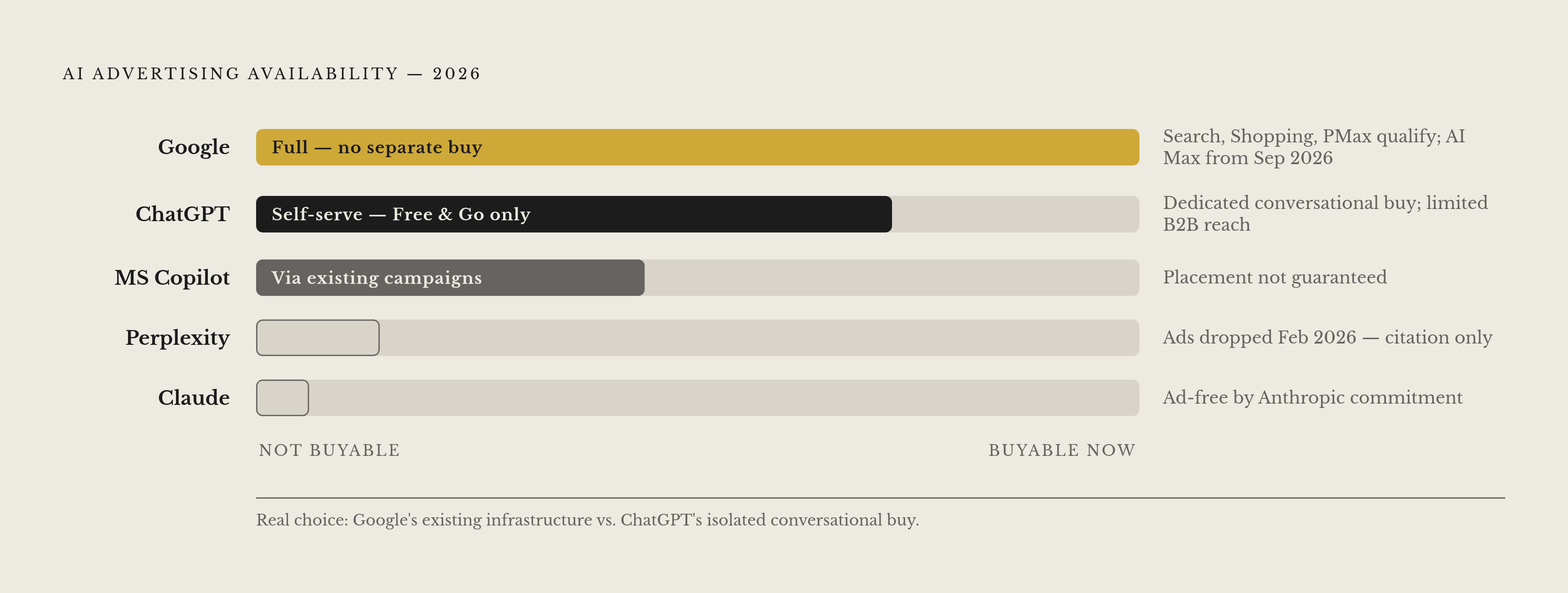
In late-2026, Google’s existing ad system is the starting point for choosing where to buy. With AI-powered targeting, Search, Shopping and Performance Max campaigns can qualify to run above, below or within AI Overviews. These are tests. For most advertisers, a first allocation that ignores Google’s AI surfaces in favor of chatbot ads alone would overlook the largest pool of AI advertising money.
Starting in September 2026, campaign-level broad match settings and automatically created assets auto-upgraded to AI Max, while Dynamic Search Ads were postponed to February 2027. Advertisers could avoid the upgrade by disabling the legacy features before September 1. The campaign settings therefore deserve attention before any new allocation. Campaigns that qualify may already reach AI answers without a separate line in the budget for AI.
ChatGPT is the dedicated AI-native buying option. Its self-serve platform allows an advertiser to run conversational placements independently, using context hints. Audience access is a separate constraint. Only Free and Go tier users see ads, which limits reach for B2B advertisers whose buyers are likely to use other paid plans. That restriction belongs in the initial allocation decision.
Ads already running through Microsoft can also reach Microsoft Copilot, though a Copilot placement is not guaranteed. Perplexity and Claude are different cases altogether. Perplexity tested sponsored questions from 2024 through late 2025, then dropped advertising in February 2026 because sponsored placement risked making users suspicious of the whole answer. Its visibility is now organic only, earned through citations. Anthropic has committed to keeping Claude ad-free for now and to explaining its reasons transparently if it revisits that policy, so no paid Claude placement is available.
Why the intent signal inside a conversation is structurally different from a keyword
A keyword gives a search marketer evidence from which to reconstruct intent. A conversational prompt can state that intent directly, including the budget, the constraint and the options already rejected. A conversational prompt connects the information supplied to the decision being made. The user describes the problem instead of leaving scattered clues for a system to work out.
That description can become more precise across turns. A travel-planning conversation may accumulate a destination, budget, travel dates, party size and exclusions as the user weighs alternatives. Each follow-up modifies an existing context. The resulting signal describes a decision in progress. Advertising can be relevant to the point that decision has reached, rather than only to the broad subject that started it.
Google’s own AI Overview targeting reflects this distinction. It uses both the user’s query and the content of the AI Overview to inform ad serving, bringing the generated response into the matching process. The affirmative case for conversational advertising is therefore not that a new surface deserves budget because it is new. It is that a person’s stated circumstances can support a more useful match between a commercial offer and an unresolved task.
That possibility changes the role of creative as well. In a context-aware exchange, a user can ask follow-ups, compare options and explore trade-offs without starting over. A relevant placement can function as decision support. Its value depends on helping with the task at hand, which makes the relationship between targeting and creative more important than the novelty of appearing near an AI answer.
Where the Google mental model breaks and what to replace it with
For planners, the first adjustment is to replace keyword enumeration with situation description. A context hint should explain what the buyer is trying to accomplish and which decision remains unresolved. More words do not make a keyword list contextual. Planners need to assess whether the offer is useful under the circumstances described.
Ad load requires a second adjustment. Conversational surfaces show ads in a minority of commercial sessions, and the average number of placements when an ad appears is about 1.71. This is not the volume pattern of a search results page with multiple ads. Planners should therefore put more weight on the quality of the creative and how well each placement fits the context, rather than count on volume to make up for weak relevance.
Measurement needs a different frame as well. AI interactions often occur while users are exploring and learning, before they reach direct comparison or purchase. Last-click attribution can understate that contribution. Incrementality, assisted conversions and downstream impact are more suitable measures of the channel’s role, while ChatGPT’s tier restrictions determine which buyers can be reached in the first place. Neither audience access nor attribution can be treated as a detail to resolve after launch.
The first operational step is to audit existing exposure. Google and Microsoft do not offer a separate AI-surface opt-out for qualifying campaigns, so an advertiser may already be participating through its current activity. That audit establishes the starting point for any additional test. It also distinguishes a change in campaign eligibility from a deliberate decision to buy a standalone conversational format.
How to frame this channel shift in a client conversation without losing the room
A client discussion should begin with that existing exposure. Campaigns that qualify may already run inside Google’s AI answers, so an audit is a first step that needs no new budget or sweeping change in strategy. From there, conversational advertising reaches the same person at a different, often earlier moment, while they are working something out.
ChatGPT then provides a way to isolate the new logic. Its dedicated buy, self-serve tooling and low daily minimum make the difference in targeting visible outside the client’s existing search stack. A first test can use two campaigns at the daily minimum, with context hints based on what buyers are trying to do. Measurement should give more weight to assisted conversions and downstream opportunity quality than to click-through rate alone. The audience-tier restriction should be settled before that test receives funding.
The measurement objection deserves a direct answer. Early ChatGPT ad click-through rates are modest, and attribution infrastructure is still developing, so search benchmarks do not transfer neatly. That is a real limitation in a channel’s first year of commercial operation. The agency earns trust by explaining what can be bought, whom it can reach and what a useful result would mean. Its role is to translate the structural shift into a decision the client can make with clear expectations.